


- Tax-to-GDP Improves to 14.00% But Ghana Still Trails Peers – Deputy Finance Minister
Ghana’s tax-to-GDP ratio improved to about 14.00% in 2025, up from approximately 12.30%, as ongoing tax administration and public financial management reforms begin to show signs of progress.
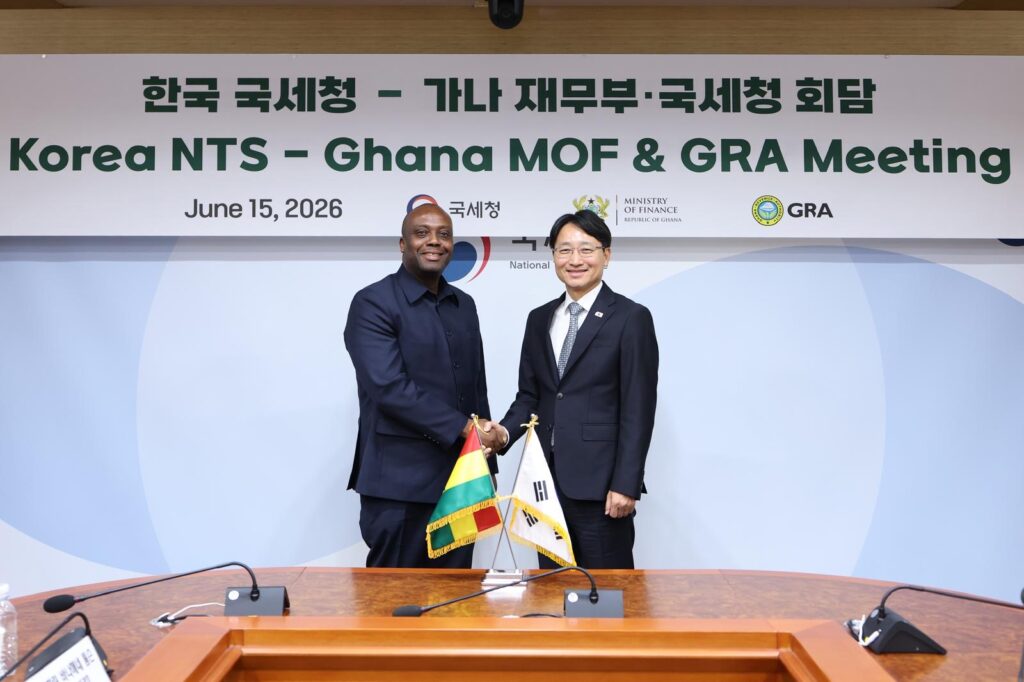
Deputy Minister for Finance, Thomas Nyarko Ampem, announced the improvement during the opening session of the Korea High-Level Invitational Visit by the Ghanaian delegation under the Ghana Tax Modernisation Project, which runs from 2023 to 2026.
He said the increase reflects gains being made under government’s domestic revenue mobilisation agenda, particularly as Ghana seeks to consolidate macroeconomic stability and strengthen fiscal sustainability.
“Ghana’s tax-to-GDP ratio, although improving from approximately 12.3 percent to about 14 percent in 2025, remains below the average for countries at similar levels of development,” Mr Ampem said.
The Deputy Minister said the progress is encouraging, but not enough. Ghana, he noted, must continue reforms aimed at improving revenue efficiency, reducing leakages, expanding the tax net and strengthening voluntary compliance.
The tax-to-GDP ratio is one of the most important indicators of a country’s ability to raise domestic revenue to finance public services, infrastructure and development priorities.
A higher ratio usually means government is collecting more tax relative to the size of the economy. For Ghana, improved tax collection is critical because the country is seeking to reduce fiscal vulnerabilities, lower dependence on borrowing and create a more sustainable basis for public investment.
Ghana’s recent economic difficulties, including debt distress, high inflation, exchange rate pressures and fiscal tightening, have made domestic revenue mobilisation more urgent.
The country has relied heavily on external financing and domestic borrowing over the years, but the debt restructuring process and the IMF-supported economic programme have placed greater emphasis on improving internal revenue generation.
Mr Ampem said government remains focused on sustaining macroeconomic stability following the successful completion of Ghana’s IMF-supported bailout programme, while also pursuing policies that support inclusive economic growth.
For policymakers, the improvement in the tax-to-GDP ratio provides evidence that reforms are beginning to produce results. However, the Deputy Minister’s own caution that Ghana still trails comparable countries shows that the country’s revenue challenge remains significant.
A tax-to-GDP ratio of 14.00% may represent progress, but it still leaves limited fiscal room for government to deliver infrastructure, health, education, security and social protection at the scale required.
This is why the Ghana Tax Modernisation Project has become a central part of the government’s reform agenda.
The project is being implemented with support from the Korea International Cooperation Agency, the Korea Institute of Public Finance and other partners. It seeks to transform Ghana’s tax administration system through innovation, technology, institutional strengthening and capacity development.
Mr Ampem, who chairs the project’s Steering Committee, said the initiative is expected to produce a comprehensive Tax Modernisation Master Plan to guide future reforms.
The plan is expected to support the creation of a more efficient, transparent and citizen-centred revenue administration system.
According to the Deputy Minister, the goal is not only to collect more revenue, but to build a tax system that is trusted, technology-driven and easier for citizens and businesses to comply with.
This is important because Ghana’s revenue problem is not only about tax rates. It is also about compliance, informality, weak enforcement, leakages, inefficient administration and low trust in how public resources are used.
Analysts say many businesses and individuals remain outside the formal tax net, while others underreport income or exploit gaps in enforcement. At the same time, taxpayers often complain about complexity, harassment, poor service delivery and limited transparency.
A modern tax system must therefore balance enforcement with trust.
Technology can help by improving data sharing, reducing human discretion, identifying non-compliant taxpayers and making filing and payment easier. But technology alone will not solve the problem unless it is supported by strong institutions, fair rules and better taxpayer service.
Mr Ampem identified modern and integrated revenue administration systems, stronger institutional capacity, enhanced collaboration among state institutions and greater use of technology as critical to sustaining progress.
These priorities are central to broadening the tax base and reducing overreliance on a small pool of compliant taxpayers.
For businesses, a more efficient tax administration system could reduce compliance costs and improve predictability. For government, it could increase revenue without necessarily imposing excessive new taxes on the same formal sector operators.
The Korea partnership is also significant because South Korea’s development experience is often cited as an example of how disciplined public administration, technology, industrial policy and domestic resource mobilisation can support economic transformation.
Mr Ampem expressed appreciation to the Government of Korea and its development partners, describing the partnership as critical to Ghana’s efforts to consolidate recent economic gains and accelerate institutional reforms.
He said lessons from Korea’s experience and recommendations from the project could help Ghana build a more resilient and effective tax system capable of financing national development priorities.
The improvement in Ghana’s tax-to-GDP ratio comes at a time when government is under pressure to show that fiscal consolidation can be achieved without undermining growth.
Raising more domestic revenue is central to that balance.
If Ghana can improve compliance, widen the tax net, reduce leakages and modernise tax administration, it can create more fiscal space for investment while reducing the need for excessive borrowing.
However, the challenge will be implementation.
Many tax reform programmes in Ghana have produced strong policy statements but weaker execution. Sustained improvement will require political commitment, institutional discipline, data integration, taxpayer education and stronger coordination among agencies.
The Ghana Revenue Authority will also have to improve taxpayer experience while strengthening enforcement against evasion.
For citizens, the broader question will be whether increased revenue translates into better public services, infrastructure and accountability.
Tax compliance improves when people believe the system is fair and that public funds are used responsibly.
Ghana’s rise from 12.30% to 14.00% is therefore an important step, but not the end of the journey.
It signals that reforms are moving in the right direction, but it also reinforces the need for deeper tax modernisation.
For the government, the message is clear: economic recovery cannot be sustained on borrowing alone. Ghana must raise more of its own revenue, do so fairly, and build a tax system that citizens can trust.

