

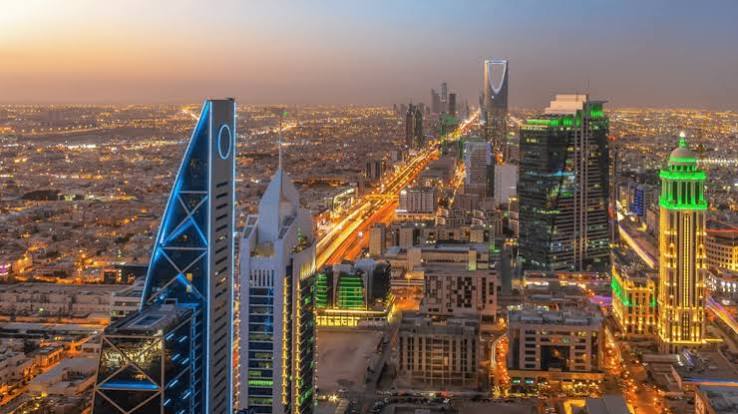

- Riyadh Tops Autumn “Visual Overwhelm” Ranking, But the Score Is Not a Diagnosis
Riyadh has been ranked the world’s most visually overwhelming autumn destination in a study commissioned by eyewear brand Overnight Glasses, which combines measures of night-time brightness, daylight, ultraviolet exposure, air quality and urban green space.
The Saudi capital received a score of 100 out of 100 in the study’s ranking of more than 40 popular destinations. Doha came second at 86.1, followed by Dubai at 80.3 and Cairo at 80.2. Delhi placed fifth, with a score of 66.4.
The figures describe a composite environmental ranking. They do not show that visitors to Riyadh or the other cities will develop eye disease, and the material provided does not disclose enough about the scoring formula to reproduce the rankings independently.
Riyadh’s score reflects a combination of conditions rather than the highest reading in every category. The study reports artificial brightness of 20,200 cd/m², 11.61 daylight hours during autumn, a seasonal ultraviolet index of 9.88, a US Air Quality Index reading of 69 and urban green space coverage of 1.11%.
Doha recorded the highest artificial brightness among the top 10, at 22,000 cd/m², while its daylight duration was almost identical to Riyadh’s at 11.59 hours. The result illustrates how the ranking’s overall score depends on several factors, not simply which city is brightest after dark.
Delhi’s profile is different. Its reported air-quality reading of 169 is the highest among the top 10, while its urban green space coverage is listed at 29.02%. The study’s table labels the air pollution measure as “PM2.5 (US AQI)”.
That distinction matters: an AQI figure is an index used to communicate pollution levels, not a direct PM2.5 concentration. Under the US Environmental Protection Agency’s scale, an AQI of 169 falls in the “unhealthy” range.
The study’s seasonal UV readings also warrant careful interpretation. Riyadh’s 9.88 and Dubai’s 9.53 fall in the very high to extreme range.
The World Health Organization says a UV index of 8 or above carries a high potential for harm to skin and eyes and advises people to avoid midday outdoor exposure.
That supports caution around intense UV exposure; it does not establish the extent of harm to a particular traveller or link the study’s composite score to clinical outcomes.
Overnight Glasses chief executive Gidon Sadovsky cited research linking air pollution with eye conditions, including age-related macular degeneration.
One British Journal of Ophthalmology study of UK Biobank participants aged 40 to 69 found that higher PM2.5 exposure was associated with higher odds of self-reported macular degeneration.
The study was observational and concerned long-term exposure in a UK population; it does not show that a short visit to one of the ranked cities causes the condition.
That distinction is important because the ranking moves between two different kinds of evidence. UV exposure and air pollution have established health relevance, while the combined “visual overwhelm” score is the brand’s own summary measure.
The information supplied does not set out the weights assigned to each factor, the underlying data sources, the precise measurement locations or the period used for each reading. Without those details, readers cannot tell how much each measure contributed to a city’s score or whether the figures are directly comparable.
The ranking also raises a seasonal question. Buenos Aires is listed with 12.93 hours of average daylight, the longest among the top 10. But the material does not explain how “autumn” was defined across cities in different hemispheres. October and November are autumn months in Riyadh and Delhi, but spring in Buenos Aires.
If the study uses the same calendar months for every destination, the comparison may not represent each city’s local autumn conditions; if it uses local seasons, the data period would vary by city.
Daylight duration, moreover, is not the same as harmful exposure. Longer days may mean more opportunity for outdoor activity, but risk depends on factors such as time spent outside, shade, cloud cover and protective eyewear.
The study’s figures can flag environmental contrasts; they cannot by themselves establish an individual’s exposure or clinical risk.
Green space is another complex measure. Riyadh’s reported 1.11% coverage is the lowest in the top 10, while Kuala Lumpur and Delhi are listed at 32.43% and 29.02%, respectively. Parks can offer shade and respite from traffic and built-up surroundings, but the release does not explain how green space was defined or whether the measure captures access, distribution or simply the share of urban land. A citywide percentage may conceal substantial differences between neighbourhoods.
The ranking’s value, then, is less as a verdict on where people should travel than as a prompt to examine the environments in which residents and visitors spend time. Bright nights, intense UV and polluted air are separate conditions that may call for different responses.
A single score can make them easier to compare, but it can also obscure what is being measured and what the evidence can support.
For travellers, the clearest practical signal in the data is the UV index. WHO guidance advises sun protection when the index is high; local forecasts can help people decide when to limit midday exposure and use protective clothing and sunglasses.
Where air-quality readings are elevated, people can consult local pollution advisories. These are general precautions, not medical conclusions about any city.
Overnight Glasses presents Riyadh as the most visually overwhelming destination in its autumn ranking. The underlying figures suggest why: a high UV index, long daylight hours and limited reported green space combine with substantial artificial brightness.
But the ranking should be read as a branded comparison of environmental indicators not as proof that Riyadh is the world’s most damaging city for eyesight.

