
- Fuel pressure mounts as CSOs push for GH¢1.65 pump-price relief
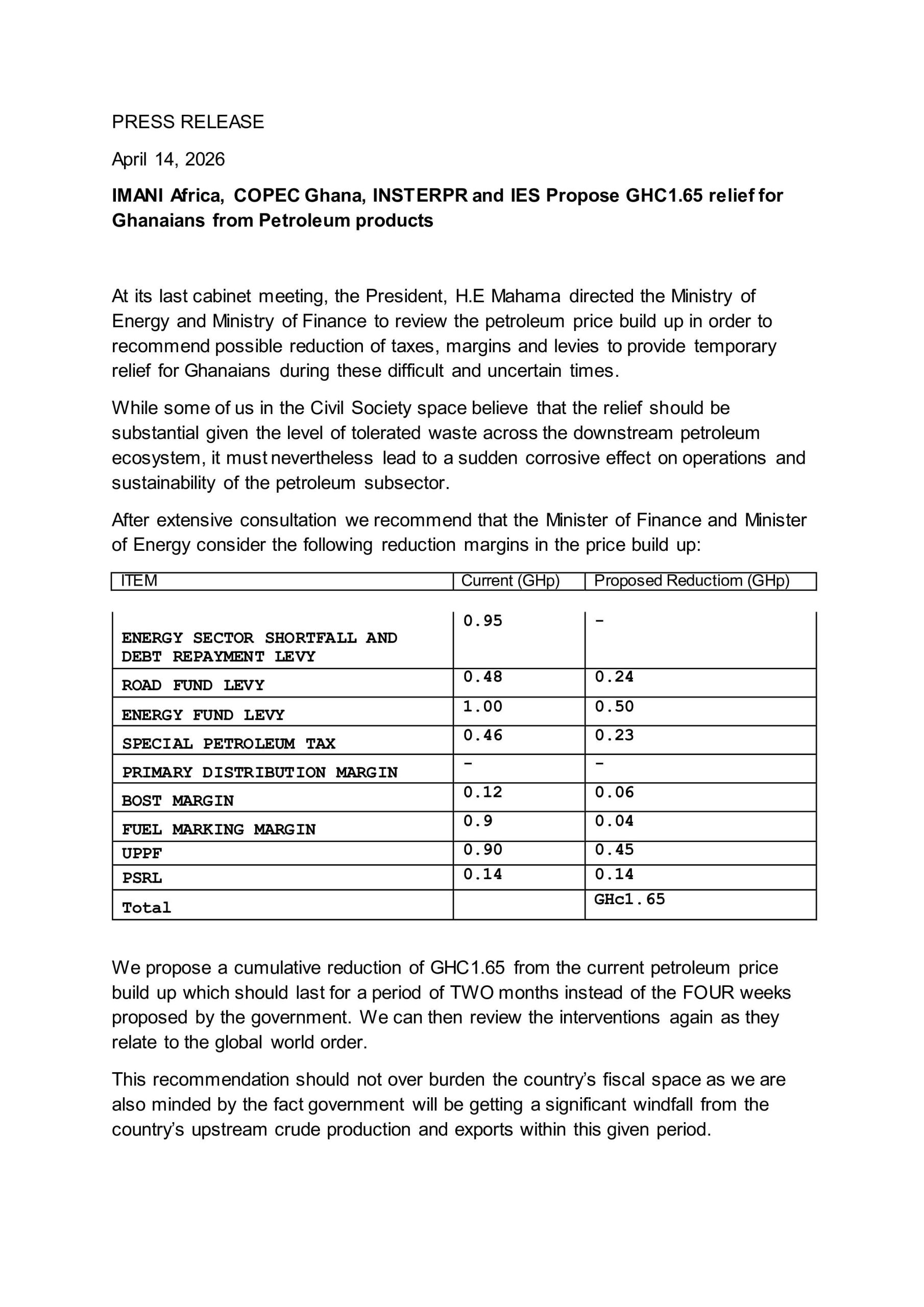
A coalition of civil society and energy policy groups has proposed a GH¢1.65 per litre reduction in Ghana’s petroleum price build-up, stepping into the government’s fuel relief debate with a package it says would give consumers meaningful short-term support while avoiding serious damage to the finances of the downstream sector.
In a press release dated April 14, 2026, IMANI Africa, COPEC Ghana, INSTERPR and the Institute for Energy Security (IES) said they were responding to President John Mahama’s directive for the Ministry of Energy and Ministry of Finance to review taxes, levies and margins on petroleum products in order to provide temporary relief for Ghanaians.
The groups said that after consultations they were recommending a cumulative GH¢1.65 cut from the current price build-up, structured across several components rather than through a blanket suspension. According to the table in the release, the proposed reductions include 24Gp on the Road Fund Levy, 50Gp on the Energy Fund Levy, 23Gp on the Special Petroleum Tax, 6Gp on the BOST margin, 4Gp on the Fuel Marking Margin, 45Gp on the UPPF, and 14Gp on the PSRL, while leaving the Energy Sector Shortfall and Debt Repayment Levy unchanged. The table on page 1 lays out the individual items and their proposed cuts.
What makes the proposal notable is not only the size of the relief but also its timing. The coalition argues that the intervention should last for two months, rather than the four weeks reportedly being considered by the government. Their reasoning is that the global fuel environment remains too uncertain for a short-lived intervention to have lasting value and that a longer but measured relief window would be more useful to households and businesses already contending with cost pressures.
The groups are also trying to answer the obvious fiscal objection. They said the recommended reduction should not “overburden” the country’s fiscal space, partly because government is expected to benefit from a significant windfall from upstream crude production and exports during the same period. In other words, they are arguing that part of the external oil gain can be recycled domestically to soften the local cost burden.
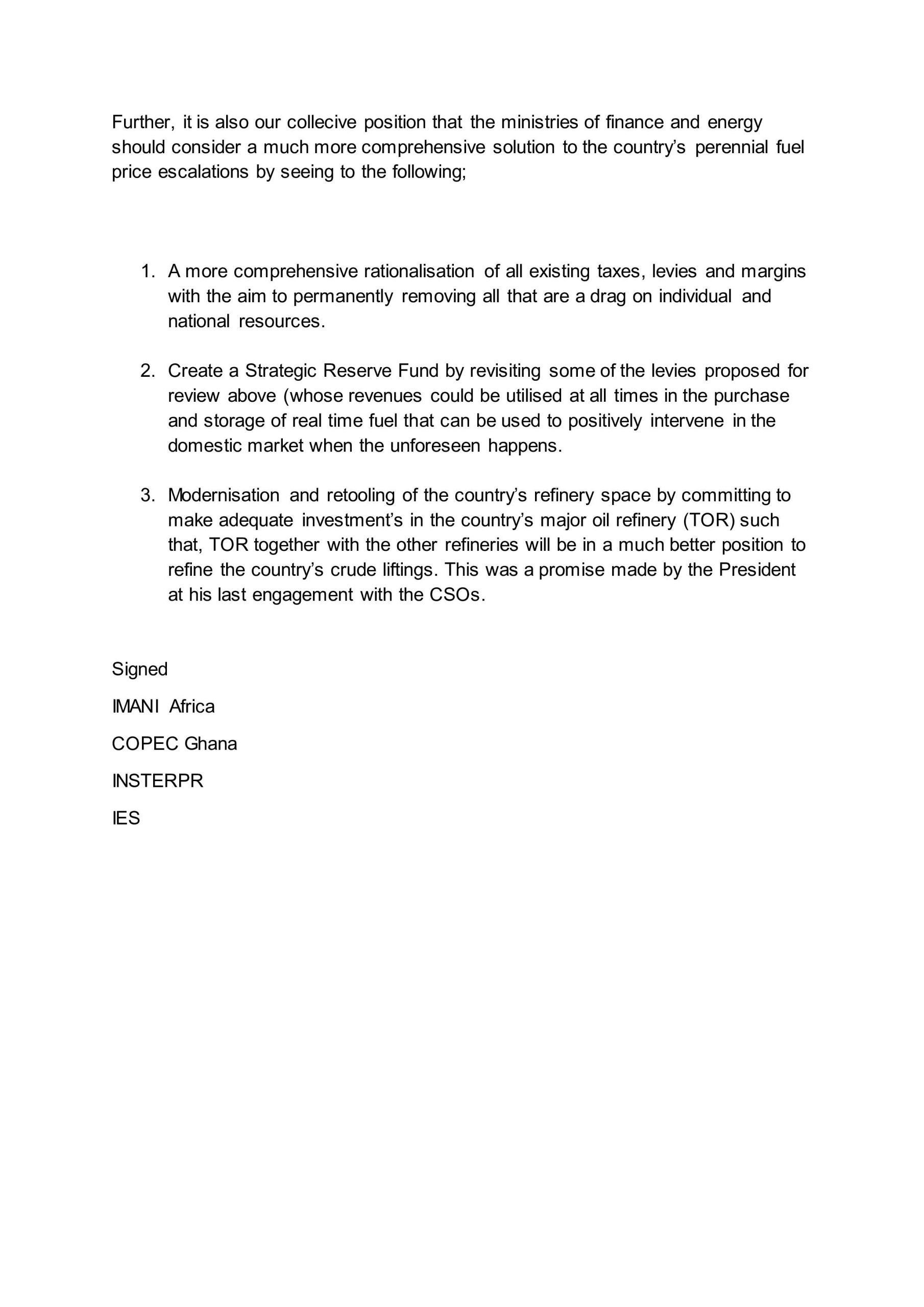
Still, the coalition makes clear that temporary relief is not enough. On page 2 of the release, the four organisations call for a more comprehensive rationalisation of all existing fuel taxes, levies and margins, arguing that some have become a drag on both household finances and wider economic efficiency. They also propose the creation of a Strategic Reserve Fund to finance real-time fuel purchases and market interventions during future shocks, and renewed investment to modernise the country’s refinery space, particularly Tema Oil Refinery, so that more of Ghana’s crude can be refined locally.
That wider framing matters. The coalition is effectively saying that Ghana’s recurring fuel-price anxiety cannot be solved only by periodic tax relief. It reflects a more structural weakness: too much dependence on imported products, too little domestic refining flexibility, and a price-build-up architecture that repeatedly leaves government caught between consumer pressure and revenue needs. That is an inference from the reforms proposed in the release.
For policymakers, the proposal sharpens an already difficult balancing act. Cut too little, and pump-price relief may prove politically and economically insignificant. Cut too much, and the state risks undermining energy-sector finances and road-related revenue streams. The GH¢1.65 recommendation is therefore best read as an attempt to find a politically defensible middle ground: meaningful enough to be felt, but restrained enough to be fiscally arguable. That is an analytical inference based on the structure of the proposed reductions.
Whether government adopts the package in full remains uncertain. But the intervention from IMANI, COPEC, INSTERPR and IES adds weight to the growing expectation that any fuel relief announced by the state will now be judged not only on immediate price effects, but on whether it forms part of a more credible long-term strategy for Ghana’s chronically volatile downstream sector.