
- Black Queens Demand Unpaid Bonuses, Per Diems and Better Welfare Support
Players of Ghana’s senior women’s national football team, the Black Queens, have publicly raised concerns over outstanding bonuses, unpaid per diem allowances and what they describe as inadequate welfare and management support, calling on authorities to urgently address conditions surrounding the team.
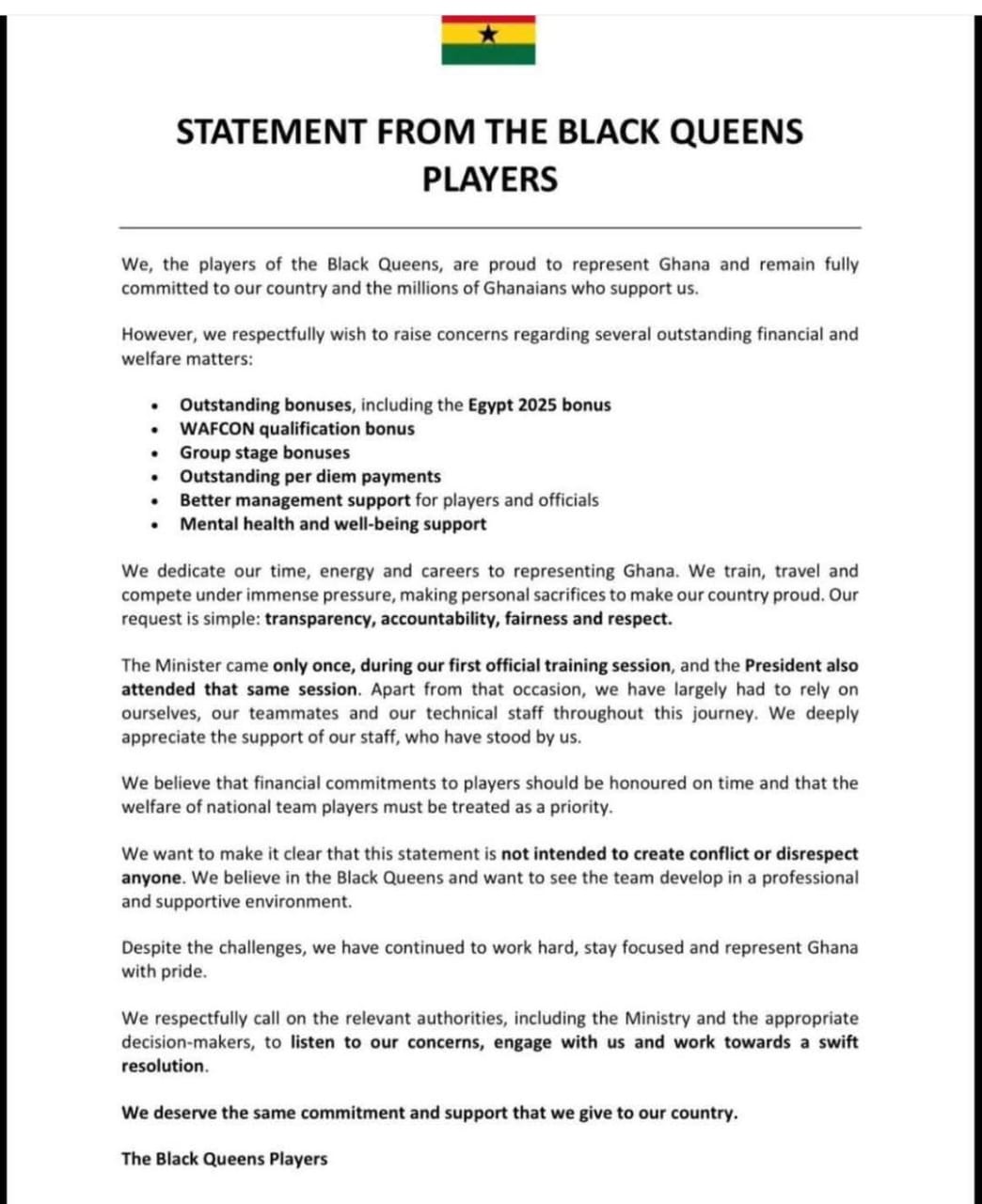
In a statement issued by the players, they reaffirmed their commitment to representing Ghana but said several financial obligations remained unresolved, including bonuses connected to Egypt 2025, qualification for the Women’s Africa Cup of Nations, group-stage bonuses and outstanding per diem payments.
“We, the players of the Black Queens, are proud to represent Ghana and remain fully committed to our country and the millions of Ghanaians who support us,” the statement said. “However, we respectfully wish to raise concerns regarding several outstanding financial and welfare matters.”
The players also called for better management support for both players and officials as well as stronger mental health and well-being arrangements, broadening their concerns beyond the payment of bonuses to the overall professional environment surrounding the national team.
The statement did not specify the total amount owed to the players or provide a breakdown of the individual bonus and per diem obligations. It nevertheless represents a significant public intervention by members of one of Ghana’s senior national teams and places pressure on the relevant authorities to clarify the status of the payments.
“We dedicate our time, energy and careers to representing Ghana,” the players said. “We train, travel and compete under immense pressure, making personal sacrifices to make our country proud. Our request is simple: transparency, accountability, fairness and respect.”
The Black Queens also raised questions about the level of direct institutional support they received during their recent campaign, saying senior government officials had limited interaction with the team.
“The Minister came only once, during our first official training session, and the President also attended that same session,” the statement said. “Apart from that occasion, we have largely had to rely on ourselves, our teammates and our technical staff throughout this journey.”
The players, however, expressed appreciation to their technical and support staff, whom they said had remained with them throughout the period.
The intervention again highlights a persistent issue in African football: the difficulty of ensuring that the financial commitments made to national-team players are fulfilled predictably and on time. For elite athletes, bonuses and per diems form part of the formal compensation structure associated with representing their country and can become a significant source of tension when payments accumulate.
The Black Queens framed the issue principally around fairness rather than confrontation.
“We believe that financial commitments to players should be honoured on time and that the welfare of national team players must be treated as a priority,” they said.
They also stressed that the statement should not be interpreted as an attempt to provoke conflict with government or football authorities.
“We want to make it clear that this statement is not intended to create conflict or disrespect anyone,” the players said. “We believe in the Black Queens and want to see the team develop in a professional and supportive environment.”
That distinction is important because the dispute comes at a time when women’s football is receiving increasing attention in Ghana and across Africa, placing greater scrutiny on the institutional arrangements supporting female national-team players.
Financial predictability is particularly important for women footballers because the economics of the women’s game remain markedly different from those of elite men’s football. National-team payments can therefore carry considerable importance for players whose club earnings and commercial opportunities may be more limited.
Beyond the immediate payment dispute, the Black Queens’ demand for mental health and welfare support also raises questions about how Ghana structures national-team programmes. Modern high-performance sport increasingly requires psychological support, sports science, nutrition, medical care and player-management systems alongside coaching and competition expenditure.
The players’ concern is consequently not simply that money remains unpaid. Their statement suggests they want a more institutionalised system in which obligations, welfare arrangements and communication are predictable rather than dependent on interventions after disputes become public.
For the authorities, the immediate priority will be establishing the exact status of the outstanding payments and communicating clearly when they will be settled.
A failure to do so risks allowing a financial dispute to become a broader question about the treatment of women representing Ghana at the highest level of international football.
The Black Queens said they had continued to train and compete despite the challenges and remained committed to representing the country with pride.
They have now asked the Ministry and other relevant decision-makers to engage them directly and pursue what they described as a swift resolution.
“We respectfully call on the relevant authorities, including the Ministry and the appropriate decision-makers, to listen to our concerns, engage with us and work towards a swift resolution,” the statement said.
Their closing message was more direct: “We deserve the same commitment and support that we give to our country.”
For Ghana, the issue now extends beyond settling outstanding bonuses. The larger test is whether the structures surrounding the Black Queens can provide the financial certainty, professional management and welfare support expected of a national team and whether players representing the country will have to make public appeals before those commitments are honoured.