

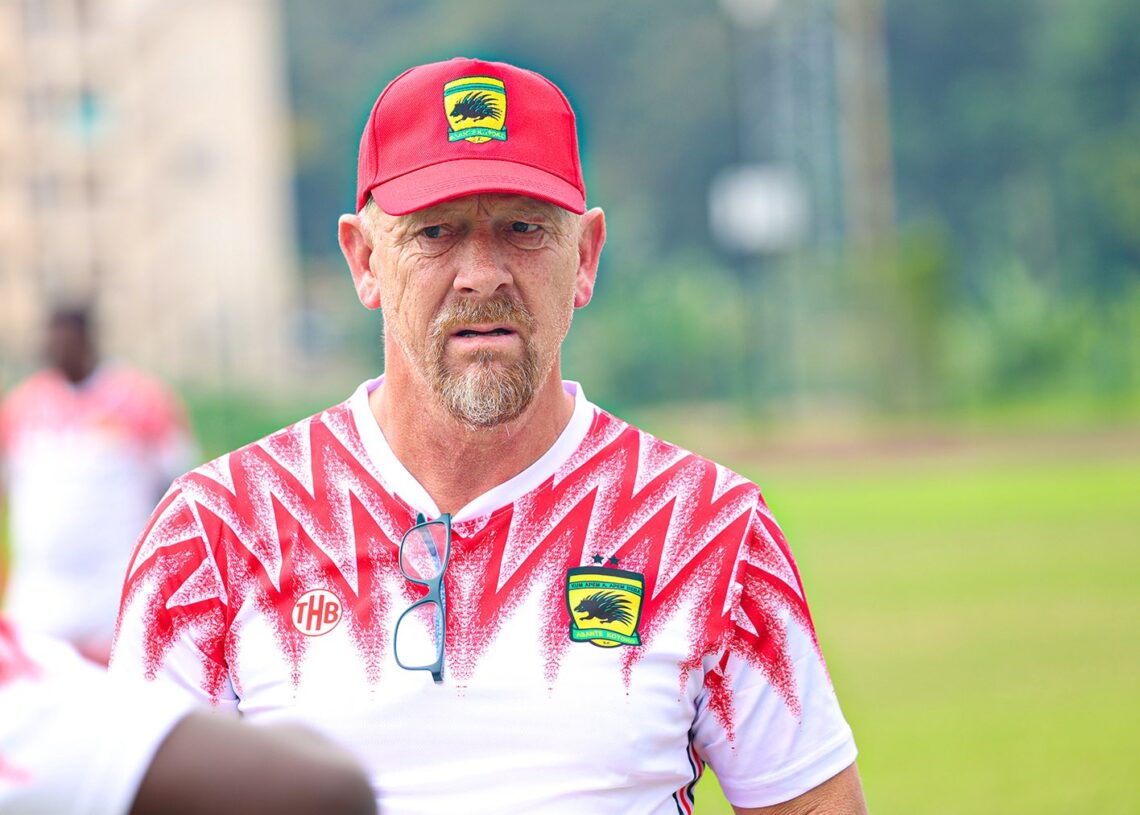

- Eric Tinkler Keeps Door Open for More Kotoko Reinforcements Ahead of 2026/27 Season
Asante Kotoko head coach Eric Tinkler has hinted that the Porcupine Warriors could make further surprise additions to their squad as the club accelerates preparations for the 2026/27 Ghana Premier League season and seeks to recover from a disappointing campaign.
The South African coach’s comments suggest Kotoko’s recruitment programme remains active even as the technical team continues to assess the squad available for the new season.
Tinkler arrived in Kumasi with a mandate to rebuild one of Ghana’s most successful clubs after Kotoko finished eighth in the 2025/26 Premier League campaign, a position the club itself acknowledged fell substantially below expectations.
The possibility of further signings fits into a broader restructuring at Kotoko, which has undergone significant changes in both its technical and football-management structures.
Former Netherlands international Stanley Menzo was appointed Director of Football in June, with Executive Chairman James Osei Brown saying the club wanted to establish a more sustainable winning structure rather than depend on short-term interventions.
Tinkler was subsequently appointed head coach in July, taking his first managerial assignment outside South Africa after spells with clubs including Orlando Pirates, SuperSport United, Cape Town City, Maritzburg United and Sekhukhune United.
His appointment effectively placed responsibility for Kotoko’s sporting recovery in the hands of an experienced coach accustomed to the pressure associated with some of southern Africa’s largest clubs.
The transfer strategy will be crucial because Kotoko’s difficulties last season were accompanied by considerable instability on the technical bench. The club went through three coaches during a campaign in which it recorded 13 wins, 10 draws and 11 defeats from 34 league matches, eventually finishing eighth and outside the positions expected of a club with ambitions of competing for major domestic honours.
Tinkler has already made clear that the objective is to transform Kotoko from what he described as a “sleeping giant” into a competitive force again.
“This season, with our planning, with our preparation, with our professionalism, good work ethic, nothing stops us from achieving our goals, only ourselves,” he said in an earlier interview with the club’s media team.
“Coming to the club, I know the pressure that is obviously going to be under me because we need to achieve, we need to win, we need to get this club back where it belongs,” Tinkler added.
That expectation makes recruitment particularly important because the South African will ultimately be assessed not simply on rebuilding structures but on whether Kotoko can convert those changes into victories and trophies.
Further signings would also give the coach greater opportunity to shape the squad around his preferred tactical approach rather than inherit a group assembled under several previous technical teams.
For a club that cycled through coaches last season, establishing a clearer relationship between recruitment strategy, player profile and coaching philosophy could be as important as the number of players ultimately brought into Kumasi.
Kotoko’s rebuild is taking place against a wider structural problem confronting Ghanaian football, where significant player turnover remains common as clubs continually develop and sell talent. Domestic clubs have increasingly depended on transfer income to meet operating costs, making squad continuity difficult and forcing technical teams regularly to integrate new players while simultaneously competing for immediate results.
Tinkler’s challenge will therefore be to strengthen weak positions without simply creating another cycle of wholesale squad turnover. Successful recruitment will depend on whether new players improve the starting team, provide genuine competition and fit into the longer-term football structure being developed with Menzo rather than merely increasing the size of the playing squad.
Expectations are especially high because Kotoko’s recent domestic performance contrasts sharply with the club’s historical standing. The Porcupine Warriors are two-time African champions, but their most recent league campaign ended with a mid-table finish, intensifying demands from supporters for management to restore consistent title contention.
The 2026/27 Premier League campaign will therefore provide the first major test of the new football structure. Kotoko are scheduled to begin the season away to newly promoted Debibi United, while the return of the Ashanti derby against FC AshantiGold later in the campaign adds another high-profile fixture to a season in which expectations will extend well beyond incremental improvement.
Tinkler’s suggestion that more unexpected additions could still arrive indicates that the squad supporters see today may not be the one with which Kotoko ultimately begin their title challenge.
The more important question, however, will be whether the recruitment delivers a coherent and competitive team capable of turning the club’s extensive off-season restructuring into the sustained results that were missing last season.

