

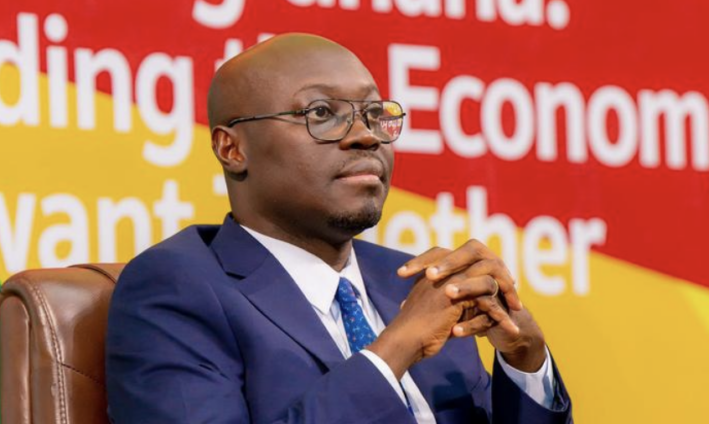

- Debt Restructuring Alone Did Not Save Ghana’s Economy, Recovery Reflects ‘Superior Economic Management’
Finance Minister Dr Cassiel Ato Forson has delivered one of the government’s most forceful defences of its economic management yet, arguing that Ghana’s recovery from crisis is the result of deliberate fiscal discipline, institutional reform and policy credibility rather than a simple dividend from debt restructuring or the IMF-supported programme.
Presenting the 2026 Mid-Year Fiscal Policy Review to Parliament, Dr Forson sought to frame the Mahama administration’s economic record as a sharp break from what he described as years of fiscal indiscipline, excessive borrowing, weak accountability and poor public financial management under the previous administration.
The Finance Minister said the government inherited an economy “on its knees” in January 2025, pointing to a period marked by sharp cedi depreciation, inflation above 50.00%, elevated interest rates, weakened investor confidence, depleted foreign reserves, sovereign credit downgrades and loss of access to international capital markets.
His message was both economic and political. Ghana’s recovery, he argued, should not be treated as an automatic outcome of the IMF programme or the domestic debt restructuring process. Those interventions may have created a platform for stabilisation, but they did not by themselves guarantee discipline, reform or credibility.
“We recount these events not to dwell on the past,” Dr Forson told Parliament, “but to remind ourselves of the heavy price of fiscal indiscipline, excessive borrowing, weak accountability and dishonest economic management.”
The statement signals how strongly the government intends to own the recovery narrative while placing responsibility for the crisis on its predecessors. It also shows that the 2026 Mid-Year Review was not merely a fiscal update. It was an attempt to define the political economy of Ghana’s recovery ahead of the 2027 budget cycle.
Dr Forson rejected suggestions that Ghana’s improving macroeconomic indicators are simply the result of debt relief, IMF supervision or favourable external conditions. In his view, external programmes can support reform, but cannot replace the hard choices required to restore economic credibility.
“Debt restructuring may create fiscal space, but it does not create fiscal discipline,” he said. “An IMF programme may provide a framework, but it cannot substitute for sound policy, disciplined implementation and political will.”
That argument goes to the heart of the government’s case. Debt restructuring can reduce immediate payment pressure. An IMF programme can impose targets and restore some confidence. But the Finance Minister is arguing that the real difference lies in what government does with the breathing space created by those arrangements.
According to Dr Forson, the administration’s recovery strategy has rested on three broad pillars: expenditure-led fiscal consolidation, tax modernisation and complementary fiscal policies aimed at supporting inflation control and exchange-rate stability.
He cited a sharp reduction in primary expenditure from 18.70% of GDP in 2024 to 13.20% in 2025, alongside an improvement in the primary fiscal balance from a deficit of 2.90% of GDP to a surplus of 2.50% of GDP. For the Finance Minister, these numbers show that the recovery has been driven by expenditure discipline, not merely by accounting gains or external support.
The fiscal adjustment is politically significant because expenditure cuts are often harder to sustain than revenue measures. Governments can announce consolidation, but the test is whether they can control spending pressures from wages, interest costs, transfers, public investment demands, state-owned enterprises and politically sensitive programmes.
Dr Forson said the government had introduced new fiscal rules requiring annual primary surpluses, strengthened expenditure controls, tightened procurement regulations and expanded oversight of state-owned enterprises.
The inclusion of state-owned enterprises is important. For years, fiscal risks from entities in the energy, transport and utility sectors have repeatedly spilled into the public balance sheet. By identifying SOE liabilities as a contributor to Ghana’s debt accumulation over the past decade, the Finance Minister is acknowledging that the national budget is not the only source of fiscal risk.
This is one of the deeper governance questions facing Ghana. It is possible for central government accounts to appear controlled while losses, arrears and guarantees accumulate elsewhere in the public sector. If Ghana’s recovery is to be durable, fiscal discipline must extend beyond the Ministry of Finance to the entire public financial management architecture.
The government also defended its revenue strategy, with Dr Forson insisting that improved compliance, rather than higher taxation, offers a more sustainable path to domestic revenue mobilisation.
That position is politically useful because the administration has abolished several controversial taxes. But it also raises the bar for performance. Removing unpopular taxes can win public support. Replacing the lost revenue through stronger compliance, customs reforms and enforcement is far more difficult.
The government’s argument is that Ghana does not need to keep layering new taxes on already burdened households and businesses if it can collect existing obligations more efficiently. That is a powerful fiscal message, but its credibility will depend on whether revenue gains prove durable beyond the current recovery cycle.
Dr Forson also pointed to reforms in the gold sector, arguing that formalising gold exports has strengthened Ghana’s external position, supported reserve accumulation and contributed to exchange-rate stability.
Gold has become central to Ghana’s recovery story. Stronger formal gold flows have helped improve foreign exchange availability and support confidence in the cedi. But this also introduces a new vulnerability: a recovery story too heavily dependent on gold must be backed by strong governance, transparent reporting and clear fiscal rules.
The Finance Minister’s remarks therefore highlight both the strength and fragility of the current recovery. Ghana’s macroeconomic indicators have improved. Fiscal balances have strengthened. Inflation has moderated sharply from crisis levels. The cedi has found periods of stability. Investor sentiment has improved.
But the recovery remains politically contested and economically incomplete. Opposition parties are likely to challenge the government’s account of who caused the crisis, what role the IMF and debt restructuring played, and whether the administration is overstating its own contribution to the rebound.
That debate will matter because economic narratives shape public trust. If citizens believe the recovery is real but not reaching them, the government’s macroeconomic story may struggle politically. If businesses see stability but still face high credit costs, weak demand or tax compliance pressure, they may remain cautious. If investors see fiscal discipline sustained, confidence could deepen.
For markets, the message from Dr Forson is one of policy consistency. The government is presenting itself as committed to fiscal restraint, stronger institutions, improved revenue administration, tighter expenditure controls and macroeconomic credibility.
For citizens, the message is more demanding. The government is effectively saying that the pain of adjustment was necessary, that past indiscipline created the crisis, and that today’s restraint is the price of preventing a return to instability.
That may be economically defensible, but it is politically difficult. Fiscal discipline often produces benefits slowly, while spending restraint is felt immediately. The government must therefore show that stabilisation is translating into jobs, lower living costs, improved services and renewed investment.
Dr Forson’s mid-year statement should therefore be read as more than a blame narrative. It is a governing thesis: Ghana’s crisis was caused by indiscipline, and Ghana’s recovery will be sustained only through discipline.
The risk is that the recovery story becomes too self-congratulatory before ordinary households feel enough relief. The opportunity is that Ghana uses this period of stabilisation to rebuild fiscal institutions strong enough to outlast one administration.
The Finance Minister’s strongest line may also be the most important test of the months ahead: debt restructuring can create fiscal space, but it cannot create fiscal discipline.
Ghana has bought time. The question now is whether it can turn that time into a lasting change in how the state borrows, spends, taxes, invests and accounts to citizens.

