
- Eurobond Repayment Hits US$2.1 Billion Since 2025 After Latest US$700 Million Settlement
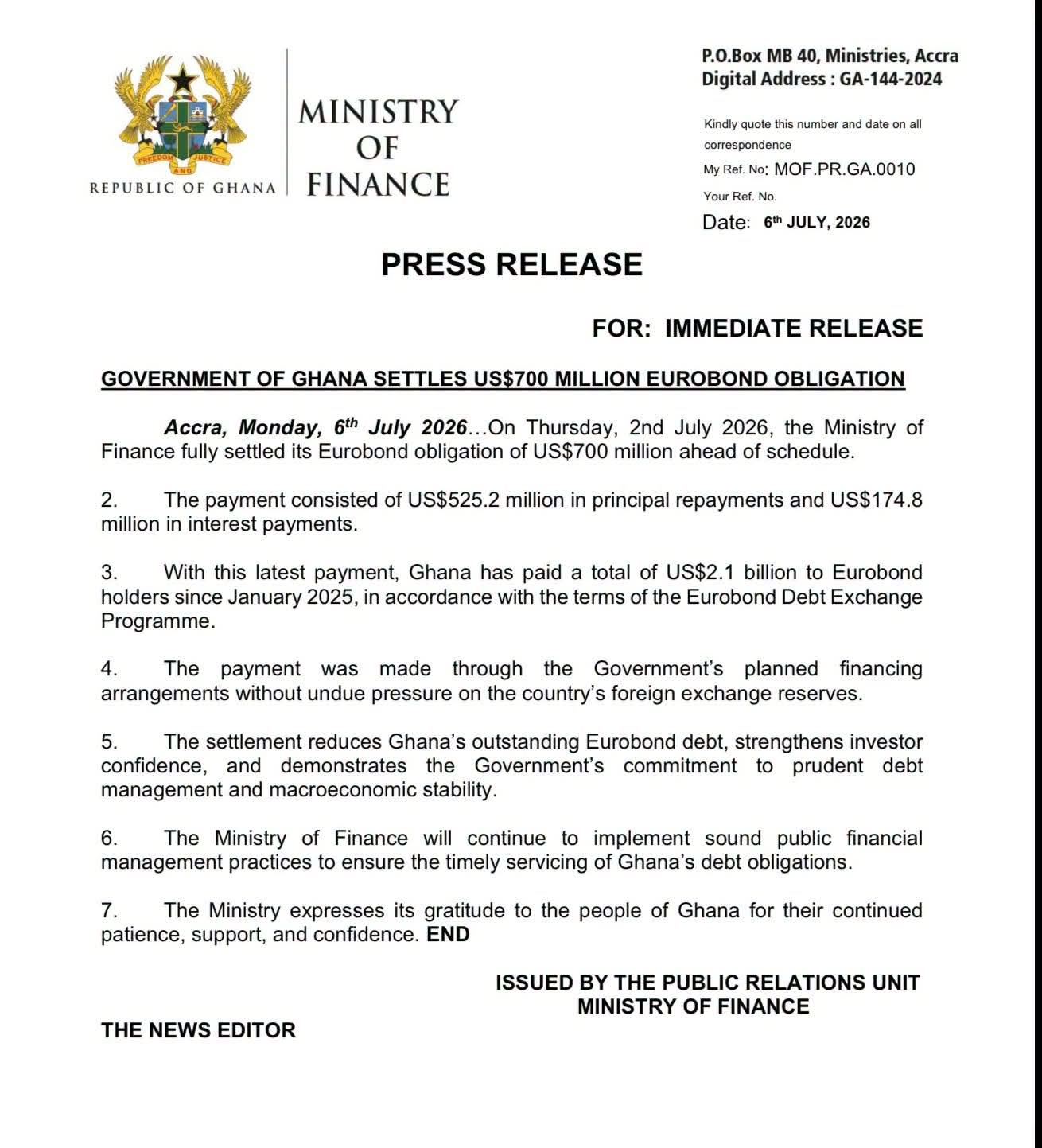
Ghana has settled a US$700 million Eurobond obligation ahead of schedule, in what the Ministry of Finance says reflects the government’s commitment to prudent debt management, investor confidence and macroeconomic stability.
The payment, made on Thursday, July 2, 2026, comprised US$525.2 million in principal repayments and US$174.8 million in interest payments.
The Ministry of Finance, in a press release dated Monday, July 6, 2026, said the settlement was executed through the government’s planned financing arrangements and did not place undue pressure on the country’s foreign exchange reserves.
“With this latest payment, Ghana has paid a total of US$2.1 billion to Eurobond holders since January 2025, in accordance with the terms of the Eurobond Debt Exchange Programme,” the Ministry said.
The latest settlement marks another important step in Ghana’s post-debt-restructuring recovery, as the country continues to rebuild credibility with international investors after the completion of its external debt exchange programme.
For the government, timely servicing of restructured Eurobond obligations is central to restoring confidence in Ghana’s sovereign credit profile and demonstrating that the country is returning to a more disciplined debt management path.
The Ministry said the settlement reduces Ghana’s outstanding Eurobond debt and reinforces its commitment to sound public financial management.
“The settlement reduces Ghana’s outstanding Eurobond debt, strengthens investor confidence, and demonstrates the Government’s commitment to prudent debt management and macroeconomic stability,” the statement said.
The repayment comes at a critical period for the economy, as Ghana continues to consolidate gains from fiscal adjustment, debt restructuring and its programme with the International Monetary Fund.
After defaulting on portions of its external debt during the height of its debt crisis, Ghana has been working to normalise relations with investors, creditors and development partners.
The ability to meet Eurobond obligations on schedule, and in this case ahead of schedule, is therefore likely to be read positively by the market, particularly if it is sustained alongside stronger fiscal discipline, improved revenue mobilisation and stable foreign exchange management.
The Ministry’s assurance that the payment was made without undue pressure on foreign reserves is also significant.
Large external debt payments often raise concerns about reserve adequacy, exchange-rate stability and the central bank’s ability to support external buffers. By emphasising that the payment was made through planned financing arrangements, the government is seeking to reassure investors that the settlement was anticipated and fiscally managed.
Still, the broader test for Ghana will be consistency.
While the US$700 million payment is a positive signal, market confidence will depend on the government’s ability to continue meeting future obligations while avoiding a return to excessive borrowing and fiscal slippages.
The post-restructuring period presents both opportunity and risk. On one hand, reduced debt-service pressure and improved policy credibility can create space for recovery. On the other, any weakening of fiscal discipline could quickly undermine the gains from restructuring.
For investors, the latest repayment provides evidence that Ghana is seeking to honour the terms of the Eurobond Debt Exchange Programme and rebuild its reputation in the international capital market.
For citizens, however, the more important question will be whether improved debt management translates into lower borrowing costs, stronger growth, better public services and reduced pressure on the national budget.
The Ministry said it will continue to implement sound public financial management practices to ensure timely servicing of Ghana’s debt obligations.
It also expressed gratitude to Ghanaians for their patience, support and confidence as the country continues its recovery from the debt crisis.
The latest Eurobond payment does not end Ghana’s debt challenges. But it sends an important signal: the government wants markets to see a country that is once again paying on time, managing its obligations carefully and working to restore credibility after one of the most difficult debt episodes in its recent economic history.