

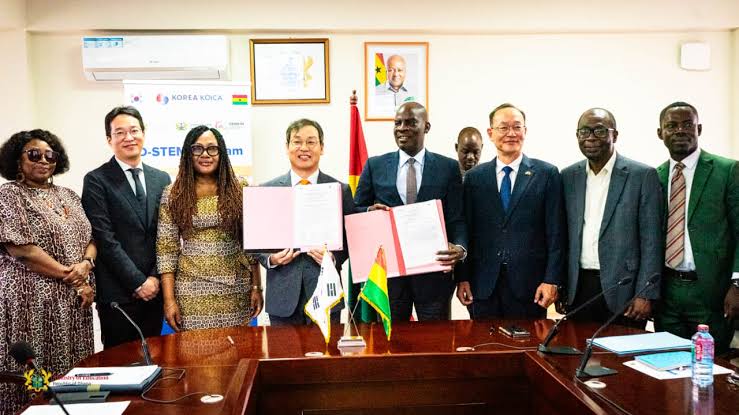

- US$28 Million Korean STEM Deal Could Reshape Ghana’s Human Capital Agenda
South Korea’s US$28 million commitment to Ghana’s digital STEM education drive is more than another development financing announcement. It is a quiet but important recognition that the next phase of Ghana’s economic transformation will depend less on natural resources and more on the quality of its human capital.
The funding, formalised through a Memorandum of Understanding between the governments of Ghana and South Korea, will support the Digital STEM Education Project, an initiative designed to modernise science, technology, engineering and mathematics education through digital tools, improved learning infrastructure and stronger teacher training.
At one level, this is an education story. At another, it is an industrial policy story.
Ghana has long spoken about industrialisation, digital transformation, value addition, youth employment and economic diversification. But all of these ambitions rest on the same foundation: a workforce capable of operating in a modern economy. Without strong STEM skills, Ghana risks becoming a consumer of imported technologies rather than a producer, adapter and exporter of technology-driven solutions.
The agreement is expected to help Ghana expand access to technology-enabled learning and narrow the country’s digital skills gap. It comes at a time when the world of work is changing quickly, with artificial intelligence, automation, data systems, clean energy, robotics, digital finance and advanced manufacturing reshaping labour markets.
For Ghanaian students, the question is no longer only whether they can complete school. It is whether the education system is preparing them for the jobs that are coming.
The Digital STEM Education Project seeks to respond to that question by improving how STEM is taught, how teachers are trained and how digital infrastructure is used in classrooms.
The project is expected to “modernise STEM instruction through digital technologies, upgraded learning infrastructure and enhanced teacher training,” according to details of the agreement.
That formulation is important because digital education is not simply about giving schools computers. Many countries have made that mistake. Devices alone do not transform learning. The real test is whether teachers can use technology well, whether students can apply knowledge practically, and whether classrooms are connected to the skills demanded by industry.
Ghana’s challenge is therefore not only a lack of technology. It is also a gap between education and productivity.
Employers often complain that many graduates leave school without the practical, digital and analytical skills required in the workplace. At the same time, young people struggle to find jobs even after years of schooling. This mismatch is one of the country’s most serious development problems.
A stronger STEM education system can help address that mismatch, but only if it is designed around practical competence.
The South Korean model is relevant here. South Korea’s own development story was built partly on disciplined investment in education, technology, manufacturing and export competitiveness. It moved from poverty to advanced industrial status within a generation by linking skills to national economic strategy.
Ghana does not need to copy Korea blindly. But it can learn from the logic of that transformation: countries become competitive when education, industry and technology policy move together.
That is the deeper significance of the US$28 million investment. If well implemented, the project could support Ghana’s efforts to build a pipeline of students capable of entering high-value sectors such as software development, engineering services, electronics, renewable energy, digital finance, agritech, health technology and advanced manufacturing.
It could also improve Ghana’s attractiveness to foreign investors. Investors looking beyond natural resources increasingly ask whether a country has skilled labour. Tax incentives and political stability matter, but companies that need engineers, technicians, data analysts and digitally competent workers will not invest deeply in countries where those skills are scarce.
For Ghana, the timing is also important. The country is seeking to rebuild economic confidence after years of fiscal pressure, debt restructuring and macroeconomic instability. While short-term reforms focus on inflation, debt and fiscal discipline, long-term recovery will depend on productivity.
A digitally skilled workforce can support business efficiency, increase innovation, improve public service delivery and help local firms compete in regional and global markets. Without such skills, Ghana’s economy may continue to depend heavily on raw material exports, imports and low-productivity services.
The Korean support also reflects a deepening strategic relationship between Accra and Seoul.
For South Korea, the project strengthens its development engagement in Africa through knowledge transfer and capacity building. Unlike some infrastructure-heavy partnerships, this investment focuses on people. It is a softer form of development diplomacy, but one that may produce more durable returns.
For Ghana, the partnership provides an opportunity to access not only funding, but also technical experience from a country that understands how education can be tied to industrial growth.
The first challenge is equity. Digital STEM education must not become an opportunity available only to students in better-resourced schools. Ghana’s rural and underserved communities must be included if the project is to narrow, rather than widen, inequality.
The second challenge is teacher capacity. A digital STEM programme is only as strong as the teachers who deliver it. If teachers are not properly trained, supported and motivated, expensive infrastructure can sit unused or underused.
The third challenge is maintenance. Ghana has seen many well-intentioned education and technology projects fade because equipment was not maintained, software was not updated, internet connectivity was weak or schools lacked budgets for continuity.
The fourth challenge is curriculum relevance. STEM education must be linked to real economic opportunities. Students must learn not only theory, but problem-solving, coding, design thinking, engineering basics, data literacy and practical technology use.
The fifth challenge is scale. US$28 million is significant, but Ghana’s education needs are much larger. The project must therefore be designed as a model that can be expanded, not a standalone intervention that ends when donor funding is exhausted.
The MoU may bring Korean support, but Ghana must ensure that the project aligns with its broader education, industrialisation and digital economy strategies. It must not become another donor-funded island disconnected from national planning.
The private sector should also be part of the conversation. Technology companies, banks, telecom firms, manufacturers, engineering companies and start-ups all have a stake in the quality of Ghana’s future workforce. They should help shape training priorities, provide internships, support practical projects and offer pathways into employment.
Otherwise, the country risks producing STEM graduates without clear routes into productive work.
The bigger point is that Ghana cannot build a digital economy on slogans. It needs classrooms that work, teachers who are prepared, students who can think critically, and institutions that connect learning to industry. South Korea’s US$28 million support gives Ghana an opportunity to make progress on that front.
But the real value of the investment will not be measured by the signing of the agreement or the size of the funding. It will be measured by whether students leave school better prepared to build, repair, code, design, innovate and compete.
Ghana’s future economy will need more than consumers of technology. It will need creators of technology. The Korean-backed STEM project is therefore a welcome step. But it also places responsibility on Ghana to ensure that this investment becomes more than another education announcement.
It must become part of a serious national effort to build the skills base for industrialisation, innovation and long-term growth. If Ghana gets that right, the US$28 million may prove to be less a grant for classrooms and more a down payment on the country’s future productive capacity.

