

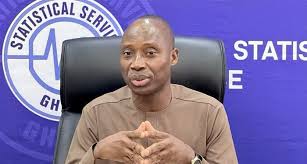

- Youth Population Rises to 36.90% as Unemployment Nearly Doubles National Rate – GSS
More than one-third of Ghana’s population is now made up of young people, but high unemployment, weak school-to-work transitions and widespread economic inactivity threaten to turn the country’s demographic advantage into a mounting development challenge, according to the Ghana Statistical Service.
Young people aged between 15 and 35 account for 36.90% of Ghana’s projected population, up from 34.60% in 2000. The country’s total population increased from 18.90 million in 2000 to 30.80 million in the 2021 Population and Housing Census and an estimated 33.70 million in 2025.
The growing youth share gives Ghana an opportunity to accelerate economic growth through a larger and more productive workforce. But the Statistical Service warned that the benefits would depend on whether young people receive relevant education, skills, healthcare and access to decent employment.
The agency’s assessment, released to mark World Population Day under the theme “Investing in Ghana’s Future through Healthy, Skilled and Empowered Young People”, places the youth employment challenge at the centre of the country’s development outlook.
National unemployment averaged 12.80% during the first three quarters of 2025, while unemployment among people aged 15 to 35 averaged 21.90%, almost twice the national rate.
The Greater Accra Region recorded the highest youth unemployment rate at 31.90%, followed by the Central Region at 27.40% and the Ashanti Region at 27.20%. All three remained above the national youth average throughout the period.
The figures expose a widening gap between Ghana’s expanding youth population and the economy’s ability to generate sufficient productive employment.
A youthful population can support faster economic growth when a large share of working-age people are employed, productive and able to save, invest and pay taxes. Without corresponding opportunities, however, the same demographic structure can increase pressure on households, public finances and social institutions.
The Statistical Service said nearly two million young people aged 15 to 35 were classified as not in education, employment or training by the third quarter of 2025.
They represented about 19.50% of Ghana’s youth population and were neither building skills through formal education nor participating in productive employment.
The size of this group is particularly significant because prolonged detachment from both education and work can reduce future earnings, weaken employability and make it harder for young people to enter stable employment later.
It also means that a substantial part of Ghana’s potential labour force is not contributing fully to economic output at a time when the country needs stronger productivity, domestic revenue and private-sector growth.
The problem extends beyond job creation to health and gender inequality.
The 2022 Ghana Demographic and Health Survey found that 15.00% of girls aged 15 to 19 had experienced pregnancy, while 11.00% had given birth.
Early pregnancy can interrupt education, limit access to skills development and reduce long-term participation in the labour market, particularly for young women.
The data suggest that Ghana’s youth policy will require more than temporary employment programmes. It will need stronger links between education and the labour market, alongside investments in reproductive health, technical training, entrepreneurship and sectors capable of generating jobs at scale.
The Statistical Service called for sustained investment in technical and vocational education and training, improved school-to-work pathways and stronger support for entrepreneurship.
It also urged the expansion of productive sectors capable of absorbing Ghana’s growing youth population into decent and sustainable work.
The challenge is not only to increase the number of jobs but to improve their quality.
Many young people who are technically employed remain in insecure, low-productivity or informal work with limited earnings and little social protection. Such employment may reduce the headline unemployment rate without delivering the productivity gains associated with a genuine demographic dividend.
Ghana’s education system must also respond more closely to changes in the economy.
Businesses frequently report shortages of technical and practical skills even as large numbers of graduates struggle to find work. Closing that mismatch will require deeper collaboration among universities, technical institutions, employers and government agencies.
Apprenticeships, workplace training and industry-linked curricula could help young people acquire skills that correspond more directly to available and emerging opportunities.
The country will also need stronger private investment in sectors with the capacity to employ large numbers of people.
Agribusiness, manufacturing, construction, digital services, tourism and the creative economy could provide important employment pathways, but their expansion depends on reliable infrastructure, access to finance and a predictable business environment.
Entrepreneurship is often presented as an alternative to unemployment, but young businesses require more than training programmes.
Access to affordable capital, markets, technology, mentorship and basic infrastructure determines whether youth-owned enterprises can survive and grow beyond subsistence operations.
Regional differences in youth unemployment also point to the need for geographically targeted interventions.
Greater Accra’s 31.90% rate suggests that migration towards the capital and the growth of the urban labour force are outpacing the creation of formal jobs.
The elevated rates in the Central and Ashanti regions indicate that the challenge is not confined to the national capital and will require local economic development strategies linked to each region’s productive strengths.
The Statistical Service said young people should be regarded as active partners in development rather than passive beneficiaries of public programmes.
When equipped with relevant skills and given opportunities to apply them, they can support innovation, productivity and inclusive growth.
The agency warned, however, that the eventual outcome would depend on decisions taken now.
“Whether today’s young people become the country’s greatest economic asset or its most pressing development challenge will depend on the investments made today to keep them healthy, equip them with relevant skills, and empower them to contribute meaningfully to national development,” it said.
Ghana has already secured the demographic conditions for a large labour force. The unresolved question is whether the economy can create the skills, institutions and jobs needed to turn that population structure into sustained prosperity.

