

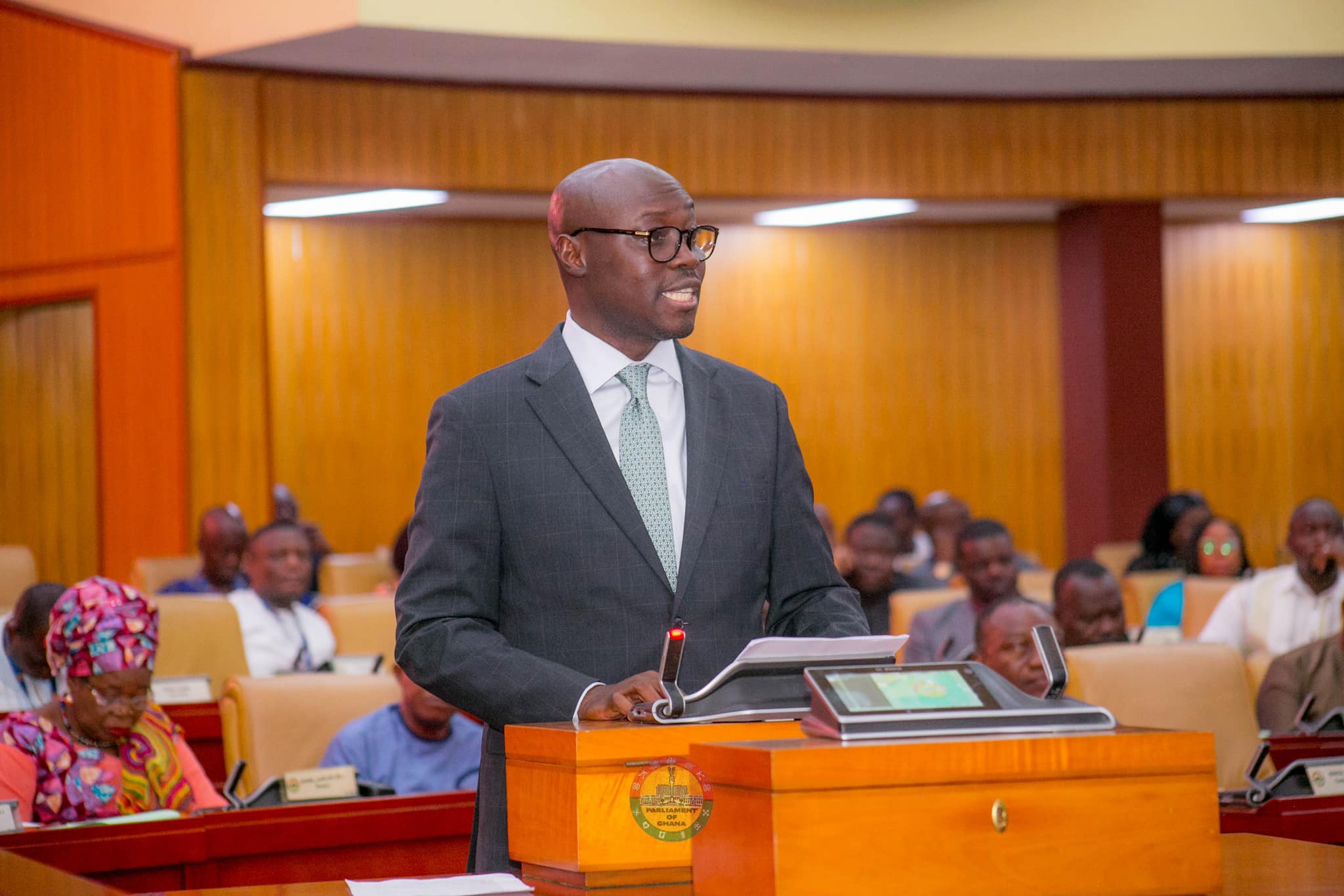

- Ato Forson Says Ghana Has Moved From IMF Dependence to Reform Partnership
Ghana says it has transitioned from dependence on International Monetary Fund financial support to a position of economic partnership after recording what the government describes as one of the strongest macroeconomic recoveries in recent years.
Presenting a statement to Parliament on Thursday, Finance Minister Dr Cassiel Ato Forson declared that Ghana would not require another IMF financial bailout “in the foreseeable future”, citing sharp improvements in growth, inflation, debt sustainability, interest rates and fiscal discipline under the administration of President John Dramani Mahama.
According to the Minister, the government inherited an economy under severe strain but moved quickly to recalibrate Ghana’s IMF-supported programme through tighter fiscal controls, expenditure rationalisation and structural reforms aimed at restoring investor confidence and macroeconomic stability.
The statement marks one of the clearest signals yet that the government wants to reposition Ghana’s relationship with the Fund from emergency financing to policy credibility and reform monitoring.
Among the measures highlighted by Dr Forson were amendments to the Public Financial Management Act to institutionalise a 1.5 per cent primary surplus target and a 45 per cent debt-to-GDP ceiling by 2034.
Government also operationalised a strengthened Sinking Fund, established an Independent Fiscal Council and created the Office of Value for Money to improve spending efficiency and strengthen public expenditure discipline.
The Finance Minister said the government had also introduced the Gold Board initiative, commonly referred to as GOLDBOD, to support foreign exchange accumulation and stabilise the cedi, while removing taxes including the E-Levy, Betting Tax, Emissions Levy and VAT on motor insurance.
Dr Forson further disclosed that the administration had reduced the number of ministers from 88 under the previous government to 60, while ministries had been trimmed from 30 to 23 as part of broader expenditure-cutting measures.
In the energy sector, the Minister said the government had renegotiated agreements with Independent Power Producers, generating savings exceeding US$250 million while clearing more than US$1 billion in legacy arrears.
The Finance Minister said the reforms had produced “clear and measurable results”, with Ghana’s real GDP growth reaching 6.0 per cent in 2025, while non-oil GDP growth climbed to 7.6 per cent, the strongest performance recorded in 14 years.
“For the first time, Ghana’s economy crossed the US$100 billion threshold in 2025,” Dr Forson told Parliament, adding that the country is now ranked as Africa’s eighth-largest economy.
He further announced that Ghana’s debt-to-GDP ratio declined from 61.8 per cent in 2024 to 44.7 per cent by the end of 2025, enabling the country to meet its statutory debt target years ahead of schedule.
Inflation, which stood at 23.8 per cent in December 2024, reportedly fell sharply to 3.4 per cent by April 2026, while Treasury bill rates and bond yields also eased significantly.
The 91-day Treasury bill rate declined from 28.4 per cent in January 2025 to 4.8 per cent by April 2026, alongside a reduction in the monetary policy rate from 27 per cent to 14 per cent.
On the external front, Ghana recorded a current account surplus of 8.3 per cent of GDP in 2025, while the cedi appreciated by 40.7 per cent against the US dollar, according to government figures.
Dr Forson argued that the turnaround demonstrates the long-term benefits of fiscal discipline and prudent economic management, stressing that macroeconomic stability remains central to job creation, investment growth and national prosperity.
Delivering what many analysts may view as the administration’s strongest statement yet on Ghana’s future relationship with the IMF, the Finance Minister declared: “No further IMF financial bailout will be required in the foreseeable future.”
“We have evolved from a position of ‘supplicant’ to one of ‘partner’,” he added to applause from the Majority side in Parliament.
The declaration is significant because Ghana has repeatedly turned to the IMF during periods of fiscal and balance-of-payments distress. Government’s current position is therefore intended to project a new policy posture: one built around fiscal restraint, domestic credibility and reduced dependence on external rescue financing.
But the claim will also be tested by execution.
Ghana’s recent macroeconomic improvements have followed a painful period of debt restructuring, high inflation, currency depreciation, fiscal adjustment and pressure on households, investors and financial institutions.
The durability of the recovery will depend on whether government can maintain spending discipline, preserve the credibility of fiscal rules, avoid election-cycle slippages and convert stability into stronger private-sector growth.
For businesses, the indicators cited by Dr Forson offer some relief. Lower inflation, lower short-term rates, a stronger cedi and improved debt metrics could support investment planning and reduce uncertainty.
Yet the real economy will require more than stabilisation. Firms continue to look for cheaper credit, reliable energy, tax predictability, infrastructure delivery and stronger demand.
The next phase of Ghana’s recovery will therefore be judged not simply by whether the country avoids another IMF bailout, but by whether it can build an economy that creates jobs, raises productivity and protects fiscal discipline without external pressure.
For now, government’s message is clear: Ghana believes it has moved from crisis to credibility.
The harder task is ensuring that the country does not return to the habits that made repeated IMF rescues necessary in the first place.

