

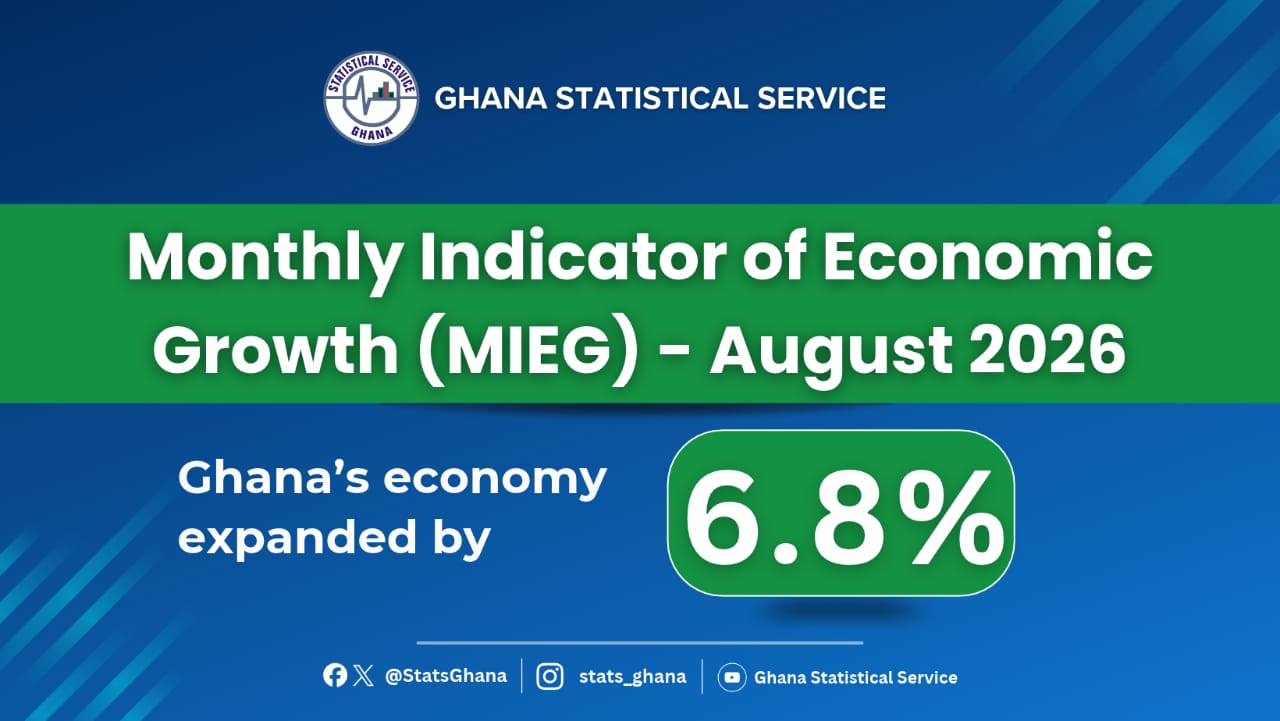

- Services Drive Ghana’s 6.8% August Expansion as Agriculture Loses Momentum
Ghana’s economic activity grew by 6.8% year on year in August 2026, up from 5.3% in August 2025. But the headline expansion was concentrated in services, which produced almost seven out of every ten parts of the increase, while agricultural growth slowed sharply.
The latest Monthly Indicator of Economic Growth (MIEG) from the Ghana Statistical Service puts services-sector growth at 10.7%, up from 7.1% a year earlier. Information and communication activities led the sector. Services contributed 4.8 percentage points to the overall 6.8% expansion, or 69.9% of the total.
Industry provided a second source of strength. It grew by 4.5%, compared with 0.8% in August 2025, adding 1.4 percentage points to overall growth. The expansion was driven mainly by manufacturing, with support from mining and quarrying.
Agriculture moved in the opposite direction. Its growth slowed to 2.6%, from 8.6% a year earlier and a revised 3.7% in July. The sector contributed 0.5 percentage points to the August increase. Net taxes on products added the remaining 0.1 percentage point.
The figures show an economy expanding faster than a year ago, but they also raise a question about the breadth of that expansion. When one sector accounts for nearly 70% of growth, overall momentum is especially sensitive to the performance of that sector.
The contribution from industry is encouraging, particularly the improvement in manufacturing, but agriculture’s slower pace leaves the expansion uneven.
The MIEG is a monthly indicator intended to provide an early reading of economic activity before the more comprehensive quarterly gross domestic product figures are released.
The Ghana Statistical Service says it is less detailed and more volatile than quarterly GDP, uses first-available data and is subject to revision. It should therefore be read as a timely signal of direction, not as a final measurement of national output.
That distinction matters. The 6.8% August reading does not mean quarterly GDP grew at that rate, nor does it establish that every part of the economy or every household experienced similar gains. It records the year-on-year movement in the monthly activity indicator. The service’s official account shows that quarterly GDP grew by 6.0% in the second quarter of 2026.
The monthly figures nevertheless offer an early indication of how the third quarter may be developing. July’s MIEG growth estimate was revised down from 7.4% to 7.0% after additional data became available.
Averaging the revised July figure with August’s 6.8% gives 6.9% for the two months. That provides a preliminary signal of activity, but September’s reading and the full quarterly GDP release will be needed for a firmer assessment.
Services are now doing much of the work in the monthly expansion. Information and communication is the leading driver within the sector, placing digital activity at the centre of the August result.
That strength may reflect the increasing role of communications and related services in economic activity. The data provided, however, do not quantify how much of the growth came from individual businesses, how widely it was distributed, or how much translated into jobs and income.
Industry’s rebound is another significant feature. Growth accelerated to 4.5% from 0.8% in August 2025, with manufacturing at the forefront and mining and quarrying adding support.
This is a stronger showing than the previous year, but the sector contributed 21.2% of the overall August expansion well below services’ 69.9% share.
The agricultural figures deserve equal attention. Growth did not turn negative; activity still expanded by 2.6%. But the pace was markedly slower than the 8.6% recorded a year earlier.
Agriculture’s smaller contribution to the month’s expansion raises questions about the momentum of production in crops and livestock and the resilience of the sector’s growth. The August indicator does not, on its own, establish what the slowdown means for food supply, farm incomes or prices. It does make the next round of agricultural and inflation data important to watch.
The changing mix of growth also shapes how the headline should be interpreted. A 6.8% expansion is a strong reading, but the composition shows that it is not being generated evenly across the three main sectors.
Services are carrying the largest share; industry is recovering from a weak comparison a year earlier; and agriculture is growing more slowly. Whether this pattern can continue and whether more sectors can contribute will help determine the durability of the momentum.
For policymakers, the data offer both encouragement and a caution. The stronger services and industry readings suggest activity was firm in August.
Yet the monthly indicator is provisional, and the July revision illustrates how estimates can change as more information becomes available. The final quarterly account will provide a fuller picture of output and sector performance.
The immediate conclusion is therefore not simply that growth accelerated. It is that August’s expansion was led decisively by services, supported by a recovery in industry, and tempered by weaker agricultural growth.
The September reading and the full third-quarter GDP estimate will show whether that sectoral balance holds or whether August’s strong headline masked a more fragile pattern beneath it.

