


- Ghana Courts Australian Capital as It Seeks to Turn Critical Minerals into Industrial Growth
Ghana is intensifying its courtship of Australian mining capital as it attempts to move beyond an economic model built largely around extracting and exporting raw minerals towards one in which lithium, bauxite, iron ore and other resources support domestic processing, manufacturing and job creation.
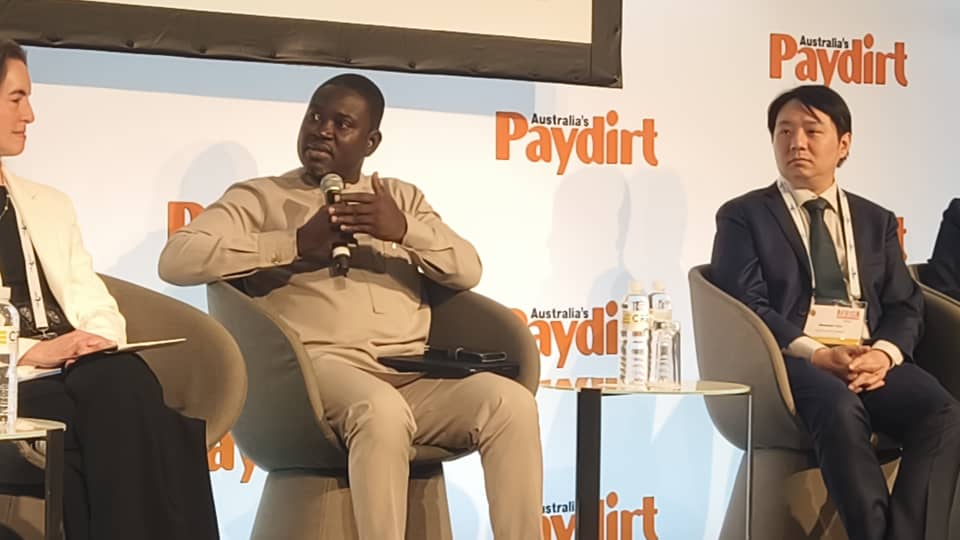
At the 2026 Africa Down Under Summit in Perth, government officials presented prospective investors with opportunities across a wider mineral portfolio while arguing that the country’s next mining cycle must deliver substantially more value inside Ghana.
The investment pitch places mineral beneficiation at the centre of a broader industrial strategy rather than treating mining simply as a source of exports, royalties and foreign exchange.
“Our country is not just about extracting resources, we are committed to a paradigm shift in mining, one that moves beyond the dig-and-ship model to a value-added approach for the creation of jobs and wealth locally,” Minerals Commission Deputy Chief Executive Maxwell Yao Akpene Klu told investors in Perth.
The statement captures an increasingly important tension in Ghana’s resources policy: the country remains one of Africa’s major mineral producers, yet a significant part of the economic value generated after extraction is captured elsewhere. Government’s proposition is that future mineral investment should increasingly connect mines to processing plants, industrial supply chains and Ghanaian businesses.
Mr Klu reinforced the point by arguing that “value addition transforms raw goods into higher-value products to boost income margins, reduce waste, and create jobs”, declaring that “the era of dig-and-ship materials at their raw state are over”.
Such an ambition could materially alter mining’s contribution to the wider economy because processing generates demand for engineering, logistics, electricity, construction, finance, technology and skilled labour beyond the mine gate.
But declaring the end of raw-material exports is considerably easier than building competitive downstream industries capable of surviving without permanent subsidies or protection.
That is where Ghana’s Australian investment campaign becomes a test of economic credibility rather than geology alone. Refineries, smelters and downstream manufacturing plants can require far greater capital commitments than mines, while their competitiveness depends heavily on reliable electricity, transport infrastructure, efficient ports, taxation and predictable regulation. A commercially attractive mineral deposit therefore does not automatically make processing the same material in Ghana financially viable.
The government is seeking to reassure investors that the institutional framework can support long-duration projects. Mr Klu highlighted Ghana’s 1992 Constitution and Minerals and Mining Act, 2006, which is currently being amended, as well as incentives including some waivers for mineral exploration.
“The investor community is investing in Ghana with confidence and knowing that their investments are protected by a stable political environment and a government that upholds the principles of good governance, including the rule of law and the sanctity of contracts,” he said.
Those assurances matter particularly to Australian investors because mining projects can involve billions of dollars committed over several decades before full returns are realised.
Australia has developed deep capabilities in exploration, mine development, mineral processing, equipment and mining services, making it a potentially valuable partner for Ghana beyond the provision of capital alone.
The opportunity for Ghana is therefore to attract not just mining companies but technology, technical knowledge, processing expertise and supply-chain businesses capable of helping build a more sophisticated domestic minerals industry.
Iron ore illustrates both the scale of the opportunity and the difficulty of execution. Ghana is estimated in the document to have more than one billion tonnes of iron ore resources and is seeking private investment through the Ghana Integrated Iron and Steel Development Corporation to create an industry spanning mining, refining and smelting.
If realised competitively, such a value chain could reduce dependence on imported steel, deepen domestic manufacturing and create demand for Ghanaian engineering and construction companies.
Yet steel production is among the most energy-intensive industrial activities, meaning electricity availability and pricing could determine whether Ghanaian ore can become commercially competitive Ghanaian steel.
The country would also require transport links capable of moving bulk minerals efficiently, significant water and logistics infrastructure and enough scale to reduce unit production costs.
This is why the viability of Ghana’s mineral-industrialisation agenda will ultimately be shaped as much by the power sector and infrastructure policy as by the quantity of minerals underground.
Lithium, bauxite and other critical minerals add another dimension to the strategy as major economies seek secure supplies for batteries, electric vehicles, renewable-energy systems and advanced manufacturing.
Resource-rich countries increasingly want to capture more of those value chains rather than remaining suppliers of raw inputs to processing industries elsewhere. Ghana is attempting to position itself within that shift, while the Minerals Commission says exploration activity remains strong across gold, lithium, iron ore and other minerals.
But the policy choices are not straightforward. Ghana wants foreign capital and technology while seeking greater domestic ownership; it wants increased public revenues without making investment uncompetitive; and it wants rapid industrialisation while maintaining environmental safeguards.
It also wants processing to take place domestically, but locally produced intermediate materials must eventually compete with established global processing hubs on price, reliability and quality if the strategy is to be economically sustainable.
Ghana’s High Commissioner to Australia, Doris Brese, sought to reinforce the broader investment case by pointing to what she described as prudent and transparent economic management and respect for the rule of law during the first 18 months of President John Mahama’s administration. Such messages are designed to reduce the political and regulatory risk premium attached to long-term resource investments.
For investors, however, confidence will ultimately depend on consistency between those assurances and the practical experience of licensing, taxation, contract enforcement and regulatory decision-making.
Human capital is another element of the strategy that receives less attention than mines and factories but may prove equally important.
The Ghanaian delegation attended the graduation of two of 25 students sponsored by the Minerals Commission at Curtin University, with eight more expected to graduate in February, as part of efforts to strengthen domestic technical capabilities.
A value-added minerals economy requires metallurgists, geologists, engineers, environmental specialists and mining economists, meaning Ghana cannot substantially increase domestic participation while remaining heavily dependent on imported expertise.
The Australian campaign should consequently be judged by outcomes rather than investor conferences or expressions of interest.
Ghana has mineral resources and a credible argument for capturing more value from them, but resources become industrial assets only when capital, infrastructure, technology, skills and policy are combined in commercially viable projects.
The success of the strategy will be measured by whether lithium, bauxite and iron ore eventually support factories, competitive Ghanaian suppliers, skilled employment and higher-value exports rather than simply adding new commodities to the country’s shipment statistics.
The most compelling part of Ghana’s message in Perth is therefore also its hardest promise to fulfil: that the age of digging minerals out of the ground and shipping them abroad should be ending.
If government can make domestic processing competitive rather than compulsory in name only, Australian capital and expertise could help convert mineral wealth into broader industrial capacity.
The real prize is not another mining boom, but whether Ghana can use its geology to build an economy whose value remains long after the ore has left the ground.

