

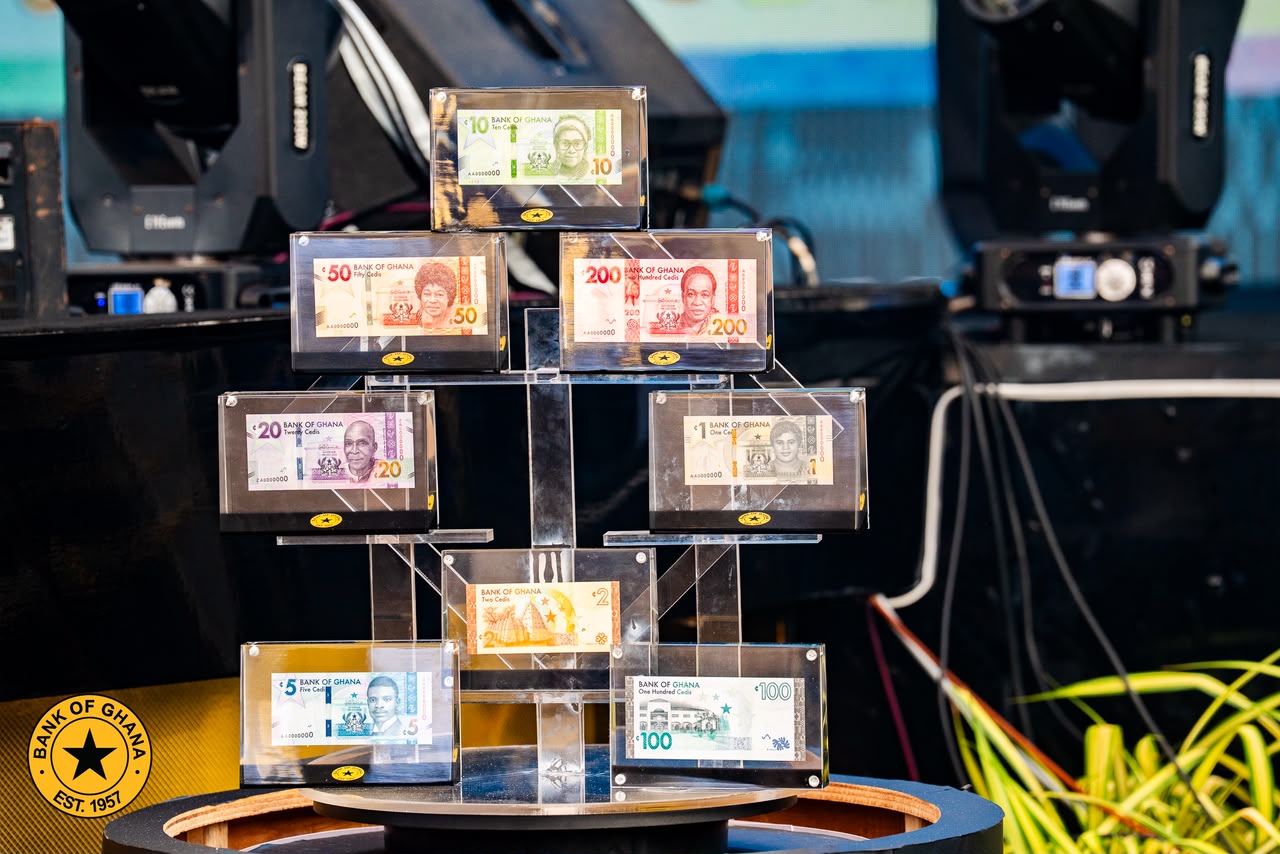

- Heritage Cedi Notes To Circulate Alongside Existing Series from December 1
The Bank of Ghana will begin issuing its Heritage Series banknotes on Tuesday, December 1, introducing redesigned currency while keeping existing notes in circulation and legal tender.
The central bank’s public notice says the new series will incorporate improved security features, durability and design.
But it also makes clear that the rollout does not require Ghanaians to exchange the notes they already hold. “There is no requirement for the public to exchange existing banknotes for the Heritage Series,” the notice states.
That clarification is central to the rollout. The introduction of a new banknote series can prompt questions about whether old notes are being withdrawn, whether people must queue to exchange cash, or whether a change in design signals a change in the value of the currency.
The Bank’s notice addresses the first two concerns directly: both series will circulate together, and the existing notes remain legal tender.
The change is therefore a currency upgrade, not a redenomination. The Ghana cedi’s international code, GHS, remains unchanged. The symbols GH¢ and ¢ will both remain valid, while “Ghana Cedi” and “Cedi” may continue to be used interchangeably.
These details are more than technical footnotes. They define what the public should expect in daily transactions. Businesses, banks, transport operators and consumers will need to accept both series during the period of co-circulation.
A shopkeeper should not reject a valid old note simply because a newer design has entered circulation; likewise, the arrival of the Heritage Series does not create a new unit of account.
The notice does not say how long the two series will circulate together, identify the denominations being introduced, or describe the specific security features.
The Bank has encouraged the public to familiarise themselves with the new notes and handle all banknotes with care.
More public information on how to recognise the updated features could help customers distinguish genuine notes from counterfeits and reduce confusion during the transition.
The central bank describes the Heritage Series as an enhancement of the existing banknotes.
In a public message about the launch, Governor Johnson Pandit Asiama said the portraits on the notes honour national heroes and described the notes as carrying “more than value” because they also carry Ghana’s history.
The Bank’s notice, however, focuses on circulation arrangements and does not detail the historical figures represented.
The launch places a practical responsibility on the Bank: the security and durability improvements need to be evident to users, while the transition must be communicated clearly enough to prevent misinformation.
New designs can support public confidence in cash, but that confidence depends on people knowing what has changed, what has not changed and how to verify the notes they receive.
For the financial system, concurrent circulation means the two series must be recognised and processed together. Banks, cash handlers and businesses will need to ensure that staff can identify and authenticate both sets of notes.
The notice does not set out the operational steps institutions should take, but the central bank’s public guidance gives them a clear baseline: neither series is to be treated as invalid simply because the other is newer.
The distinction between a redesigned note and a change in the currency’s value is especially important. A new design does not, by itself, alter the cedi’s exchange rate, purchasing power or the prices of goods and services.
Nor does the unchanged GHS code imply a new currency. The Bank has said the code remains as it is.
The public should also be cautious about claims that existing notes must be exchanged immediately or will soon become worthless. The notice explicitly rejects compulsory exchange and confirms that the existing series remains legal tender.
Anyone encountering a demand to swap notes should check the Bank’s official communications rather than rely on forwarded messages or unofficial instructions.
The Heritage Series is scheduled to enter circulation after its official launch, beginning December 1.
Its success will depend not only on the physical notes, but also on a smooth transition: clear explanations, consistent acceptance by businesses and reliable information about the security features.
For now, the Bank’s central message is straightforward: Ghanaians can continue using the notes they already have. The new series will join them in circulation, while the cedi’s name, symbols and international code remain unchanged.

