

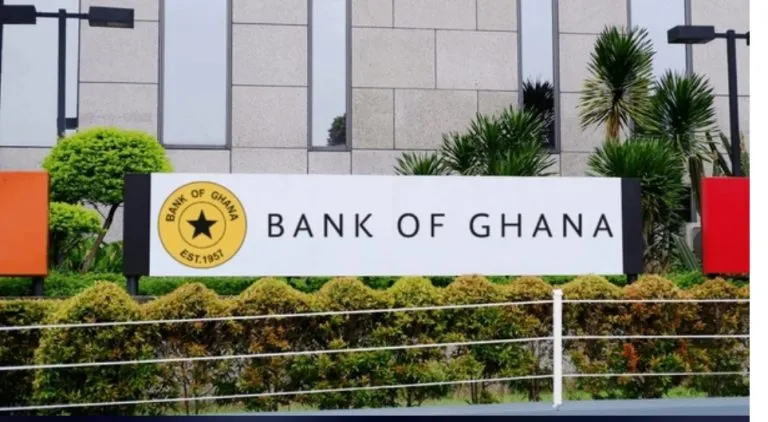

- Ghana Lending Rates Fall to 15.64% as Treasury Yields Begin to Edge Higher – BoG Report
Ghana’s average lending rate declined sharply to 15.64% in June 2026, extending a broad reduction in borrowing costs over the past year, although renewed increases in Treasury bill and government bond yields point to emerging pressure within the domestic interest-rate market.
The Bank of Ghana’s July 2026 Summary of Economic and Financial Data showed that the average lending rate fell from 27.00% in June 2025, representing a decline of 11.36 percentage points within 12 months.
The Ghana Reference Rate, which serves as a benchmark for pricing commercial bank loans, also dropped to 10.02% from 23.80% during the same period. The 13.78 percentage-point decline reflects the significant easing in the monetary policy rate, interbank rate and Treasury bill yields, which are used in calculating the reference rate.
The data indicate that the monetary easing cycle has begun to transmit to the credit market, reducing the indicative cost at which businesses and households can access bank financing.
The Bank of Ghana’s monetary policy rate remained at 14.00% in June, unchanged since March 2026. It had declined from 28.00% in June 2025 to 25.00% in July, 21.50% in September and 18.00% in November before falling to 15.50% in January 2026 and 14.00% in March.
The cumulative 14.00 percentage-point reduction in the policy rate over the 12 months to June helped establish a substantially lower benchmark for financial-market pricing.
Interbank rates also declined, with the weighted average rate at which banks lend to one another overnight falling to 10.24% in June 2026 from 27.02% a year earlier.
The lower interbank rate suggests improved liquidity conditions within the banking system and a reduced cost of short-term funding among financial institutions. This has contributed to lower bank funding costs and helped lenders reduce the rates charged on loans.
However, the decline in lending rates appears to be losing some momentum. The average lending rate fell from 20.58% in January to 19.17% in February, 17.74% in March, 16.33% in April, 15.83% in May and 15.64% in June.
The Ghana Reference Rate similarly declined only marginally from 10.06% in April to 10.03% in May and 10.02% in June, signalling that the downward adjustment may be approaching a floor under prevailing market conditions.
Treasury bill rates, which dropped steeply during the early months of 2026, have also begun rising.
The interest-equivalent yield on the 91-day Treasury bill increased from 4.89% in March to 4.90% in April, 4.91% in May and 5.27% in June. The 182-day bill rose from 6.51% in March to 7.21% in June, while the 364-day bill increased from 9.57% to 11.29%.
The rise was most pronounced at the longer end of the Treasury bill market, where the 364-day yield gained 1.72 percentage points between March and June.
Although Treasury yields remained considerably below the levels recorded a year earlier, their recent upward movement suggests that investors are demanding higher returns, particularly for instruments with longer maturities.
The secondary government bond market recorded a similar pattern. Yields on most post-Domestic Debt Exchange Programme bonds rose in June following substantial declines earlier in the year.
The four-year bond yield increased to 10.70% in June from 10.50% in May, while the five-year yield climbed more sharply to 13.00% from 9.80%. The six-year bond yield rose to 12.84% from 10.56%.
At the longer end, the eight-year bond yield increased to 14.16%, the 10-year yield rose to 14.33%, and the 12-year bond returned 14.92%. The 13-year and 14-year instruments recorded yields of 14.70% and 14.50%, respectively.
The increase across much of the yield curve indicates a reassessment of the returns investors require to hold longer-term government debt. This may reflect inflation expectations, fiscal financing requirements, liquidity preferences and the higher risks associated with committing funds over longer periods.
The Bank of Ghana report does not provide a specific explanation for the rebound in government security yields.
The shift occurred as headline inflation rose to 5.30% in June from 3.70% in May. While inflation remained low relative to 2025 levels, the increase may affect investors’ assessment of real returns, particularly on short-term government instruments.
Deposit rates showed less movement than other market rates. The average savings deposit rate remained at 5.00% in June, while rates on three-month and six-month time deposits were unchanged at 10.50%.
Demand deposit rates stood at 1.12%, down from 2.63% in June 2025.
The relative stability of savings and time-deposit rates, despite the sharp decline in lending rates, could narrow banks’ interest spreads. This may encourage financial institutions to place greater emphasis on fee income, transaction banking and improved operating efficiency to sustain profitability.
For borrowers, the decline in the average lending rate and Ghana Reference Rate represents a substantial improvement from the high-cost credit conditions that prevailed a year earlier.
However, the average lending rate is not necessarily the final rate paid by every customer. Banks typically apply additional risk premiums based on a borrower’s credit profile, the type of facility, collateral, operating sector and repayment history.
The latest interest-rate data therefore present two competing trends. Monetary easing and improved banking-sector liquidity have significantly reduced borrowing costs, creating a more supportive environment for private investment and credit expansion.
At the same time, the rebound in Treasury bill and secondary bond yields suggests that the downward interest-rate cycle may be entering a more challenging phase. Sustaining lower lending rates will depend on the direction of inflation, fiscal borrowing, liquidity conditions and the Bank of Ghana’s future monetary policy decisions.
Ghana’s interest-rate environment remains considerably more favourable to borrowers than it was in June 2025. Yet the recent rise in government security yields signals that further reductions in the cost of credit may become slower and more difficult during the second half of 2026.

