


- 2027 Budget: Ghana’s Growth Plan Begins With GH¢30bn
The government’s New Economy programme now has a first-year price tag: GH¢30 billion in 2027, equivalent to 1.5 per cent of gross domestic product. The allocation gives a concrete scale to the administration’s four-year US$10 billion ambition.
It also raises the harder question that will follow the budget announcement: can Ghana turn a new spending commitment into productive capacity without weakening the fiscal stability it has worked to restore?
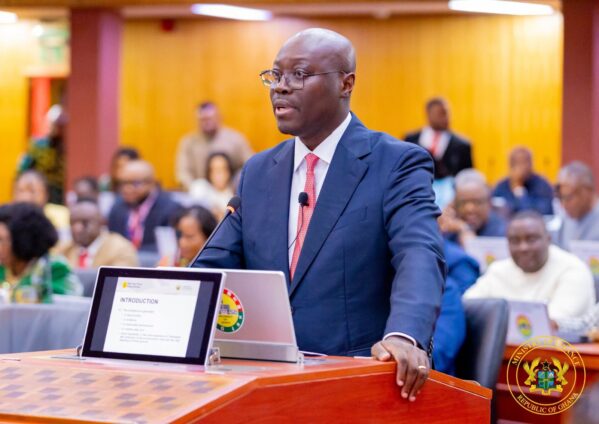
Finance Minister Cassiel Ato Forson said the allocation would support productive infrastructure, industries and strategic sectors, with the aim of expanding businesses, lifting exports and creating jobs. “We will judge growth by the jobs it creates, the income it raises, and the productive capacity it leaves behind,” he told Parliament.
He also said projects would undergo appraisal and value-for-money assessments, and that commitments would be budgeted, authorised and transparently reported.
That promise of transparency is central. GH¢30 billion is large enough to shape the investment outlook, but the figure alone reveals little about what will be built, when it will be delivered or how its returns will be measured.
The public needs to see the project pipeline, funding releases, procurement decisions and progress against job and export targets. Without that, the programme risks being judged by its allocation rather than the economic results it produces.
The financing plan draws on two fiscal measures. The government intends to reduce its primary surplus target by one percentage point of GDP, from 1.5 per cent to 0.5 per cent, creating more room for investment.
It also expects tax reforms and stronger compliance to generate an additional 0.5 per cent of GDP. Together, the government says, the measures will support annual investment equivalent to 1.5 per cent of GDP over the programme period.
This is not a simple choice between investment and restraint. A primary surplus means government revenue exceeds non-interest spending. Reducing the target from 1.5 per cent to 0.5 per cent still preserves a surplus, but leaves a narrower cushion to manage shocks and debt obligations.
The second funding source also depends on revenue reforms delivering the expected yield. If compliance gains fall short, the government will face pressure to find savings, borrow more or scale back projects.
The 2027 budget projects a cash-basis fiscal deficit of 3.6 per cent of GDP and a commitment-basis deficit of 2.9 per cent. It targets a primary surplus of 0.5 per cent on a commitment basis.
Those figures frame the programme’s central test: whether government can fund investment while staying within its fiscal commitments and avoiding a renewed build-up of debt.
The programme is meant to move Ghana from stabilisation towards a more productive economy. Its areas of focus include commercial agriculture, energy infrastructure, technology, textiles and garments, value addition to minerals, tourism and pharmaceuticals.
The government has earmarked US$3 billion of the four-year programme for commercial agriculture, signalling an attempt to use investment to raise domestic production and reduce food imports
Agriculture is a revealing test case. More production could strengthen food security, reduce some import demand and create work across farming, processing, packaging and transport. But funding alone cannot resolve constraints such as irrigation, storage, market access, reliable energy and affordable finance.
If these pieces are not coordinated, capital spending may produce assets without the supply-chain improvements needed to raise productivity or incomes.
The same challenge applies to the other sectors. Investment in energy infrastructure may support manufacturing, but projects need credible demand, sound procurement and a clear route to operation.
Mineral processing can retain more value locally, but it requires infrastructure, skills and access to markets. Support for textiles or pharmaceuticals will have to build firms able to compete and sell, rather than sustain activity through indefinite public protection.
The budget sets a 2027 real GDP growth target of at least 5.2 per cent, with inflation expected to remain within the Bank of Ghana’s 8 per cent target, plus or minus two percentage points.
These are important measures of economic performance, but the New Economy’s success should also be assessed through employment, earnings, productivity and export growth. A higher growth rate that does not broaden opportunity would fall short of the minister’s stated test.
There is a further issue of additionality. The New Economy allocation sits within a budget that also includes major capital programmes, including GH¢29.8 billion for the Big Push.
The public accounts should make clear how these allocations relate to one another, which projects are included in the GH¢30 billion commitment and how total investment spending is being counted. Clear reporting would help prevent double-counting and show whether new money is reaching genuinely additional projects.
The programme’s central economic case is sound: Ghana needs to produce more, process more locally and create jobs from investment. But credibility will depend on the gap between announced and actual spending, the quality of project selection and the strength of the revenue measures supporting the plan.
The new allocation offers a framework for turning stability into productive investment. It does not guarantee that transformation.
The first-year GH¢30 billion therefore marks both a commitment and a test. If the money is released on schedule, directed towards viable projects and reported transparently, it could help create lasting capacity and broader sources of growth.
If projects stall or revenues disappoint, the government may have to choose between its investment ambitions and the fiscal buffer it has pledged to preserve. The measure of the New Economy will not be the amount written into the budget, but the jobs, incomes and productive assets that remain after the funds are spent.

