


- NDPC, Bank of Ghana Discuss Shift From Stability to Jobs-Led Growth
The Chairman of the National Development Planning Commission, Dr. Nii Moi Thompson, has engaged the leadership of the Bank of Ghana on strategies to move the economy from macroeconomic stability to employment-intensive growth, arguing that Ghana’s recent gains in inflation, exchange rate stability and fiscal consolidation must now translate into jobs, wages and better living standards.
The engagement brought together Dr. Thompson and senior officials of the central bank, including Governor Dr. Johnson Asiamah, for discussions on how monetary, financial and development planning institutions can collaborate to deepen Ghana’s recovery and make growth more meaningful to ordinary citizens.
Dr. Nii Moi Thompson, who also serves as the President’s Senior Advisor on the Sustainable Development Goals, said the rapid improvement in core macroeconomic indicators had raised public expectations for a better life. However, he warned that those expectations could not be met by relying solely on headline GDP growth.
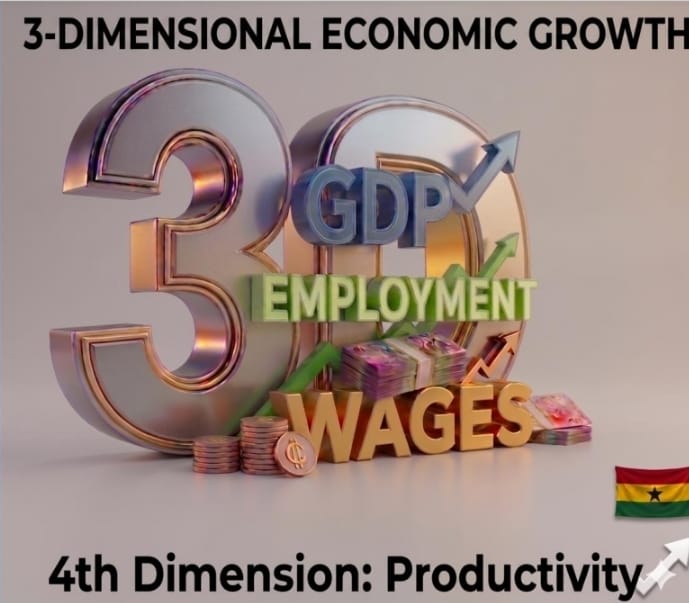
He argued that Ghana must move from what he described as a one-dimensional model of economic growth, focused mainly on GDP, to a three-dimensional model that also measures employment creation and wage growth.
“This is the only way to make economic growth meaningful to the average Ghanaian,” he said.
According to Dr. Thompson, Ghana’s “absorption rate” a measure of the economy’s capacity to create jobs had declined in recent years from about 65 per cent to 62 per cent, even though GDP growth remained positive. The trend, he suggested, pointed to a structural weakness in the economy, where output growth does not automatically generate sufficient employment.
He also addressed public concerns that recent declines in inflation have not been widely felt in the cost of living. Dr. Thompson said the “seeming paradox” could be better understood through an expanded definition of inflation that includes the Producer Price Index.
He noted that while the Consumer Price Index measures prices of goods and services bought by households, the Producer Price Index captures input costs, production costs and margins.
According to him, what happens within the Producer Price Index “black box” ultimately determines whether producers reduce price levels or merely allow prices to rise more slowly, resulting in lower consumer inflation without immediate price relief for households.
Dr. Thompson further explained that there is usually a lag of about 18 months between improvements in macroeconomic indicators and the point at which citizens begin to feel the benefits in their daily lives. He, however, stressed that the speed and quality of transmission would depend on sectoral policies and broader government interventions.
A major focus of the discussion was private sector credit and its role in job creation.
Dr. Thompson urged the Bank of Ghana to work with commercial banks and government to address what he described as the low and uneven distribution of private sector credit in the country.
He disclosed that domestic credit to the private sector in Ghana had averaged only 12.8 per cent for more than 30 years, compared with 35 per cent for lower middle-income countries and 44 per cent for sub-Saharan Africa. “This is unacceptable,” he said.
He added that the pattern of credit allocation within Ghana also reflected deep structural distortions. According to him, bank credit to the commerce sector had averaged 16 per cent per year, higher than any other sector, while imports averaged 7.6 per cent and exports just 0.43 per cent. Manufacturing and construction, two of the biggest employment-generating sectors, averaged 11.5 per cent and 8.6 per cent respectively.
Dr. Thompson said the government’s ability to build on the macroeconomic gains of 2025 would depend on a “purposeful reversal” of such structural distortions in banking, especially if Ghana is to move from stabilisation to production-led and jobs-rich growth.
Governor Dr. Johnson Asiamah welcomed the presentation and pledged the Bank of Ghana’s readiness to work with the NDPC to support the transformation of the Ghanaian economy. He also expressed support for the Commission’s efforts to make Local Economic Development the foundation of national development.
Dr. Asiamah assured Dr. Thompson that the Bank would honour the NDPC’s request for a regional and district breakdown of bank credit in Ghana, a move expected to support the Commission’s Local Economic Development agenda and help identify gaps in access to finance across the country.
The discussions signal a possible broadening of Ghana’s economic policy conversation beyond inflation control and exchange rate stability to include the distributional and employment effects of growth.

