
- Hamis Ussif Named Acting GNPC CEO After Amoah’s Reassignment
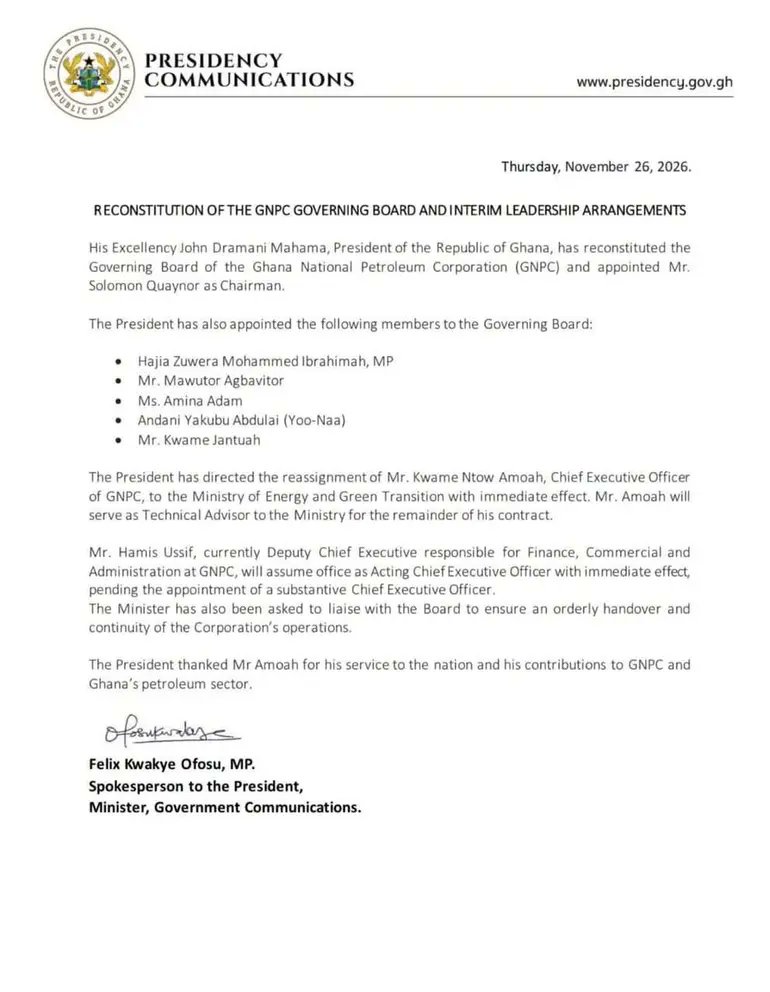
Ghana’s National Petroleum Corporation is entering a leadership transition, with President John Dramani Mahama reconstituting its governing board, naming Solomon Quaynor as chairman and reassigning Chief Executive Officer Kwame Ntow Amoah to the Ministry of Energy and Green Transition.
The changes, announced by the Presidency on Thursday, also make Hamis Ussif, GNPC’s Deputy Chief Executive responsible for Finance, Commercial and Administration, acting chief executive with immediate effect.
He will serve in the role while the government searches for a substantive CEO.
The announcement sets out both a new board and interim executive arrangements, but leaves key questions about the corporation’s longer-term leadership unanswered.
It does not specify how long the appointment process will take, or outline the new board’s priorities. Its immediate emphasis is on an orderly handover and continuity of operations.
That transition will be closely watched because the appointments affect the governance of a national institution whose decisions help shape the country’s petroleum sector.
The new board will be expected to provide oversight while the acting CEO manages day-to-day responsibilities.
How clearly those roles are defined and how swiftly a permanent chief executive is appointed will matter to the corporation’s stability.
The reconstituted board will be chaired by Quaynor. Its members are Hajia Zuwera Mohammed Ibrahimah, MP; Mawutor Agbavitor; Amina Adam; Andani Yakubu Abdulai, also known as the Yoo-Naa; and Kwame Jantuah.
The President’s decision to move Ntow Amoah to the Energy Ministry is described as a reassignment, effective immediately.
He will serve as a technical adviser to the Ministry for the remainder of his contract.
The Presidency also thanked him for his service to the nation and his contribution to GNPC and Ghana’s petroleum sector.
That wording makes the immediate change clear, but it does not indicate whether the reassignment is linked to a specific ministerial assignment or policy priority. It also does not state whether the move changes the terms or duration of his existing contract. Those details may become clearer as the Ministry and the corporation manage the transition.
Ussif’s appointment is explicitly interim. The Presidency says he will act as CEO pending the appointment of a substantive chief executive.
His current portfolio covers finance, commercial operations and administration areas that place him at the centre of the corporation’s internal management during the handover.
The Ministry has been asked to liaise with the board to ensure an orderly transfer of responsibilities and the continued operation of GNPC.
That direction is significant: it signals that the transition is expected to be managed across the corporation and its supervising ministry, rather than treated solely as a change in personnel.
For GNPC, continuity will depend on more than maintaining routine operations. The new board and acting chief executive will need to establish clear channels for decision-making while the substantive CEO appointment remains pending.
A prolonged interim arrangement could create uncertainty over strategic priorities and accountability; a rapid appointment, by contrast, will still need to give the incoming leadership a clear mandate and working relationship with the board.
The composition of the new board brings together members from different public and professional backgrounds, including a parliamentarian and the Yoo-Naa.
The announcement does not describe the specific expertise each member will bring to GNPC or identify the committees they may serve on.
The board’s effectiveness will ultimately depend on how it exercises oversight, evaluates management decisions and provides direction during a period of change.
The transition also presents an opportunity to define what the government expects from the corporation.
The Presidential Communication does not set out new operational or investment targets, nor does it announce changes to GNPC’s mandate.
It is therefore too early to infer a shift in petroleum policy from the personnel changes alone. The immediate task, as stated, is to complete the handover and maintain continuity.
That distinction matters. A change in board and executive leadership can affect the pace, scrutiny and coordination of decisions, but it does not by itself establish a new strategy.
The first signals will come from the board’s priorities, the terms of reference given to the acting CEO and the choice of a substantive chief executive.
For now, the arrangement divides responsibilities between a newly constituted governing board, an acting chief executive and the Energy Ministry, where Ntow Amoah will serve as technical adviser.
The Ministry’s role in coordinating the handover is intended to prevent disruption while the new structure takes shape.
The central test will be whether the transition is orderly in practice. GNPC must continue its work while the board establishes its oversight role and the government completes the appointment of a permanent CEO.
The Presidency has made continuity an explicit instruction; delivery will depend on the speed, clarity and discipline with which these arrangements are carried out.