


- Credit Bureau Coverage Increases By 26.80 Percentage Points, but MSMEs Still Face Financing Barriers — BoG
The Bank of Ghana (BoG) has called for a fundamental shift in how financial institutions assess the creditworthiness of micro, small and medium-sized enterprises (MSMEs), arguing that traditional lending models continue to exclude economically viable businesses despite the rapid expansion of digital payments and the availability of alternative financial data.
The central bank believes that transaction histories generated through mobile money, utility payments, supplier settlements and other commercial activities could provide financial institutions with a more comprehensive understanding of borrowers who operate outside conventional banking arrangements.
Dr Settor Kwabla Amediku, Special Aide to the Governor of the Bank of Ghana on Financial Stability, said the challenge confronting Ghana’s financial system was no longer simply the absence of information about small businesses, but the inability of lenders to translate existing economic activity into credible evidence of repayment capacity.
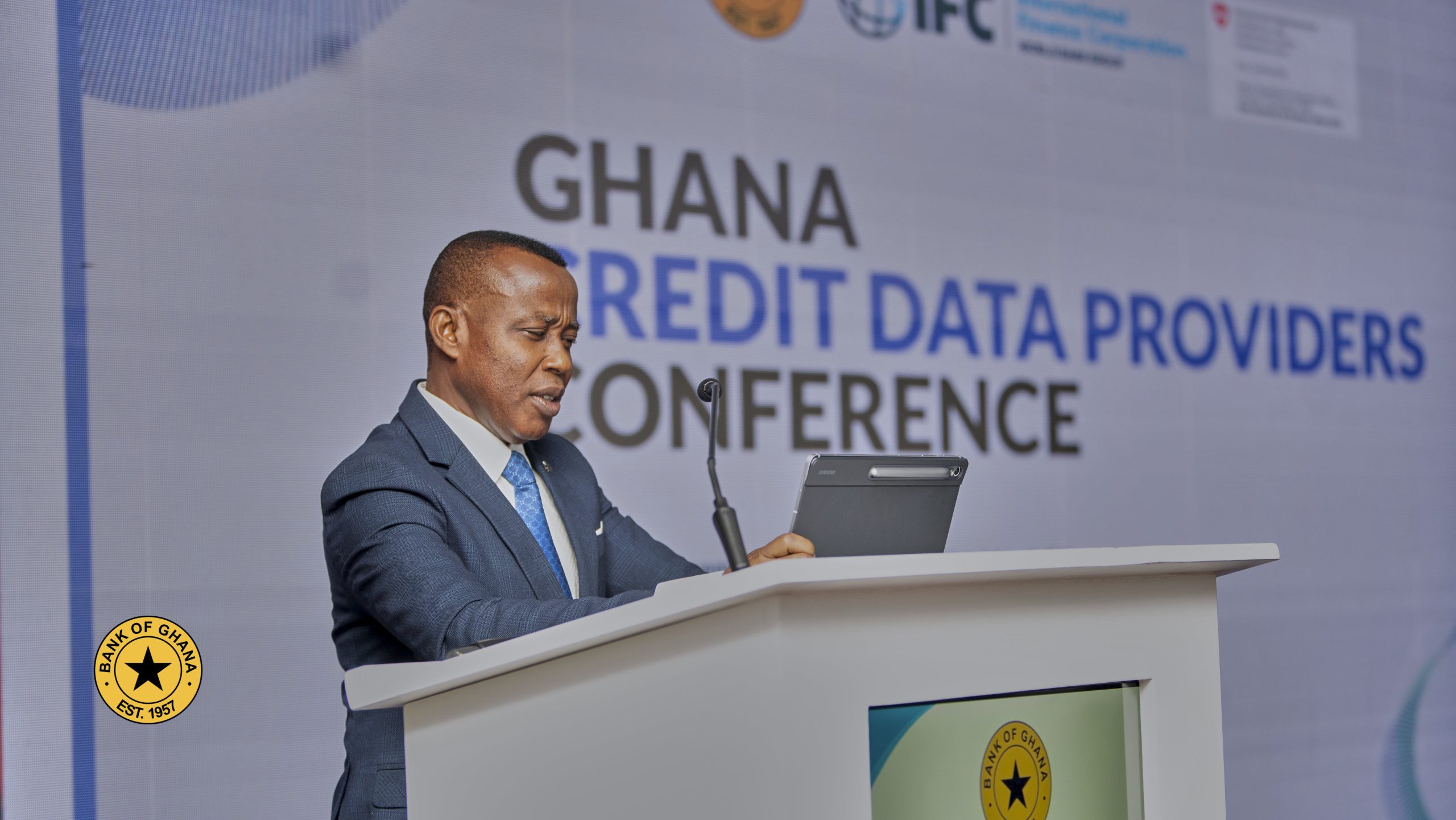
Speaking on behalf of the Second Deputy Governor of the Bank of Ghana, Matilda Asante-Asiedu, at a conference on enhancing MSME access to finance through alternative data and collaboration, Dr Amediku challenged financial institutions to reconsider lending practices that rely heavily on established credit histories and formal financial statements.
The conference brought together financial sector regulators, banks, credit bureaus, fintech companies and development partners, including the International Finance Corporation (IFC) and Switzerland’s State Secretariat for Economic Affairs (SECO).
Dr Amediku said expanding access to credit would require a financial ecosystem capable of recognising legitimate commercial activity that frequently remains outside established credit assessment systems.
He illustrated the problem through the example of a trader operating in Accra’s Makola market who regularly pays suppliers, settles utility bills and receives mobile money payments but struggles to obtain working capital because she lacks a conventional borrowing record.
The situation reflects a structural weakness in Ghana’s credit market, where enterprises can demonstrate consistent commercial activity without necessarily possessing the documentation lenders traditionally require.
The central bank official described the problem as a cycle in which businesses cannot access credit because they lack borrowing histories, yet cannot establish those histories because they have never obtained credit.
“A business cannot obtain credit because it has no credit history. It cannot build a credit history because it has never obtained credit.”
The remarks highlight a challenge confronting lenders attempting to assess smaller businesses, particularly those operating in informal markets where transactions are increasingly digital but financial records remain fragmented.
Dr Amediku disclosed that Ghana’s credit bureau coverage had increased from 33.20% in 2019 to approximately 60.00% by December 2025, representing an improvement of 26.80 percentage points over six years.
The expansion suggests that the country’s credit reporting infrastructure has improved significantly, creating a stronger foundation for lenders to assess repayment behaviour and financial obligations.
However, the official cautioned that wider coverage does not necessarily translate into greater access to credit.
“Being counted in a database is not the same as being understood by a lender.”
He argued that the next phase of credit reporting reforms must prioritise the depth, diversity, accuracy and timeliness of borrower information rather than simply increasing the number of individuals recorded by credit bureaus.
The distinction is significant because traditional credit reporting systems primarily capture information generated through formal borrowing relationships.
For businesses that rely on mobile money collections, informal supplier arrangements and daily cash-flow transactions, such records may provide only a partial picture of financial capacity.
Alternative data could help address these information gaps by allowing lenders to assess regular sales, supplier payment patterns, inventory purchases and other indicators of business activity.
However, Dr Amediku acknowledged that alternative data does not guarantee loan repayment.
Rather, its value lies in providing additional evidence that could improve lending decisions and support more accurate assessments of credit risk.
The potential implications for Ghana’s MSME sector are considerable.
Referring to Ghana Statistical Service data, Dr Amediku cited a figure of 78.30% to illustrate the importance of MSMEs to employment and economic activity.
He maintained that the difficulty facing many smaller businesses was not necessarily the absence of profitable commercial opportunities but the challenge of demonstrating creditworthiness within conventional banking systems.
The problem affects market traders, agricultural producers, manufacturers and emerging digital enterprises whose business activities generate identifiable transaction records.
For these enterprises, access to working capital can determine whether they are able to replenish inventories, fulfil customer orders, purchase equipment or expand operations.
Limited credit access can therefore constrain business growth even where demand for goods and services exists.
Dr Amediku noted that Ghana’s expansion of digital payment systems had already begun to change this situation.
He recalled that during the early stages of mobile money development, some financial institutions were reluctant to participate in the emerging payment ecosystem.
However, the growth of digital transactions has subsequently created opportunities for financial institutions and technology companies to provide short-term credit products to individuals previously excluded from formal banking.
He cited examples of small traders accessing modest amounts of digital credit, purchasing merchandise, completing sales and repaying their obligations within a single business day.
Such transactions demonstrate how financial products can be structured around the cash-flow characteristics of small businesses rather than conventional monthly repayment models.
The development also creates commercial opportunities for banks, fintech companies and licensed payment service providers seeking to expand lending into previously underserved market segments.
Dr Amediku argued that improving macroeconomic conditions could further support these developments.
He pointed to declining interest rates and relative exchange-rate stability as factors that could help financial institutions assess and price credit more effectively.
Nevertheless, he emphasised that financial inclusion must not come at the expense of prudent lending practices.
“We are not asking financial institutions to lower their credit standards. We are asking them to raise the quality of information which they use to assess borrowers.”
The statement reflects the central bank’s attempt to balance the objective of expanding credit with its responsibility to preserve financial stability.
Alternative data can improve assessments of creditworthiness, but poorly designed lending models could expose borrowers to excessive debt and financial institutions to higher default risks.
The challenge is therefore to identify information that genuinely improves lending decisions without introducing new vulnerabilities into the financial system.
Dr Amediku identified data integrity, privacy protection, fairness, transparency, information security and responsible lending as essential requirements for developing a credible alternative credit reporting ecosystem.
He warned that inaccurate information could prevent deserving borrowers from obtaining financing, while poorly designed artificial intelligence and credit-scoring models could introduce discrimination into lending decisions.
These concerns are particularly relevant as financial institutions increasingly explore automated credit assessment systems.
Although such technologies can reduce administrative costs and process applications more quickly, their effectiveness depends on the quality of the underlying data and the safeguards governing their use.
Borrowers must also have opportunities to understand how their information is used, challenge inaccuracies and obtain timely corrections.
The Bank of Ghana official consequently urged financial institutions to strengthen their data management practices before expanding the use of alternative credit information.
He disclosed that the central bank, working with the IFC, commissioned an alternative data ecosystem mapping study in March 2025 to identify information sources capable of improving financial inclusion.
The findings are expected to inform decisions about priority data sources, reporting standards, interoperability and safeguards.
For the central bank, the objective is to create a system in which different institutions can contribute relevant information to support responsible lending.
Banks, mobile money operators, telecommunications companies, utility providers, fintech firms, credit bureaus and trade creditors could all play important roles.
However, the participation of multiple institutions would also require clear arrangements governing consent, data sharing, security and accountability.
Dr Amediku stressed that no single institution possesses a complete picture of a borrower’s financial activities.
Effective collaboration could therefore enable lenders to identify viable enterprises that would otherwise remain excluded from formal credit markets.
The potential benefits extend beyond individual borrowers.
More accurate credit assessments could improve risk-based loan pricing, strengthen portfolio management and help financial institutions identify emerging financial difficulties earlier.
For the wider economy, improved financing for smaller businesses could support investment, productivity and employment.
Nevertheless, the official warned that reforms should be judged by measurable results rather than the number of stakeholder meetings or policy discussions held.
He challenged conference participants to agree on five concrete outcomes, including priority alternative data sources, stronger reporting participation, technical standards, institutional responsibilities and an implementation roadmap with measurable targets.
He called for progress to be assessed within a year, rather than allowing the conference to become another engagement without demonstrable results.
“Conferences, they do not transform economies.”
His message was that institutional collaboration must produce practical changes in the availability and quality of credit.
The central significance of the Bank of Ghana’s intervention is that financial inclusion can no longer be measured solely by access to bank accounts, mobile money services or credit bureau registration.
The more consequential question is whether those systems allow financially responsible individuals and businesses to obtain appropriate financing at sustainable costs.
Ghana’s digital payments infrastructure has created a substantial volume of transaction information, but much of its potential value for assessing smaller businesses remains underutilised.
Turning that information into reliable credit intelligence could improve lending decisions and expand access to working capital.
However, the process will require stronger consumer protections, better reporting standards and closer coordination between financial institutions and regulators.
Dr Amediku concluded by returning to the example of the Makola trader, stressing that financially excluded entrepreneurs were not necessarily seeking special treatment or relaxed lending standards.
Rather, they needed an opportunity to demonstrate the economic value of businesses built through years of commercial activity.
The challenge for Ghana’s financial institutions is therefore to develop lending systems capable of recognising that activity without compromising sound credit assessment.
For the Bank of Ghana, the next stage of financial inclusion will depend on whether digital transaction records can become a credible bridge between informal economic activity and formal credit.

