


- Trade Minister Backs Cement Industry Shift Away From Imported Clinker
The Chamber of Cement Manufacturers, Ghana, has called for a structural transformation of the country’s cement industry, urging producers, policymakers and investors to reduce dependence on imported clinker and accelerate the use of local raw materials in cement production.
The call comes as rising fuel costs, port congestion, global supply disruptions and exchange rate pressures continue to increase the cost of clinker imports, a major input in cement manufacturing.
Speaking on the sidelines of INTERCEM Africa 2026 in Accra, Chairman of COCMAG, Frederic Albrecht, said Ghana must rethink its cement production model because traditional clinker production is not commercially feasible in the country.
“Clinker production is not possible in Ghana because of unsuitable limestone deposits. Yet clinker remains a major input in cement production, and importing it is increasingly expensive due to rising fuel costs, port congestion, and global supply disruptions,” he said.
His comments point to a long-standing structural weakness in Ghana’s cement value chain.
Although Ghana has a growing cement market supported by housing, infrastructure and industrial development, the sector remains heavily exposed to imported clinker.
That dependence leaves local producers vulnerable to global energy price swings, shipping disruptions, port delays and foreign exchange volatility.
For an economy seeking to conserve foreign exchange and deepen local industrial production, the continued import reliance creates both cost and strategic risks.
Mr Albrecht said reducing clinker content and adopting alternative raw materials would allow Ghana to lower production costs, improve competitiveness and make better use of local resources.
“We must develop a different type of cement that allows Ghana to become more self-sufficient. By reducing clinker ratios and utilising local raw materials, we can lower production costs, improve competitiveness, and reduce pressure on foreign exchange,” he said.
The argument is both industrial and macroeconomic.
For cement manufacturers, lower clinker ratios can reduce exposure to imported inputs and energy-intensive global supply chains.
For the wider economy, reduced clinker imports could help ease demand for foreign exchange and support domestic value addition.
For consumers, the long-term benefit could be more affordable cement if production efficiencies are passed through to the market.
The push also has a climate and sustainability dimension.
Clinker is the most carbon-intensive component of cement production. Its manufacture requires very high temperatures and heavy energy use.
Mr Albrecht noted that clinker production requires temperatures of up to 1,500 degrees Celsius, making it directly tied to volatile fuel prices.
“Clinker production is highly energy-intensive, requiring temperatures of up to 1,500 degrees Celsius. This makes it directly tied to fuel prices, which are volatile. Reducing dependence on clinker is therefore both an economic and strategic necessity,” he said.
That point is important because cement production is one of the world’s most carbon-intensive industrial activities.
Reducing clinker content is therefore not only a cost-reduction strategy. It can also support lower-carbon cement production and align Ghana’s building materials industry with global sustainability trends.
Mr Albrecht pointed to innovations already underway by CBI Ghana and Ghacem, including products such as Eco Cool and Supercem, which are being produced with lower clinker content.
“These products demonstrate that Ghana can position itself as a global leader in sustainable cement production. By leveraging local materials, we are not only reducing costs but also making better use of Ghana’s natural resources,” he said.
The examples show that alternative cement production is no longer theoretical.
The challenge is scale.
For the industry to shift meaningfully away from clinker dependence, producers will need investment in alternative production systems, testing, standards, market education and regulatory support.
Mr Albrecht said establishing alternative production systems takes about three years and requires foresight, investment and collaboration between government and industry.
“Establishing alternative production systems takes about three years. It requires foresight, investment, and strong collaboration between industry players and government. We are grateful to the Ministry of Trade, Agribusiness and Industry for supporting this transition,” he said.
That timeline suggests that even with strong policy backing, the transition will not be immediate.
Cement production is capital-intensive, and any shift in raw material mix must meet technical, safety and durability standards.
Builders, engineers, contractors and regulators must also have confidence that lower-clinker cement products can perform reliably across different construction uses.
This makes standards enforcement and public education central to the transformation.
If properly managed, however, Ghana could position itself as a regional leader in sustainable cement production.
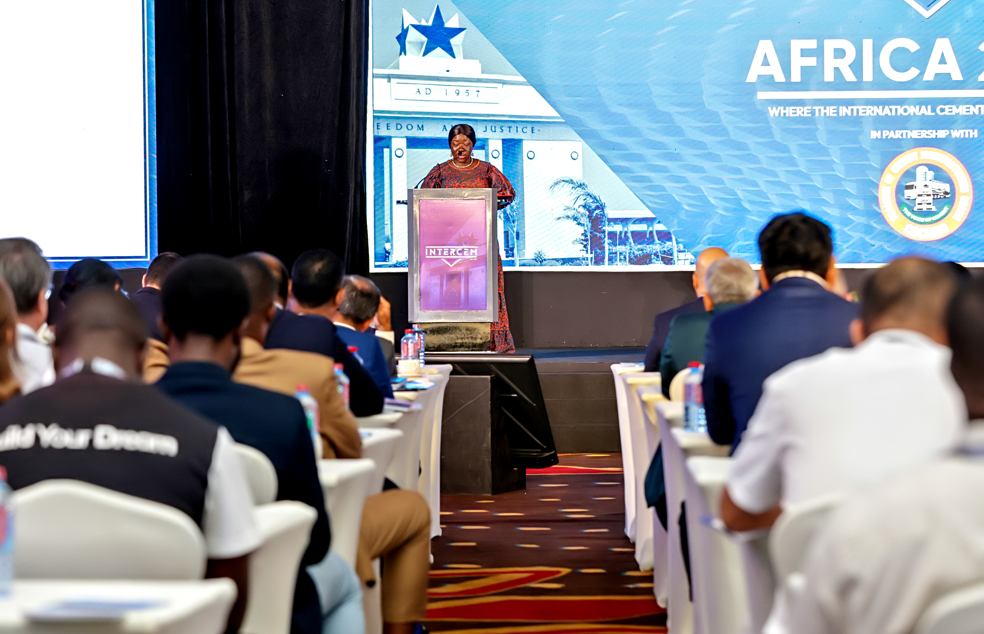
The INTERCEM Africa 2026 conference, organised in partnership with COCMAG and in collaboration with CBI Ghana and the LC3 Project, brought together more than 100 companies from about 40 countries.
The event provided a platform for cement producers, policymakers, investors and technology providers to discuss innovation, supply chains and the future of cement production in Africa.
Delivering the keynote address, Minister of Trade, Agribusiness and Industry, Elizabeth Ofosu-Adjare, backed the industry’s push for innovation and local raw material use.
“Our cement industry must become more affordable, accessible, and sustainable. We must reduce clinker imports and invest in local raw material production. The example set by CBI and Ghacem shows that this transformation is achievable,” she said.
Her comments place the issue squarely within Ghana’s broader industrial policy agenda.
The country’s infrastructure and industrialisation ambitions will continue to drive cement demand.
Roads, bridges, housing, industrial parks, ports, schools, hospitals and private real estate all depend on cement supply.
If the industry remains heavily import-dependent, rising costs and external shocks could affect construction costs and public infrastructure budgets.
A more localised and sustainable cement value chain could therefore support government’s wider development priorities.
The minister also noted that Ghana’s growing infrastructure and industrialisation agenda will continue to drive cement demand, making sustainability a priority.
That demand outlook is critical.
Ghana cannot reduce cement consumption given its infrastructure needs. The practical question is how to produce cement more efficiently, affordably and sustainably.
COCMAG’s proposal is that the answer lies in reducing clinker content and substituting more local materials such as clay and other suitable inputs.
Chief Executive Officer of COCMAG, Bishop Dr George Dawson-Ahmoah, said the conference was helping industry players share knowledge and adopt sustainable practices.
“This conference provides a valuable platform for innovation and collaboration. It is helping Ghana’s cement producers adopt more sustainable practices, including the use of clay and other local materials to reduce clinker dependency,” he said.
The reference to clay and local materials is particularly important because technologies such as limestone calcined clay cement have gained global attention as a route to lower-carbon cement.
Such approaches can reduce clinker use while maintaining product performance, provided quality standards are carefully maintained.
For Ghana, the opportunity is to build an industrial model that reduces import dependence, lowers carbon intensity and supports local resource use.
But the policy environment will matter.
Government may need to support research, standards development, investment incentives, certification systems and public procurement policies that encourage lower-clinker cement where appropriate.
Regulators will also need to ensure that innovation does not compromise construction safety.
The construction industry depends heavily on trust in cement quality. Any transition must therefore be guided by rigorous testing and transparent standards.
There is also a competitive issue.
If some producers invest in alternative systems while others continue to rely on imported clinker, market rules must ensure fair competition.
Policy support should encourage innovation without distorting the market or creating barriers for smaller producers.
The case made by COCMAG is ultimately about industrial resilience.
Ghana’s cement industry cannot control global fuel prices, shipping disruptions or external clinker markets.
But it can reduce exposure to those risks by changing how cement is produced locally.
The transition will require investment, collaboration and patience.
But if successful, it could reduce foreign exchange pressure, lower production costs, support sustainable construction and strengthen Ghana’s position in Africa’s building materials industry.
The cement sector is now being asked to move from import dependence to local innovation.
For a country seeking to industrialise and build at scale, that shift may be essential.

