

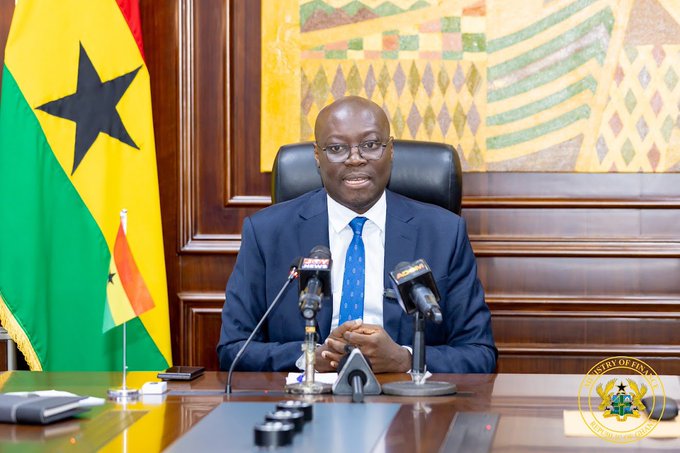

- Ato Forson Says Ghana Must Secure Fair Mining Returns as Perseus Pays US$35.00m Dividend
Ghana has received a US$35.00 million dividend, equivalent to about GH¢391.20 million, from Perseus Mining Ghana Limited, marking a sevenfold increase from the US$5.00 million paid to the state last year.
The payment represents the Government of Ghana’s 10.00% interest in the mining company and provides a significant boost to state revenues from the extractive sector at a time when government is seeking to maximise returns from the country’s natural resources.
Finance Minister Dr Cassiel Ato Forson, who received the dividend on behalf of government, said the sharp increase reflected Perseus Mining’s stronger profitability and demonstrated why Ghana must ensure that the state receives an appropriate share of the value generated from its mineral resources.
“Ghana must receive its fair share from the extractive sector,” Dr Forson said, linking the payment to the government’s broader approach to mining taxation and revenue sharing.
He said the government’s introduction of a sliding-scale system is intended to ensure that public revenues rise when mining companies benefit from stronger profitability and favourable market conditions.
The principle is straightforward: when commodity prices and mining profits increase, the fiscal benefits accruing to the state should also rise. For Ghana, which remains heavily dependent on extractive industries for export earnings and fiscal revenues, the effectiveness of that framework is central to determining how much value is retained domestically from the exploitation of finite mineral resources.
The increase in Perseus Mining’s dividend from US$5.00 million to US$35.00 million represents a 600.00% rise year-on-year. It also illustrates the potential value of the government’s carried interest in profitable mining companies, particularly during periods of strong commodity prices and improved operational performance.
Receiving the payment, Dr Forson reaffirmed the government’s commitment to securing greater value from the sector without undermining the stability and predictability required by long-term investors.
That balance remains one of the most important issues in Ghana’s mining policy. The government needs mining companies to continue investing in exploration, production and local infrastructure, but it must also ensure that the fiscal framework delivers adequate returns to the state and host communities.
Perseus Mining’s Board Chairman, Ehunabobrim Prah Agyensaim VI, attributed the higher dividend to strong company performance, prudent resource management and collaboration with the Government of Ghana.
The dividend forms only one part of the company’s fiscal contribution. As of June 30, 2026, Perseus Mining had paid approximately GH¢1.70 billion in royalties, GH¢4.20 billion in corporate income tax and the Growth and Sustainability Levy, and GH¢1.96 billion in PAYE and other statutory taxes.
Combined, those disclosed payments amount to about GH¢7.86 billion, excluding the latest GH¢391.20 million dividend and other potential payments not specified in the figures provided.
The scale of those contributions highlights the broader importance of mining to Ghana’s public finances. Beyond dividends attached to state equity interests, government revenues from the sector include royalties, corporate income taxes, employment-related taxes, levies and other statutory payments.
The challenge for policymakers is ensuring that strong mineral production and commodity prices translate into durable fiscal benefits rather than temporary windfalls.
That requires effective tax administration, transparent mineral agreements and close monitoring of production, costs, transfer pricing and export revenues. It also requires a fiscal regime capable of capturing additional value when profitability improves without creating such uncertainty that it discourages future capital investment.
The latest Perseus payment also gives renewed significance to the government’s sliding-scale approach. A progressive fiscal mechanism can allow the state to participate more strongly in periods of elevated profitability while providing investors with greater predictability about how additional returns will be shared.
For Ghana, this is particularly important because mineral resources are non-renewable. Once extracted and exported, the economic value can only be captured once, making the quality of taxation, royalties, dividends and domestic linkages central to whether mining ultimately strengthens the country’s long-term development position.
Perseus Mining also supports education, healthcare, infrastructure, skills development and local enterprise initiatives within its host communities. Such spending can deepen the local economic impact of mining, although community investment remains distinct from statutory taxes, royalties and dividends owed to the state.
That distinction is important when assessing the contribution of extractive companies. Corporate social investment can support development in mining communities, but it should complement rather than substitute for contractual and statutory fiscal obligations.
The sevenfold increase in the state’s dividend therefore provides a useful test of the wider proposition that Ghana should benefit more when mining companies perform strongly.
If similar improvements in profitability across the sector translate into higher royalties, taxes and dividends, the fiscal gains could provide additional resources for infrastructure, social spending and debt reduction.
But the longer-term objective must extend beyond collecting more revenue during strong commodity cycles. Ghana must also use mining income to build productive assets, support economic diversification and reduce the country’s dependence on the extraction and export of raw commodities.
The US$35.00 million Perseus Mining dividend is therefore significant both as a revenue payment and as a signal about the state’s approach to extracting greater value from its mineral endowment.
For government, the central policy test will be whether it can replicate that principle across the wider mining sector: maintaining an investment environment attractive enough to sustain production while ensuring that rising corporate profitability translates into a correspondingly stronger return for the Ghanaian public.

