- Government halts sachet water price hike and opens urgent talks with producers
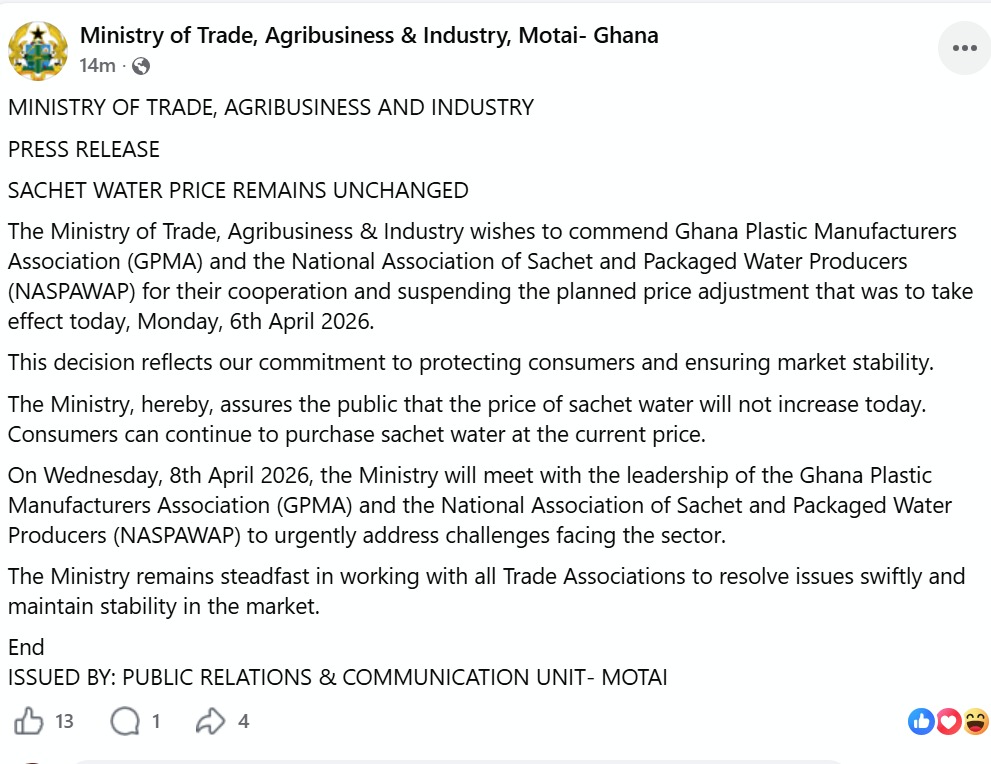
Ghana’s government has suspended a planned increase in the price of sachet water, stepping in at the last minute to keep prices unchanged on Monday, April 6, in a move aimed at shielding consumers from further cost-of-living pressure while opening urgent talks with industry players.
In a statement, the Ministry of Trade, Agribusiness and Industry said the price adjustment had been put on hold following engagement with the Ghana Plastic Manufacturers Association and the National Association of Sachet and Packaged Water Producers. The ministry said the decision reflected government’s intention to preserve market stability while protecting consumers.
“This decision reflects our commitment to protecting consumers and ensuring market stability. The price of sachet water will not increase today. Consumers can continue purchasing at current rates,” the ministry said.
The intervention is economically significant because sachet water, more commonly known as “pure water”, is not a discretionary consumer product in Ghana. It is a daily necessity for millions of households, particularly in urban and peri-urban communities where access to reliable pipe-borne water remains uneven or inadequate. That makes any price movement in the sector politically sensitive and economically visible far beyond the product itself.
Over time, sachet water has become woven into both Ghana’s informal and formal retail economies, sustaining thousands of producers, hawkers, distributors, and micro-retailers. A price increase, even if modest, tends to feed directly into household spending pressures while also rippling through the supply chain that surrounds one of the country’s most ubiquitous FMCG products.
The industry, however, is operating under mounting cost strain.
Producers have repeatedly complained about rising input prices, including the costs of plastic resin, packaging materials, energy, and transport. Currency movements and utility tariffs have also added pressure, tightening margins in a sector where consumer resistance to price increases remains high. The ministry did not outline the precise trigger for the proposed adjustment, but its acknowledgement of the challenges suggests it recognises that the issue is not simply one of pricing discretion, but of production viability.
That tension sits at the centre of the policy dilemma. On one hand, government is under pressure to prevent further increases in essential goods as households continue to adjust to a still-fragile cost environment. On the other, suppressing prices in the face of rising producer costs risks pushing strain deeper into local manufacturing and distribution.
The ministry said it will meet urgently with GPMA and NASPAWAP on Wednesday, April 8, to discuss the structural pressures affecting the industry and explore a way forward.
“The Ministry remains steadfast in working with all trade associations to resolve issues swiftly and maintain stability in the market,” the statement added.
That meeting will matter because the current intervention appears to be a pause rather than a resolution. The government has bought consumers some short-term relief, but it has not removed the cost dynamics facing producers. If those pressures remain unresolved, the risk is that today’s suspended increase simply becomes a larger confrontation later.
For investors and businesses, especially those in consumer goods and packaging, the episode is another reminder that Ghana’s inflation story is no longer only about broad macroeconomic indicators. It is increasingly about whether improvements at the top of the economy are filtering down into the cost structures of everyday essentials.
The sachet water dispute also highlights a deeper structural issue. In a country where clean drinking water should ideally be secured through dependable public infrastructure, the price of a plastic sachet has become a proxy for both urban household vulnerability and industrial stress. That is what makes this more than a narrow consumer story.