

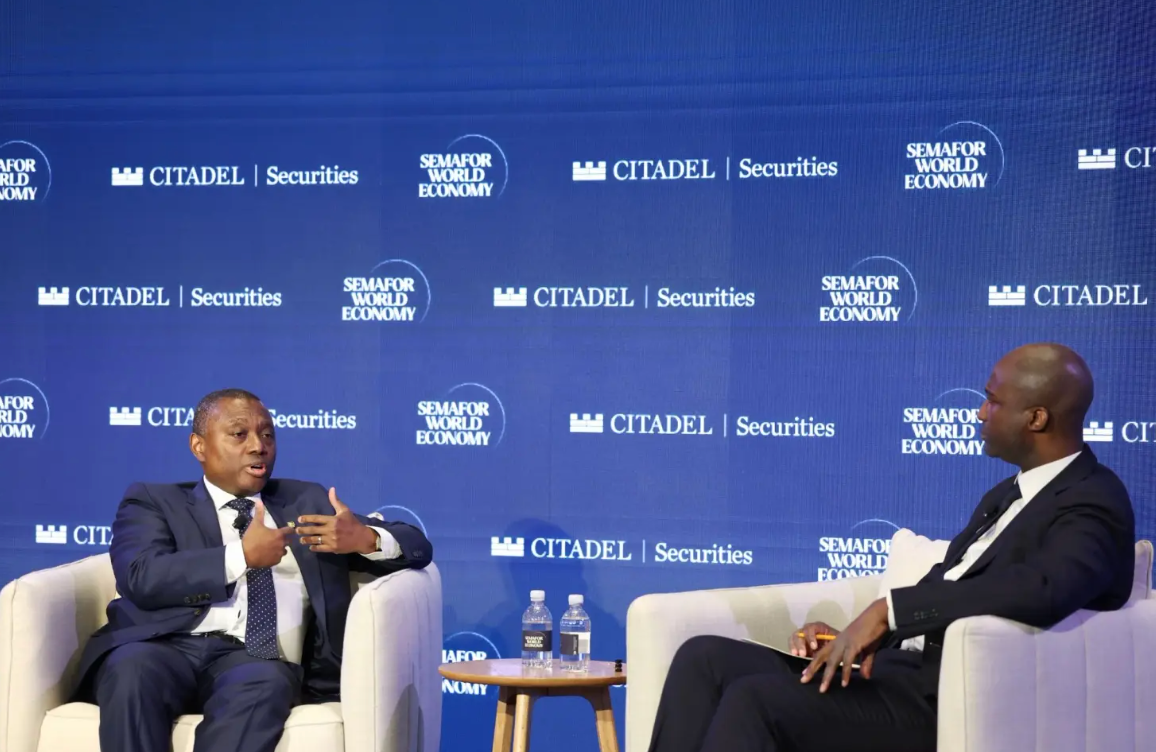

- Standard Bank chief says South Africa can reach 4% growth if reform drive holds
South Africa could raise its medium-term growth rate to as much as 4 per cent if the government sustains the pace of structural reform now beginning to take hold, according to Standard Bank Chief Executive Sim Tshabalala, in one of the clearest signals yet from corporate South Africa that the country’s long-stalled reform agenda may finally be starting to take effect.
Speaking at Semafor World Economy in Washington, DC on Wednesday, Tshabalala said South Africa had the potential to lift growth to between 3 and 4 per cent over the medium term, provided the state maintained faster execution across key bottleneck sectors and tackled what he described as the country’s most politically sensitive reform deficit: the rule of law.
His remarks will resonate across African policy and investor circles because they cut against the more familiar narrative of South Africa as a structurally constrained economy destined for low growth. Instead, Tshabalala’s message was that the country’s problem is no longer an absence of reform ideas but whether implementation can be sustained with enough speed and credibility to change the growth trajectory.
“The faster the government executes the reforms, the faster the country will grow,” he said.
That view reflects a growing conviction in business circles that South Africa’s reform cycle, long heavy on diagnosis and light on delivery, is beginning to show more practical traction. Tshabalala said early gains in energy, logistics, and water infrastructure were rooted in reforms designed by the reform acceleration unit created by the then African National Congress government in 2020, but argued that the current coalition administration had moved faster in execution.
He described the governing coalition anchored by the ANC, the Democratic Alliance, the Inkatha Freedom Party, and the Freedom Front Plus as a centrist arrangement that had preserved policy orthodoxy while improving delivery.
For markets, that formulation matters. Investors tend to respond not only to the content of reform but also to whether political coalitions are capable of carrying it through without destabilising the policy framework. Tshabalala’s assessment suggests that, at least from the perspective of one of Africa’s largest banking groups, South Africa’s coalition politics may be proving more economically functional than many had expected.
Still, he was careful to identify the country’s most urgent unresolved constraint.
“There’s a direct correlation between the rule of law and GDP growth,” Tshabalala said.
That warning lands at an awkward time for Pretoria. South Africa’s law-enforcement and accountability architecture is once again under sharp public scrutiny, with the Madlanga Commission examining systemic procurement failures and corruption in the police department. The hearings have already intensified concern that governance failures remain deeply embedded in parts of the state, even as economic reforms gather pace elsewhere.
The political backdrop has only sharpened that unease. Public attention has been drawn to the suspension of Police Minister Senzo Mchunu and criminal charges against National Police Commissioner Fannie Masemola, who is accused of obstructing investigations and enabling corrupt procurement schemes. At the same time, the Constitutional Court is expected to rule on whether lawmakers acted lawfully when they rejected an independent panel’s finding that President Cyril Ramaphosa may be cased to answer over the 2020 theft of foreign currency from his Phala Phala game farm.
Taken together, those developments reinforce Tshabalala’s point: South Africa may be making progress on economic reform, but its growth ceiling will remain constrained if institutional credibility and legal accountability continue to come under strain.
That tension is central to the investment case. Energy, freight logistics, and water reform can ease supply-side bottlenecks and improve operating conditions for businesses. But without stronger rule-of-law signals, the country may struggle to convert those gains into the deeper confidence needed to unlock faster capital formation and long-term expansion.
For now, Standard Bank is not changing its near-term view. Tshabalala said the bank had left its baseline forecast unchanged despite the Middle East war, which is putting pressure on energy markets and exposing fiscal vulnerabilities across sub-Saharan Africa. The lender still expects South Africa’s economy to grow by about 1.5 per cent this year.
That makes his medium-term optimism all the more notable. It suggests the bank sees today’s low growth not as the limit of the country’s potential, but as a temporary floor from which reform-led acceleration is possible.
Even so, the immediate macro picture remains difficult. Finance Minister Enoch Godongwana has already cut fuel taxes to ease the impact of rising oil prices, sacrificing revenue in the process, and has warned that the country’s budget assumptions are now under strain because of the war shock.
So, while Tshabalala’s 3-4 percent growth scenario offers a more hopeful narrative, it is also a conditional one. South Africa, in this telling, now has reform momentum. What it still lacks is the institutional certainty to make that momentum durable.

