- President Mahama names Fiscal Council members in push to rebuild credibility around Ghana’s public finances
President John Mahama has nominated five members to Ghana’s Fiscal Council, in a move that signals an effort to reinforce the institutional guardrails around public finance management as the country seeks to lock in fiscal discipline after years of debt distress and macroeconomic instability.
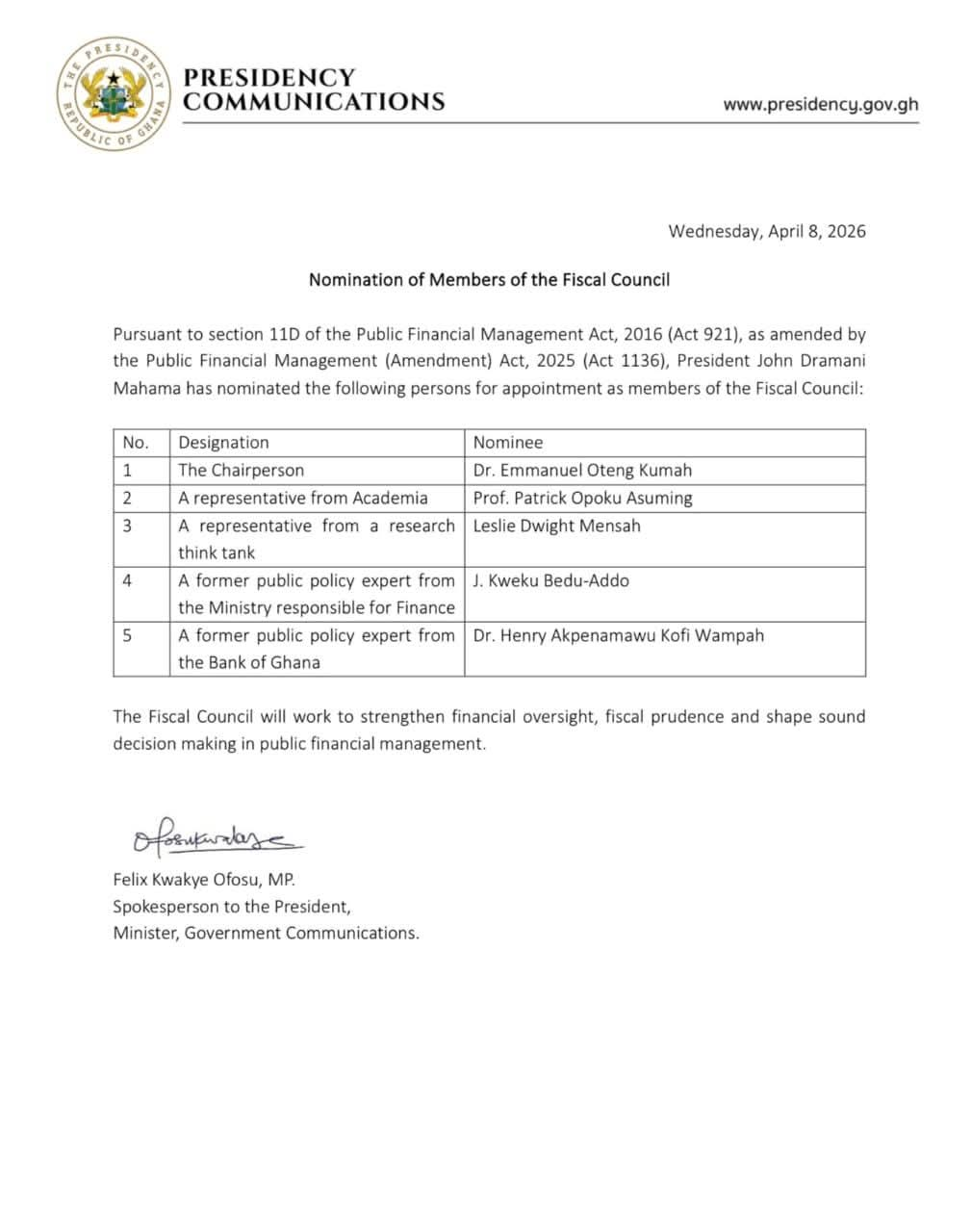
In a statement issued on Wednesday, April 8, the Presidency said the nominations were made pursuant to section 11D of the Public Financial Management Act, 2016 (Act 921), as amended by the Public Financial Management (Amendment) Act, 2025 (Act 1136). The Council, the statement said, “will work to strengthen financial oversight and fiscal prudence and shape sound decision-making in public financial management.”
The nominees are Dr Emmanuel Oteng Kumah as chairperson; Prof Patrick Opoku Asuming as a representative from academia; Leslie Dwight Mensah as a representative from a research think tank; I. Kweku Bedu-Addo as a former public policy expert from the ministry responsible for finance; and Dr Henry Akpenamawu Kofi Wampah as a former public policy expert from the Bank of Ghana.
At one level, the announcement is administrative. At another, it is a market signal.
Ghana’s fiscal story is no longer judged only by budget speeches and IMF programme benchmarks. It is increasingly judged by whether the institutions meant to impose discipline are credible, technically competent, and capable of shaping decision-making before fiscal slippage becomes politically convenient. In that sense, the composition of the Fiscal Council matters because it sits at the intersection of policy credibility and investor confidence.
The mix of appointments appears designed to project exactly that. The inclusion of figures with backgrounds in academia, central banking, research, and fiscal policy suggests that the administration wants the Council to be seen not merely as a statutory formality but as a technocratic body with enough intellectual weight to influence debate around spending, borrowing, and budget execution.
That matters in Ghana’s current macroeconomic setting. The country has made visible progress in stabilising inflation, restoring a measure of exchange-rate calm, and restructuring debt. But markets have learned, not just in Ghana but across emerging economies, that recovery can be undone as easily by weak institutions as by adverse shocks. The existence of fiscal rules is not enough. What matters is whether there are credible actors willing and able to insist that the rules mean something.
The nomination of Dr Henry Kofi Wampah, a former Bank of Ghana governor, is particularly notable in that regard. It brings to the Council a figure associated with macro-financial oversight and could be read as an attempt to ensure that fiscal choices are viewed not in isolation but through their consequences for liquidity, inflation, debt dynamics, and market confidence. The presence of Prof. Patrick Opoku Asuming and Leslie Dwight Mensah also points to an effort to connect the Council’s work to research and evidence rather than purely administrative judgement.
The more thought-provoking question, however, is not who has been nominated. It is how much room the Council will be given to matter.
Fiscal councils are most useful when they do more than validate official optimism. Their real value lies in restraint: forcing uncomfortable questions about deficits, revenue assumptions, expenditure quality, and debt sustainability before pressures become crises. In countries with fragile fiscal histories, their relevance depends on whether they can challenge rather than merely endorse.
That is why the Mahama administration’s next test will not be the announcement itself but the operational seriousness that follows. Will the Council issue rigorous assessments? Will its advice shape policy timing and budget choices? Will it become part of how Ghana’s fiscal credibility is rebuilt, or simply part of how it is narrated?
For investors and policy watchers, the creation or revival of such bodies often matters less for what they do immediately than for what they imply about policy direction. In Ghana’s case, these nominations suggest an awareness that the country’s fiscal recovery needs deeper institutional backing if it is to outlast short-term political cycles.
The broader message from the Presidency’s statement is therefore clear enough: fiscal prudence is being framed not only as a programme requirement but as a governance priority. The harder part will be proving that institutional oversight can remain firm when the politics of spending become more demanding.