


- Two New Airlines Could Enter Ghana’s Domestic Market By 2027 — GCAA
At least two new airlines could enter Ghana’s domestic aviation market by 2027, potentially doubling the number of active operators and increasing pressure on carriers to improve service and reduce fares.
Stephen Wilfred Arthur, Director-General of the Ghana Civil Aviation Authority, said the prospective operators were proceeding through the regulator’s five-phase certification process.
“We still have that hope that those currently going through the five phases of certification could be completed on time for them to join the current operators,” he said.
“We are hopeful when all these players come on board, that could go a long way to reduce fares and bring on board the required options for consumers within Ghana.”
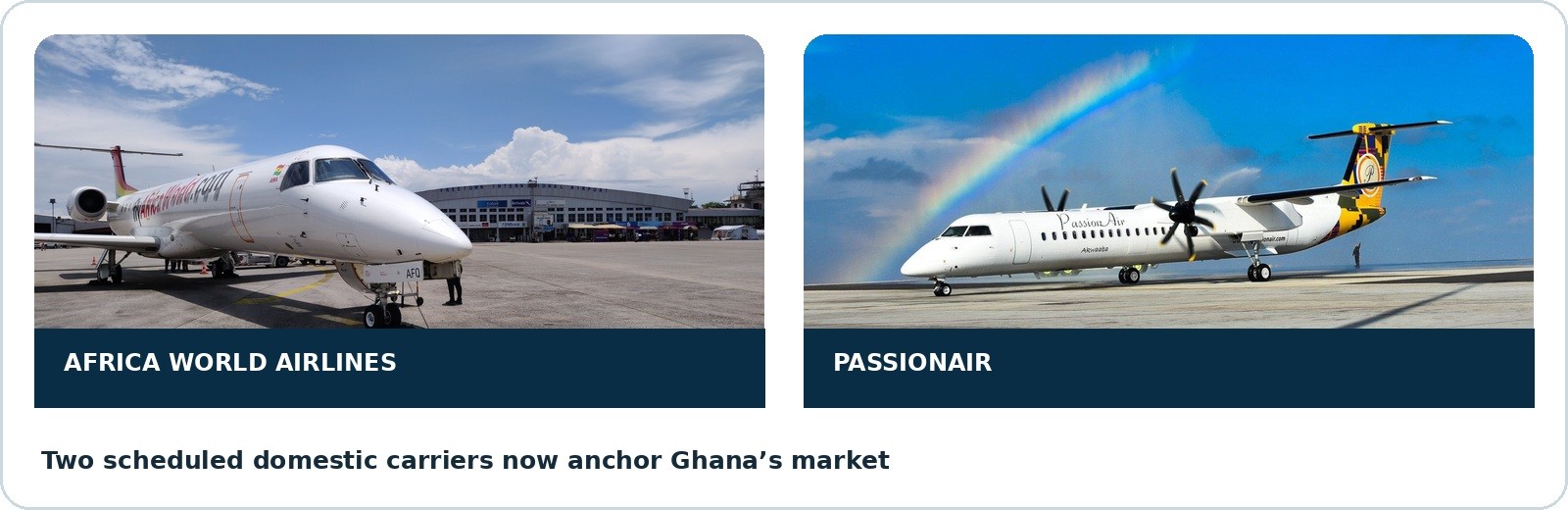
Ghana’s domestic market currently has two operating airlines, down from about five in an earlier period.
The possible arrival of two carriers could restore some of the competition lost through previous airline failures. It would also increase the number of seats available to passengers and potentially strengthen connections between Accra and regional capitals.
But the entry of additional airlines will not by itself guarantee cheaper or more reliable travel.
The decisive question is whether Ghana’s passenger market is large enough to support four financially sustainable operators after accounting for high fuel costs, dollar-denominated aircraft leases, maintenance expenses and relatively low household purchasing power.
Prospective airlines must complete the GCAA’s certification process before beginning commercial operations.
The process is designed to determine whether an applicant has the management competence, financial resources, technical systems, aircraft arrangements, qualified personnel and safety procedures required to operate.
A new carrier may announce an intended launch date, acquire aircraft or begin recruiting employees, but it cannot lawfully transport passengers until the regulator is satisfied that it has met the applicable requirements.
The GCAA’s expectation that at least two applicants could complete certification by 2027 is therefore not a guarantee that both will begin operations within that period.
Their entry remains subject to their ability to satisfy each phase of the process and address any deficiencies identified by the regulator.
Rev Arthur said the authority was seeking to attract operators without weakening safety requirements.
“We are very much open, and we create a level playing field for all prospective applicants or airlines, without any discrimination, whether you are from here or from there,” he said.
“At all times we will never compromise on safety and security just for the sake of injecting the space with more players.”
That position is important because the pressure to reduce fares and make better use of regional airports could create demands for faster approvals.
In aviation, however, delays in certification can sometimes reflect unresolved questions about financing, staffing, aircraft suitability or operational preparedness. Compressing the process for economic reasons would transfer risk from investors to passengers.
Ghana’s domestic aviation market is concentrated around a small number of routes connecting Accra with Kumasi, Tamale, Takoradi and Wa.
Where only a limited number of airlines operate, passengers may face fewer departure times, reduced flexibility and higher prices, particularly when demand rises around holidays and major events.
Additional operators could increase seat capacity and force airlines to compete more aggressively on fares, punctuality and customer service.
“One of the cardinal factors to consider is to inject competition,” Rev Arthur said.
“When there are more players in the industry, or more airlines in the air transport space, definitely there will be more seats by way of capacity.”
More seats can lower fares if capacity grows faster than passenger demand and airlines compete to fill aircraft.
But that same dynamic can create financial instability if carriers engage in unsustainable price competition.
Airlines have significant fixed costs. Aircraft leases, insurance, technical support and employee expenses must be paid even when planes are not full. An operator may therefore increase flights and cut fares to gain market share but still lose money on each service.
Ghana’s previous experience with airline exits shows that early competition can be followed by rapid consolidation when operators lack adequate capital or encounter governance problems.
Rev Arthur identified undercapitalisation, boardroom disputes, corporate-governance weaknesses and aviation-fuel costs among the reasons some domestic airlines had failed.
This means Ghana needs more than additional airline licences. It needs carriers with sufficient capital to withstand disruptions, exchange-rate movements and periods of weak demand.
The economic case for new airlines depends partly on whether lower fares can draw more passengers into the market.
“The market certainly is there, and that is why it is important for us to stimulate the market with healthy competition,” Rev Arthur said.
Domestic aviation competes not only among airlines but also with road transport.
A passenger travelling between Accra and Kumasi must weigh the shorter flight time against the cost of the ticket, travel to and from the airport, check-in requirements and possible delays.
If competition lowers fares materially, air travel could become attractive to a larger segment of business travellers, public-sector workers, tourists and households.
That would increase passenger numbers rather than merely dividing the existing market among more operators.
The extent of such demand growth will determine whether four airlines can operate sustainably. If the passenger base remains broadly unchanged, additional capacity may place severe pressure on airline margins.
The country’s airports also need adequate ground transport, reliable schedules and commercial activity around them if infrastructure investment is to generate broader economic returns.
“We are also working to improve the economy around this aviation infrastructure that government is building in the country,” Rev Arthur said.
“We cannot develop all these infrastructures and at the end of the day it is very difficult for people to fly in the country.”
The government has removed duties and taxes on spare parts for domestic airlines as part of measures intended to reduce operating expenses.
The intervention could lower aircraft-maintenance costs and help operators keep more of their fleets serviceable.
But aviation costs remain heavily influenced by fuel, leasing expenses, insurance, maintenance contracts and the exchange rate.
“We are very much proud of the recent withdrawal of the import duties on aircraft spares and the like by the government,” Rev Arthur said.
“We do appreciate that it is not the only reason. They have fuel, they have the leasing cost.”
Many of these obligations are priced in foreign currency, while domestic airlines earn most of their revenue in cedis. Currency depreciation can consequently raise costs even when passenger demand remains stable.
The tax relief could improve airline economics at the margin, but sustained fare reductions will require a combination of lower costs, stronger passenger volumes and improved aircraft utilisation.
The GCAA does not directly set commercial ticket prices. Rev Arthur said the regulator expected competition and market forces to exert downward pressure on fares.
That expectation will be tested if the prospective airlines complete certification.
Their arrival could mark an important expansion of Ghana’s domestic aviation market. But the meaningful measure of success will not be the number of carriers launched in 2027.
It will be whether those airlines can remain safe, solvent and reliable while expanding the number of Ghanaians able to travel by air.

