


- BoG Prepares Tighter Credit and Liquidity Rules as Private-Sector Lending Surges 35.5%
The Bank of Ghana is preparing tighter credit-risk and liquidity requirements for commercial banks as a sharp recovery in private-sector lending raises the need to prevent easier financial conditions from creating new vulnerabilities.
Private-sector credit grew by 35.5 per cent in August 2026, more than double the 13.3 per cent recorded a year earlier, according to Governor Dr Johnson Pandit Asiama.
In real terms, credit growth accelerated to 29 per cent from just 1.7 per cent over the same period in 2025, pointing to a significant improvement in the flow of bank financing to households and businesses.
The expansion has been supported by a decline in the banking sector’s average lending rate to 15.9 per cent in August, from 24.2 per cent a year earlier, alongside stronger credit demand and an easing in banks’ lending stance.
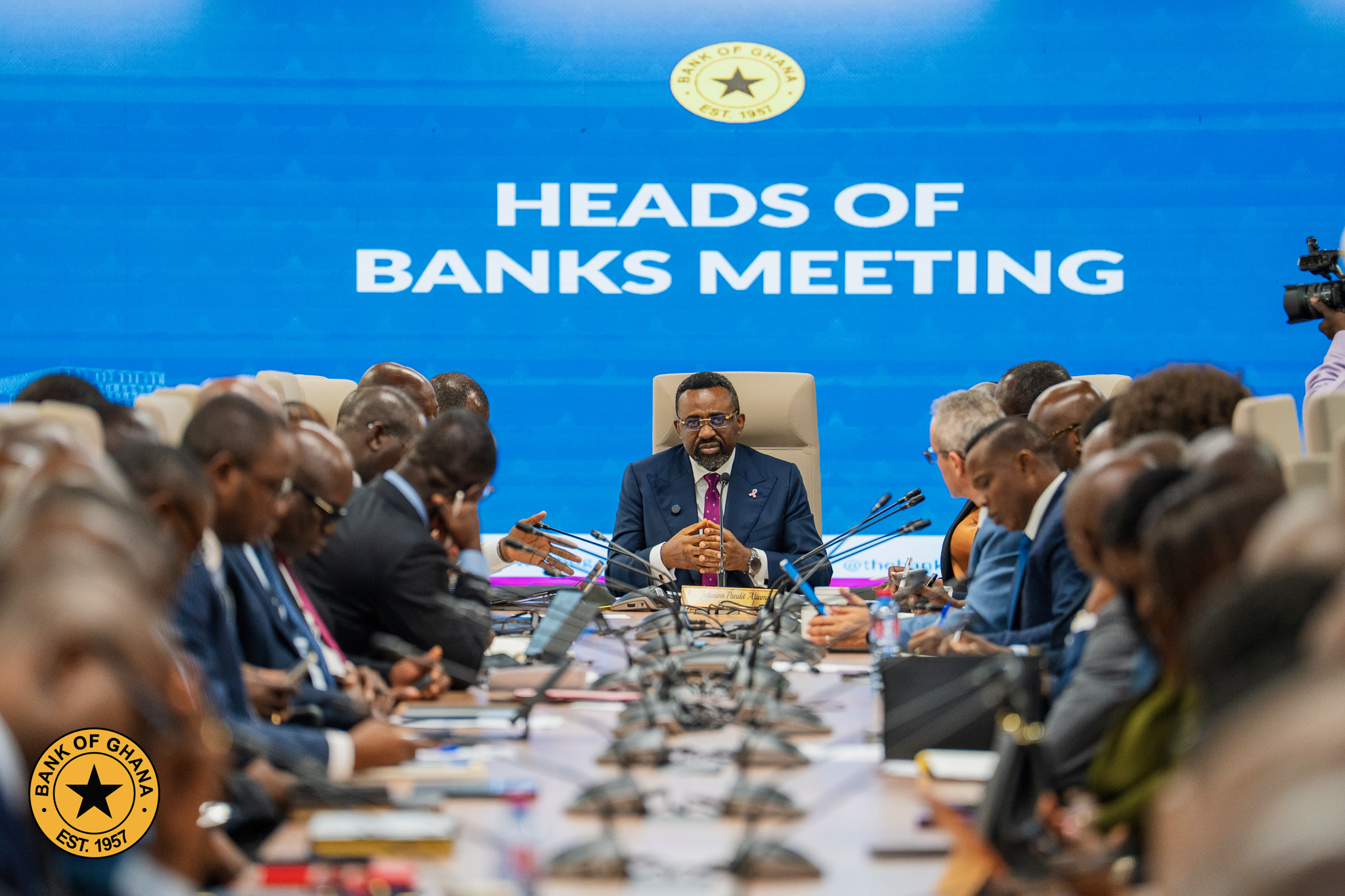
Speaking at a post-Monetary Policy Committee engagement with heads of banks on Tuesday, Dr Asiama said the recovery was supporting economic activity but cautioned that rapid lending growth must be matched by sound underwriting and risk management.
“As private-sector credit expands rapidly, this growth must be supported by sound underwriting standards and effective risk-management frameworks,” he said.
The warning reflects a central challenge facing the banking industry. Lower interest rates and stronger credit growth can stimulate investment and economic activity, but the benefits could prove temporary if banks weaken lending standards and generate a new cycle of non-performing loans.
Although the industry’s non-performing loan ratio has declined significantly, the Governor said it remained above regulatory thresholds.
Banks would therefore be required to strengthen credit-risk management and comply fully with the central bank’s guidelines on non-performing loans.
The Bank of Ghana will shortly issue a Credit Risk Management Directive to complement the NPL Notice introduced in 2025.
The directive will cover the full credit cycle, including loan origination, administration, monitoring, risk measurement and recovery.
Its timing is significant. Ghana’s banking industry is moving from a period characterised by high interest rates, weak credit demand and balance-sheet repair into one of faster lending and declining financing costs.
Without stronger controls, the same conditions supporting the credit recovery could encourage aggressive loan expansion, inadequate borrower assessment and the underpricing of risk.
The proposed directive suggests the regulator wants to ensure that the current rebound produces sustainable financing rather than a delayed deterioration in banks’ asset quality.
The central bank is also engaging banks on the results of macroprudential stress tests conducted under severe but plausible economic and financial scenarios.
Dr Asiama urged institutions to address the vulnerabilities identified by the exercise, stressing that the central bank’s assessment did not replace banks’ responsibility to conduct their own stress tests.
The Bank will also introduce a Liquidity Coverage Ratio Directive, establishing what Dr Asiama described as the first prudential benchmark for banking-sector liquidity.
Under the framework, banks will be required to hold sufficient high-quality liquid assets to survive a severe liquidity stress period lasting 30 days.
The proposed rule will complement the Liquidity Risk Management and Liquidity Monitoring Tools directives issued earlier in 2026.
The framework would strengthen the regulator’s ability to assess whether banks hold genuinely usable liquid resources rather than assets that may become difficult to sell or pledge during market stress.
Liquidity risks can emerge even in apparently well-capitalised banks when deposit withdrawals, market disruptions or payment obligations create a sudden demand for cash. The 30-day requirement is intended to provide a buffer while institutions and regulators respond to such stress.
The regulatory measures come as the Bank of Ghana maintains the monetary policy rate at 14 per cent.
Dr Asiama said the MPC’s unanimous decision reflected broadly balanced risks to inflation and economic growth.
Headline inflation increased from 4.6 per cent in July to 5 per cent in August, driven by utility-tariff adjustments and elevated crude oil prices.
Inflation nevertheless remained below the lower boundary of the central bank’s medium-term target of 8 per cent, plus or minus 2 percentage points. Core inflation and inflation expectations also continued to moderate.
The decision to hold the rate rather than reduce it further indicates that the central bank is unwilling to respond to low headline inflation without considering emerging external and domestic risks.
Several major central banks have adopted more cautious positions, with some beginning to raise rates in response to persistent geopolitical tensions, elevated energy costs and uncertain trade conditions.
Higher international rates could increase global yields and tighten financing conditions for frontier economies such as Ghana.
The possibility of a strong El Niño event later in 2026 also presents risks to food production and inflation.
On the domestic side, GDP expanded by 6 per cent in the second quarter, compared with 6.6 per cent during the corresponding period of 2025. Services and industry were the principal drivers, while consumer and business confidence remained positive.
These conditions reduced the urgency for additional monetary stimulus, particularly when lending rates and private credit were already responding strongly to the earlier easing cycle.
Ghana’s external sector continued to provide a buffer against global uncertainty.
The trade surplus widened to US$8.85bn during the first eight months of 2026 from US$6.69bn in the corresponding period of 2025.
Gross international reserves stood at US$12bn as of September 22, equivalent to 4.5 months of import cover.
Dr Asiama attributed the reserve support partly to stronger gold-export receipts, although he acknowledged that external-sector payments remained elevated.
The distinction is important because strong export earnings do not automatically translate into sustained reserve accumulation when debt payments, energy imports and foreign-exchange interventions remain high.
The Governor also ordered banks to give their fraud-management functions direct and unrestricted access to managing directors or chief executives.
The directive follows concerns raised by the Ghana Association of Banks about the inconsistent organisational placement of fraud functions across institutions.
“Fraud is a significant risk that requires our serious attention,” Dr Asiama said.
He urged banks to establish effective controls to prevent, identify and deter fraud while ensuring that responsible personnel possess the necessary technical competence and professional certifications.
Giving the function direct access to senior management is intended to protect its independence and prevent commercially sensitive fraud concerns from being suppressed within other operational departments.
The central bank is consolidating the operational notices and guidelines issued under the Foreign Exchange Act into a single compendium.
The document will clarify requirements governing foreign-currency accounts, international transfers and trade payments.
Dr Asiama said compliance with foreign-exchange rules remained “non-negotiable”, directing banks to maintain appropriate documentation and internal controls and ensure that foreign currency is used for its declared purpose.
The intervention comes as pressure on the cedi and elevated corporate demand for dollars increase scrutiny of how foreign exchange moves through the banking system.
The Bank of Ghana is also increasing its focus on cyber, technology and fintech-related risks.
It is working with the industry to implement the Cyber and Information Security Directive while strengthening supervisory expectations concerning third-party risks and the protection of customer funds.
Further guidance is being developed on the governance and operational independence of payment service providers operating within corporate groups, as well as the responsible use of artificial intelligence in finance.
The Bank will also intensify action against illegal digital-credit providers and review the resilience of the mobile-money and digital-payments ecosystem.
Separately, the central bank and Ministry of Finance have formally launched a National Remittance and Diaspora Savings Strategy intended to convert a greater share of remittance inflows into investment.
The strategy is expected to be completed within nine months, with full implementation scheduled to begin in the first quarter of 2027.
Dr Asiama said banks would play an important role in its design and execution.
The Governor’s message to the industry was therefore two-sided: banks are being encouraged to expand credit, support investment and participate in financial innovation, but the freedom to grow will come with stronger prudential expectations.
Ghana’s credit recovery is a positive signal for businesses emerging from years of expensive financing. The durability of that recovery, however, will depend on whether banks can expand their loan books without rebuilding the asset-quality, liquidity and governance risks the sector has spent years trying to correct.

