

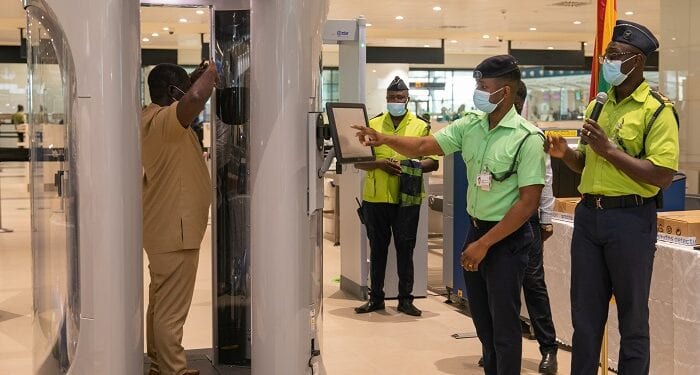

- Accra Airport Upgrades Screening Systems to Cut Passenger Delays
Ghana has taken another step in its airport modernisation drive with the deployment of advanced security screening technology at Terminals 2 and 3 of the Accra International Airport, as the country seeks to improve passenger processing, strengthen aviation security and enhance its competitiveness as a regional air transport hub.
The Ghana Airports Company Limited has introduced next-generation computed tomography screening systems capable of producing high-resolution three-dimensional images of cabin baggage. The technology is expected to improve the ability of security personnel to detect prohibited items while reducing the need for manual inspection of passengers’ hand luggage.
Under the new system, passengers will no longer be required to remove laptops, tablets and liquids from their bags during security checks. This is expected to shorten screening times, reduce congestion and improve the overall passenger experience at Ghana’s main international airport.
The deployment comes at a time when aviation hubs across Africa are investing in technology, infrastructure and passenger services to attract airlines, improve connectivity and support tourism and trade. For Ghana, the investment is part of a broader effort to align airport operations with evolving global aviation safety and security standards while improving efficiency at one of the country’s most important gateways.
Efficient airport processing has become an important measure of aviation competitiveness. Long queues, repeated manual checks and slow passenger flow can affect traveller experience and airline operations. By adopting CT screening systems, GACL is seeking to reduce friction in the passenger journey while maintaining stronger security controls.
The economic significance of the upgrade goes beyond convenience for travellers. Faster passenger processing can increase terminal efficiency, reduce bottlenecks during peak travel periods and support higher passenger throughput. For airlines, smoother security procedures can contribute to better turnaround planning and more predictable airport operations.
This matters as Ghana continues to position Accra as a preferred aviation gateway in West Africa. Accra International Airport plays a central role in connecting Ghana to regional, continental and international markets. Its efficiency has direct implications for tourism, business travel, cargo movement, investment promotion and the country’s wider services economy.
The airport’s role has also become more important under the African Continental Free Trade Area framework, with Ghana hosting the AfCFTA Secretariat and seeking to strengthen its position as a commercial and logistical hub. Improved airport infrastructure can support this ambition by making Accra more attractive for regional connectivity, conferences, trade missions and corporate travel.
GACL said the deployment forms part of its continuing airport modernisation programme, which combines advanced security technology with operational efficiency while ensuring compliance with international safety requirements.
The new technology also reflects a broader shift in global aviation security. Airports are increasingly moving towards smarter screening systems that rely on advanced imaging, automated detection and risk-based passenger processing. These systems are designed to improve both safety and speed, allowing airports to handle rising passenger volumes without compromising security.
For passengers, the most immediate benefit will be convenience. The ability to keep laptops, tablets and liquids inside hand luggage should reduce delays at checkpoints and make the security process less stressful. This is particularly important for business travellers, families, tourists and transit passengers who expect airports to deliver faster and more predictable service.
For Ghana’s aviation authorities, the investment signals a commitment to maintaining Kotoka International Airport’s relevance in a competitive regional environment. Airports in countries such as Ethiopia, Kenya, Rwanda, Nigeria and Côte d’Ivoire are all positioning themselves as major aviation nodes, with competition increasingly shaped by infrastructure quality, airline partnerships, operational reliability and passenger experience.
The deployment of CT screening systems therefore strengthens Ghana’s aviation value proposition. It shows that airport competitiveness is no longer determined only by runway capacity, terminal buildings or airline routes. It is also shaped by the quality of security processing, the use of technology and the ability to deliver a seamless travel experience.
The investment is also likely to support confidence among international airlines and passengers. Modern screening systems help demonstrate that Ghana is keeping pace with global aviation standards and is prepared to manage security risks using advanced tools.
However, the full benefit of the technology will depend on implementation. Modern equipment must be supported by well-trained personnel, proper maintenance, clear passenger communication and efficient checkpoint management. If these elements are aligned, the system could significantly improve passenger flow at Kotoka.
The upgrade also reinforces the importance of infrastructure-led competitiveness in Ghana’s broader economic strategy. Airports are not merely transport facilities. They are economic assets that influence trade, tourism, investment, diplomacy and national image.
By investing in smart airport security, Ghana is seeking to protect passengers, improve efficiency and strengthen the country’s position in the regional aviation market.
The message from the latest deployment is clear: aviation competitiveness now depends as much on technology and passenger experience as it does on physical infrastructure. For Ghana, modernising Accra International Airport is not only about improving security. It is about making the country easier to access, easier to do business with and more attractive as a gateway to West Africa.

