

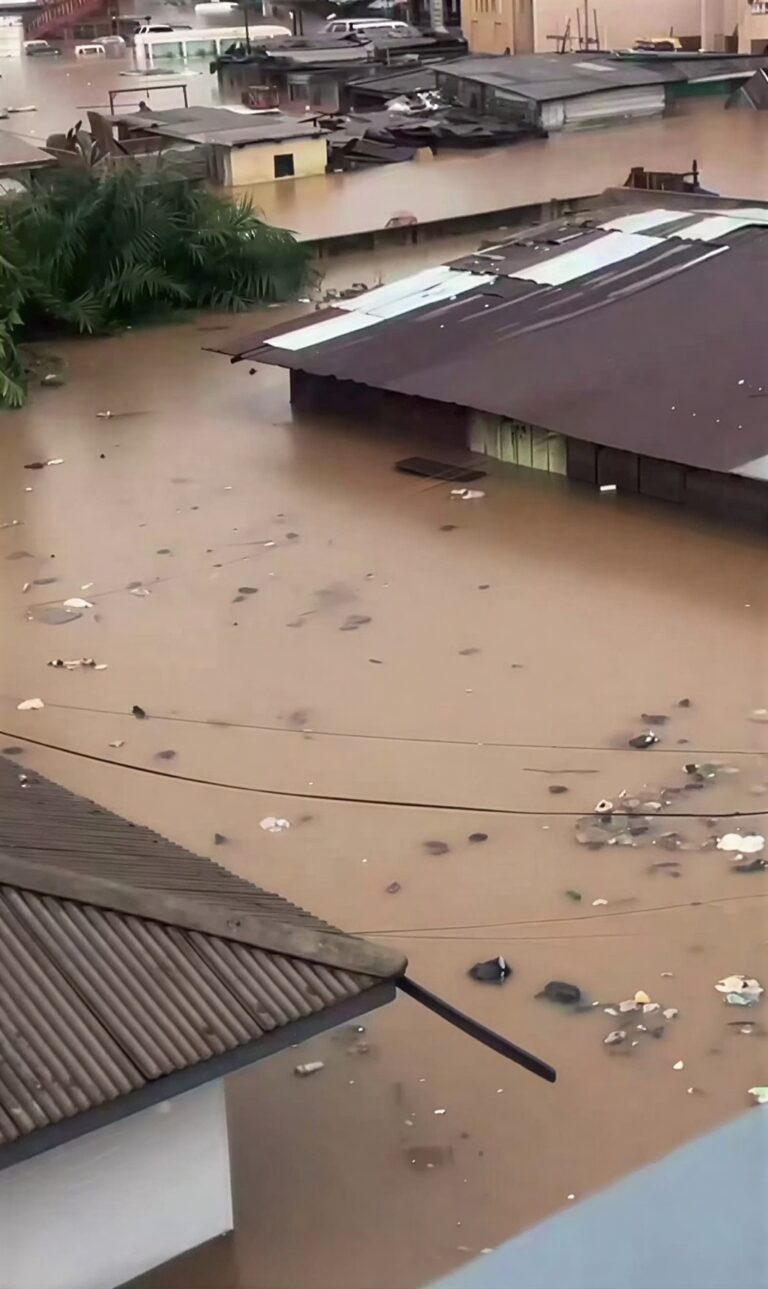

- Accra Floods Could Trigger GHS 500m Insurance Claims as Rains Expose Ghana’s Protection Gap
The floodwaters that swept through parts of Accra from Sunday night into Monday morning may disappear from the roads within hours, but for Ghana’s insurance industry, the real reckoning is only beginning.
Behind the dramatic images of submerged cars, flooded shops, soaked homes, stranded commuters and waterlogged roads lies a quieter financial question: how much of the destruction will end up on the books of insurance companies, and how much will remain another private tragedy for households and businesses that were never insured in the first place?
The answer may define one of the most important tests for Ghana’s non-life insurance industry this year.
Heavy rains that began late on Sunday, June 28, and continued into the morning of Monday, June 29, triggered flooding across parts of Accra, submerging roads, slowing traffic and forcing some motorists to abandon routes. Low-lying areas and key arterial roads were among the hardest hit, with floodwaters disrupting the Monday morning commute and exposing, once again, the capital’s chronic vulnerability to intense rainfall.
For insurers, the first wave of claims is likely to come from motor policies.
Flooded engines, damaged electronic control units, soaked interiors, contaminated fuel systems, damaged gearboxes and water-damaged wiring can be expensive to repair. Modern vehicles are more electronic than mechanical, meaning even moderate flood exposure can turn a repair bill into a near-total loss.
But not every motor policy will respond. In Ghana, many vehicle owners carry only compulsory third-party cover. That protects against liability to others, not the owner’s own flood-damaged car. The policies that matter in this case are comprehensive motor policies and, depending on wording, policies that do not exclude flood, storm or water ingress.
That means the number of damaged vehicles visible on social media will almost certainly be higher than the number of payable claims.
This is Ghana’s protection gap in plain sight.
Let’s work with some moderate estimates we at NorvanReports want to work with to help explain the situation for you reading this article to understand the situation the insurance firms or industry have at hand.
So now let’s say if 1,000 vehicles suffered some level of flood damage during the latest Accra event, but only 35.00% to 45.00% had comprehensive cover capable of responding to flood-related damage, insurers may see 350 to 450 valid motor claims. If the average settlement ranges between GHS 25,000.00 and GHS 65,000.00, depending on vehicle type and damage severity, motor claims alone could fall between GHS 8.75 million and GHS 29.25 million.
A more severe scenario is possible. If the number of affected insured vehicles rises to 800 or more, and if a meaningful number of high-value SUVs, commercial vehicles, ride-hailing cars and company fleets are involved, motor-related insured losses could easily move toward GHS 50.00 million.
The bigger exposure, however, may not be motor. It may be shops, warehouses, offices, workshops, clinics, pharmacies, supermarkets, market stalls, fuel stations, small factories and residential properties that took in water overnight.
For commercial property owners, losses can include damaged stock, soaked furniture, destroyed electrical fittings, damaged refrigerators, spoiled goods, computer equipment, generators, signage, documents and structural repairs. For some businesses, the more painful loss may be business interruption: the days or weeks of lost sales after the water recedes.
Again, policy wording will matter. A standard fire policy may not automatically cover flood unless special perils, storm and flood extensions have been purchased. A shop owner who bought basic cover may discover that flood damage is excluded. A business that bought property cover but not business interruption cover may receive payment for damaged assets but nothing for lost income.
This is where the insurance conversation becomes uncomfortable. Ghana’s insurance industry has grown stronger on paper, but the country remains severely underinsured where disaster risk is concerned. The formal insurance sector is still small relative to the size of the economy, and many households and micro-businesses in flood-prone areas have no meaningful risk transfer at all.
The 2025 Financial Stability Review shows an industry that is improving but still structurally limited. Ghana’s insurance industry assets stood at GHS 21.90 billion at the end of 2025, representing only 3.40% of total financial system assets. Non-life insurance revenue rose to GHS 6.00 billion in 2025, while non-life insurers recorded insurance service results of GHS 1.49 billion. The sector’s capital position was also strong, with non-life insurers recording an average capital adequacy ratio of 356.00%, far above the statutory minimum of 150.00%.
Those figures suggest the industry is not weak. But floods test insurers differently from ordinary claims.
A road accident affects one policy. A building fire affects one insured. A flood affects many policyholders at once. It clusters claims by geography and by event. It hits motor, property, engineering, stock, contents and business interruption lines simultaneously. It also creates pressure on claims departments, loss adjusters, assessors, reinsurers and customer service teams at the same time.
That is why the Accra floods are not just another weather story. They are a climate-related underwriting event.
A reasonable working estimate is that the June 29 Accra flood event could produce gross insured claim notifications of between GHS 150.00 million and GHS 500.00 million across motor, commercial property, residential property, stock and business interruption, depending on the final count of insured vehicles and businesses.
This is not an official industry figure. It is an analytical projection based on likely claim categories, average settlement bands, visible scale of damage and the concentration of high-value commercial and residential assets in Accra.
At the lower end, GHS 150.00 million would represent about 2.50% of Ghana’s 2025 non-life insurance revenue and about 10.07% of the 2025 non-life insurance service result. At the upper end, GHS 500.00 million would represent about 8.33% of non-life insurance revenue and 33.56% of the sector’s 2025 underwriting result.
If further heavy rains over the coming days trigger repeat flooding in the same catchment areas, claim notifications could rise beyond GHS 700.00 million, particularly if warehouses, fleet vehicles, fuel stations, supermarkets and large retail outlets are affected. At that level, the event would begin to look less like a normal claims spike and more like a sector-wide earnings shock.
Reinsurance will soften the blow for some insurers, especially those with well-structured catastrophe, property and treaty arrangements. But reinsurance is not free protection. A high claims year affects future pricing, renewal negotiations, retention levels and reinsurer appetite. Insurers with weaker risk selection or heavy exposure to flood-prone properties may face tougher treaty terms next year.
The immediate impact will fall unevenly. Large composite and non-life insurers with diversified portfolios, strong reinsurance and better capital buffers will absorb the shock more comfortably. Smaller insurers with concentrated exposure to motor, fire and commercial property in Accra may feel sharper pressure, especially if multiple mid-sized claims arrive at once.
Loss adjusters will also become central players. Insurers must distinguish between genuine flood damage, pre-existing defects, poor maintenance, underinsurance, exaggerated stock values and claims that fall outside policy terms. That process can create disputes, especially where customers believe “insurance” should automatically mean payment.
The industry must therefore communicate clearly. Policyholders need to know whether their cover includes flood. They need to report losses quickly, take photographs, preserve evidence, avoid moving damaged items without documentation where possible, and prevent further loss. Vehicle owners should not attempt to start engines that have taken in water, because that can worsen damage and complicate claims.
For shop owners, documentation will be decisive. Stock records, invoices, photographs, inventory books, sales records and policy schedules will determine whether claims are processed smoothly or delayed.
This is where many small businesses may suffer twice. They may have lost stock to floodwaters, but also lack the documentation required to prove the size of the loss. In the informal economy, where records are weak and insurance uptake is low, floods become not only a physical disaster but a financial exclusion event.
The government’s own disaster-risk financing gap is also being exposed.
A sovereign parametric flood insurance solution for the Greater Accra Metropolitan Area has reportedly been technically completed, with products such as an Excess Rainfall Cover and a Flood Footprint Product designed to trigger faster payouts for emergency response. But the scheme has not gone live, with government approval and premium arrangements still pending. That means the June 2026 floods occurred without the automatic financial safety net the scheme was meant to provide.
Parametric insurance does not wait for every damaged shop, car or house to be individually assessed. It pays when a predefined trigger is met, such as rainfall exceeding a threshold or satellite-detected flood footprint. In a flood-prone city such as Accra, the value of such a mechanism is speed. NADMO, local authorities and emergency responders need liquidity within days, not months.
Instead, Ghana remains trapped in the old pattern: rain falls, drains overflow, homes flood, businesses count losses, politicians visit affected areas, NADMO distributes limited relief, and the national conversation fades until the next flood.
The insurance industry cannot fix Accra’s drainage problem. It cannot stop people from building in waterways. It cannot remove waste from gutters or enforce zoning regulations. But it can price risk, transfer risk, signal risk and finance recovery.
That requires a different approach from insurers. Flood-prone neighbourhoods should be mapped more aggressively. Underwriting should reflect actual exposure, not merely location names on proposal forms. Motor insurers must reassess flood accumulation in areas where vehicles are repeatedly exposed. Property insurers must demand better risk information from commercial clients. Brokers must stop selling cheap covers that exclude the very risks clients assume they are buying.
The National Insurance Commission also has a role. The industry’s planned transition to risk-based capital will make catastrophe and concentration risk more important. If a company writes too much business in flood-prone zones without adequate capital and reinsurance, it should face stronger supervisory attention. The June floods should therefore become part of a wider climate-risk stress test for non-life insurers.
Ghana’s insurance sector entered 2026 with improved capital buffers and stronger real revenue growth. That is positive. But capital strength is most meaningful when tested by real-world shocks. Accra’s floods are one such shock.
The weather outlook suggests the threat has not passed. Forecasts for Accra show more rain and drizzle during the week, including morning rain, showers and possible thunderstorms over the coming days. That means the industry may still be dealing with an unfolding event, not a closed claims episode.
This is important for insurers counting losses. Claims from Monday morning may be only the first round. If more rain falls on already saturated ground, drains may overflow more easily. Previously weakened structures may suffer further damage. Vehicles already exposed may deteriorate. Businesses that cleaned up once may be flooded again.
That is how a manageable event becomes a costly season. The deeper issue is that Ghana’s insurance market is still too small for the scale of risk sitting inside the economy. Accra is full of uninsured and underinsured assets: shops packed with inventory, cars bought on loans, homes built with lifetime savings, warehouses holding imported goods, and small businesses with no emergency buffer.
When floods hit, the visible loss is water on the street. The hidden loss is balance-sheet destruction.
For insurers, the June floods could bring a surge in claims. For the uninsured, there will be no claims, only losses.
That distinction should guide the national conversation. If Ghana wants a more resilient economy, insurance must move from being treated as a compliance product to being understood as financial infrastructure. Motor insurance must go beyond third-party minimums. SMEs must be helped to buy affordable property and business interruption cover. Parametric flood insurance must be activated before, not after, the next disaster. Local assemblies must integrate insurance data into urban planning. Banks must require stronger insurance for assets used as collateral in flood-prone zones.
The rains have once again exposed Accra.
But they have also exposed the balance sheet of Ghana’s protection gap.
For the insurance industry, the next few weeks will be about claims, reserves, reinsurance recoveries and customer trust.
For Ghana, the bigger question is whether the country will keep treating floods as seasonal misfortune or finally recognise them as predictable financial shocks that require proper risk financing.
The water will recede.
The claims will arrive.
The losses that are uninsured will remain.

