



- Accra is not flooding by accident; it is drowning from greed, weak planning and official betrayal
The rains that began on Saturday night, scattered through Sunday morning, returned on Sunday night and continued into Monday morning did not merely flood Accra. They exposed it.
They exposed a capital city that is sinking, not only physically in its low-lying communities, but morally under the weight of greed, negligence, weak planning, official cowardice and the reckless sale of lands that were never meant to carry houses, shops, warehouses, churches, schools, filling stations or gated estates.
Once again, parts of Accra woke up under water. Homes were flooded. Shops were invaded. Traders could not reach markets. Trucks carrying food and other goods were stranded on major roads. Families spent the night lifting mattresses, schoolbooks, fridges, televisions, clothes, certificates and children above rising water. Some watched helplessly as floodwater entered rooms they had spent years furnishing. Others stood outside in the rain, barefoot, soaked and afraid, wondering whether the next sound would be a collapsing wall, a floating gas cylinder, a live electric cable or a child crying from another room.
Accra floods almost every year. The script hardly changes. The rains come. The drains overflow. Roads become rivers. The Odaw basin trembles. Kaneshie, Adabraka, Odawna, Circle, Dansoman, Weija, Kasoa corridors, Spintex, Sakumono, parts of Tema, low-lying sections of East Legon, Ashaiman, Mallam, Achimota and several other vulnerable communities begin to count their losses. Politicians visit. NADMO officials count affected households. Engineers explain drainage bottlenecks. Chiefs and land sellers go quiet. Assemblies promise demolition. Government announces another committee or desilting exercise. Then the sun returns, the floodwater dries, and Ghana behaves as though the disaster has passed.
The latest flooding is not just another seasonal inconvenience. It is a civic indictment. It shows that Accra has become a city where water is treated as an afterthought until it returns to reclaim its natural path. It shows that Ghana has allowed private greed and public negligence to defeat basic urban planning. It shows that we have built a capital city that refuses to respect its wetlands, floodplains, waterways and low-lying ecological buffers.
The uncomfortable truth is that Accra’s floods are no longer acts of God alone. They are acts of men.
They are the product of chiefs who have sold lands that should have remained protected. They are the product of families and stool land administrators who have treated every open space as cash. They are the product of officials who have approved buildings in places where water should naturally collect, slow down, filter and move. They are the product of assemblies that issue permits today and pretend to be shocked tomorrow when houses appear in waterways. They are the product of developers who fill wetlands with laterite, sand and stones, raise a few pillars, and call it progress. They are the product of citizens who throw refuse into drains and then complain when the same drains return the punishment to their doorsteps.
The rain is not innocent. Climate patterns are changing. Downpours are becoming more intense. Urban drainage systems are under pressure. But Ghana cannot hide behind climate change when the country has spent decades destroying the natural systems that once helped Accra absorb and manage rainfall.
Wetlands are not empty lands. They are not useless lands. They are not waiting rooms for private developers. They are living infrastructure. They hold water. They slow runoff. They reduce flood velocity. They protect downstream communities. They support biodiversity. They act as natural sponges in urban systems where concrete, asphalt and roofing sheets have replaced soil and vegetation.
But in Accra, many wetlands have been treated as development opportunities. Ramsar sites have been encroached upon. Floodplains have been sold. Watercourses have been narrowed. Drains have been blocked by buildings. Low-lying lands have been parcelled out to desperate homebuyers and speculative developers. Some buyers may have acted in ignorance. Others knew exactly what they were buying and decided that if others had built there, they too could build.
This is how a city commits slow suicide. Accra’s floods are not only about poor drains. That explanation is too easy. Drains matter, but even the best drains will fail when wetlands are filled, waterways are built over, refuse blocks channels, and buildings rise in places where no responsible planning authority should have allowed construction. The problem is not merely that water has nowhere to go. It is that Ghana has sold the places where water used to go.
That is why every serious conversation about flooding must go beyond desilting. Desilting is necessary, but it is not enough. Dredging is useful, but it is not enough. Emergency pumping is helpful, but it is not enough. Sandbags, rescue boats and press conferences after floods are not enough. Accra does not need another seasonal performance of concern. It needs a brutal reckoning with the land economy that is drowning the city.
At the heart of this disaster is the politics of land. In many parts of Accra, land has become the easiest path to wealth. Traditional authorities, family heads, speculators, real estate intermediaries, local officials, surveyors, political actors and building inspectors all operate within a system where the boundaries between legality, influence and silence are often blurred. A plot may be known to be risky. A site may sit in a water retention zone. A development may clearly obstruct drainage. But if the buyer has money, if the seller has power, if the assembly is weak, if the regulator can be pressured, and if enforcement can be delayed, the building goes up.
Once built, it becomes politically difficult to remove. Families move in. Tenants rent. Churches worship. Businesses open. Children are born there. Then the state hesitates. Demolition becomes emotional. Enforcement becomes selective. Politicians fear votes. Chiefs fear exposure. Assemblies fear litigation. Residents claim victimhood. The law becomes negotiable. Nature, however, does not negotiate.
When the rain comes, water does not care about land title, building permit, political connection, stool authority or court injunction. It follows gravity. It follows the path Ghana blocked.
There is the visible cost: destroyed furniture, damaged electrical appliances, soaked mattresses, collapsed walls, spoiled food, flooded shops, stranded vehicles, broken roads, damaged goods, lost trading hours and emergency response spending. For a household in a flood-prone community, one night of flooding can wipe out years of slow accumulation. A fridge bought on credit. A television paid for over months. A child’s schoolbooks. A trader’s stock. A seamstress’s machines. A barber’s equipment. A provision shop’s inventory. A family’s documents. These are not abstract losses. They are life savings in physical form.
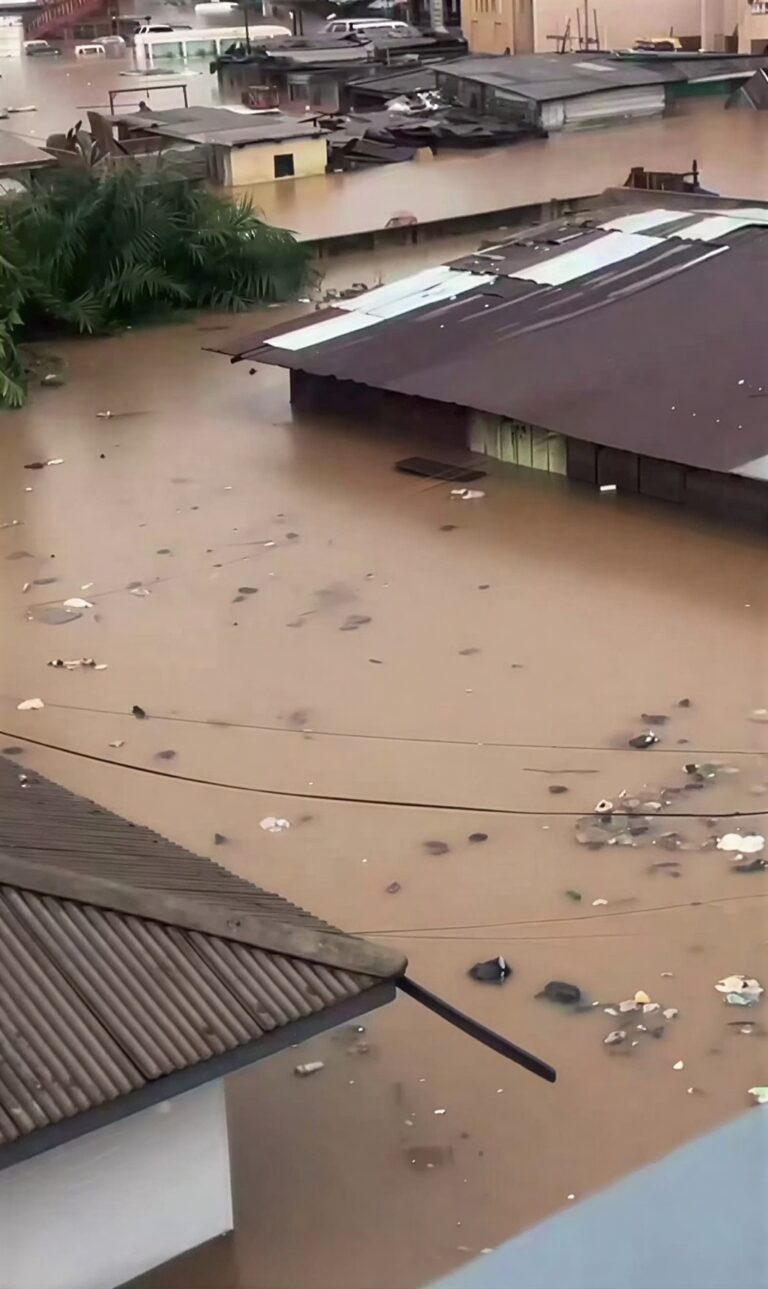
There is also the hidden cost: lost productivity, higher transport fares, market delays, food spoilage, disease risk, school absenteeism, hospital visits, trauma, insurance claims, loan defaults, rent disputes and business interruption. When trucks carrying tomatoes and other perishable commodities are stranded because roads into Accra are flooded, the impact is not limited to transporters. Farmers lose value. Market queens lose sales. Retailers face shortages. Consumers pay more. Restaurants adjust menus. Families spend more on food. A flood in Accra can become a price shock in the market.
There is the public infrastructure cost: damaged roads, weakened bridges, flooded substations, broken drains, overwhelmed health facilities and pressure on emergency services. Every cedi spent repairing preventable flood damage is a cedi not spent expanding drainage, improving schools, equipping hospitals or supporting productive sectors.
Flooding humiliates families. It strips people of privacy. It turns bedrooms into gutters. It forces mothers to carry children through dirty water. It makes fathers stand helpless as property disappears. It leaves children afraid of rain. It makes the elderly relive danger each time clouds gather. It creates anxiety that no public official sees when cameras leave. Long after the water dries, the smell remains. The stains remain. The fear remains.
For poor households, the trauma is worse because recovery is slow. They cannot simply move to a hotel. They cannot easily replace appliances. They may not have insurance. They may not have savings. They may be tenants in structures built by landlords who will repair nothing. They may continue to live in the same danger because they have nowhere else to go.
This is where the flood question becomes a question of justice.
The people who suffer most are often not the people who made the worst decisions. A chief may sell risky land and live elsewhere. A developer may rent out rooms and move on. An assembly official may approve a permit and retire. A politician may campaign on drainage promises and disappear after elections. But the trader, tenant, child, driver, hawker, food vendor and small business owner pay the daily price.
This is wickedness dressed up as urban growth. Accra’s expansion has been celebrated for too long without asking what kind of city is being built. Estate houses rise where water should breathe. Roads are tarred without proper drainage. Shopping centres appear without sufficient runoff management. Informal settlements grow along waterways because housing is unaffordable elsewhere. Middle-class developments fill wetlands and call themselves lifestyle communities. The city spreads, but its planning discipline does not.
Ghana must stop pretending that every building is development. Some buildings are future disasters. Some estates are flood traps. Some permits are death warrants signed in bureaucratic language. Some land sales are acts of violence against unknown future families.
The latest rains should force a different conversation. Not one more speech about desilting. Not one more pledge about emergency response. Not one more photo opportunity with flooded victims. Ghana needs a hard urban reset.
First, Accra needs a public, legally enforceable flood-risk and no-build map. Every Ramsar site, wetland, floodplain, watercourse, drainage reserve and high-risk low-lying area must be clearly mapped, published and protected. Citizens must know where not to buy. Banks must know where not to finance mortgages. Insurers must know where risk is extreme. Assemblies must know where permits are prohibited. Chiefs and family heads must know where land sales will attract sanction.
Second, every building permit issued in a flood-sensitive zone must be audited. Ghana cannot continue to demolish selectively while leaving the approval chain untouched. If a building sits in a waterway, who approved it? If a permit was granted for a Ramsar area, which officer signed it? If a plan was endorsed despite known flood risk, who benefited? If public officials cannot be held responsible for dangerous approvals, demolitions will remain theatre.
Third, the state must confront land sellers, not only occupants. It is too easy to demolish the poor person’s structure while powerful sellers keep the proceeds. If land that should not have been sold was sold, the seller must face legal and financial consequences. Chiefs, families, estate developers and intermediaries must not profit from ecological destruction and leave residents to face bulldozers and floods.
Fourth, Ghana must stop politicising demolition. Where structures block waterways or sit within protected ecological zones, enforcement must be lawful, humane, compensated where appropriate, but firm. A city cannot survive if every illegal structure becomes untouchable because elections are near. The choice is painful enforcement today or recurring disaster tomorrow.
Fifth, drainage planning must follow urban growth, not chase it after damage has been done. Roads, housing, markets, transport terminals and industrial areas must be designed with stormwater systems that reflect today’s rainfall intensity and tomorrow’s climate risk. Accra’s drainage cannot remain trapped in an older imagination of the city while the built environment expands beyond control.

Sixth, waste management must be treated as flood prevention. Choked drains are not only engineering failures. They are behavioural and enforcement failures. Citizens who dump refuse into drains are not innocent. Businesses that use gutters as waste bins are contributing to flood risk. Assemblies that fail to collect waste regularly are part of the problem. Flood control begins with the discipline of keeping drains alive.
Seventh, the government must develop a serious relocation and housing strategy for the most vulnerable communities. It is dishonest to tell people to leave flood-prone informal settlements when they have no affordable alternative. Enforcement without housing justice simply moves poverty from one danger zone to another. Accra needs social housing, rental regulation, serviced plots, and planned urban expansion that gives low-income families somewhere safe to live.
Finally, Ghana must put money behind resilience. Flood prevention is expensive, but flood recovery is more expensive over time. Every year of delay adds to the repair bill. The country needs long-term drainage investment, wetland restoration, urban greening, early warning systems, local emergency response capacity and climate-resilient infrastructure financing. The cost will be high. But the cost of doing nothing is already being paid every rainy season by families who cannot afford it.
The painful irony is that Accra knows its flood zones. The city knows where water gathers. It knows which drains overflow. It knows which roads disappear. It knows which communities panic when rain clouds form. It knows which wetlands have been stolen. It knows which Ramsar sites have been invaded. It knows which buildings are standing in the wrong places.
The problem is not ignorance. It is impunity. And impunity is more dangerous than rainfall.
When citizens break the law and the state looks away, disaster becomes policy. When chiefs sell protected land and nobody acts, disaster becomes tradition. When assemblies approve the unapprovable, disaster becomes administration. When politicians defend encroachers for votes, disaster becomes democracy without conscience. When residents dump waste into drains and blame only government, disaster becomes civic hypocrisy.
Accra is drowning because too many people have benefited from the conditions that make it flood.
This is why the latest floods should make Ghana angry, not merely sympathetic. Sympathy dries quickly. Anger may force reform.
There should be anger for the family whose home flooded again after years of promises. Anger for the trader whose goods were destroyed. Anger for the driver trapped for hours. Anger for the child who could not sleep because water entered the room. Anger for the patient who could not reach hospital. Anger for the food truck stranded with perishable goods. Anger for the taxpayer who will pay again for emergency repairs. Anger for the fact that a capital city can still be brought to its knees by a predictable rainy season.
But anger must be disciplined. It must not become noise. It must become policy pressure.
Accra does not need another year of ritual outrage. It needs political courage, planning discipline and civic honesty. The city must decide whether it wants to remain a place where every rainy season becomes a national embarrassment or become a capital that respects the basic rules of land, water and urban survival.
The rains from Saturday night to Monday morning have spoken with brutal clarity. They have shown that low-lying Accra is becoming more exposed. They have shown that floodwater is now a recurring auditor of Ghana’s planning failures. They have shown that the cost of greed is no longer hidden in land documents and assembly files. It is floating in people’s bedrooms, shops and streets.
We can continue to blame the rain. We can continue to blame the volume of water. We can continue to blame climate change while ignoring the houses built on waterways, the wetlands filled for profit, the drains choked by refuse, the permits signed against common sense and the chiefs and officials who cash in before disaster arrives.
Or we can finally admit the truth.
Accra is not flooding only because it rains. Accra is flooding because Ghana has allowed greed to defeat planning, impunity to defeat enforcement, and private interest to defeat the public good.
Until that changes, every rainy season will return with the same message.
The water remembers where it belongs. Accra has simply forgotten.

