

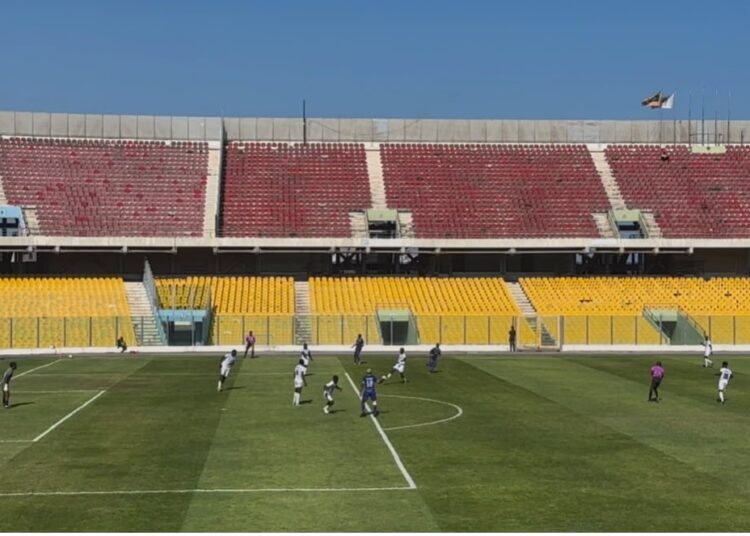

- Accra Sports Stadium Regains CAF Approval as Black Stars Return for 2027 AFCON Qualifiers
The Accra Sports Stadium has reportedly regained approval from the Confederation of African Football to host senior international matches, clearing the way for the Black Stars to return to Ghana’s traditional football home as the country begins its qualification campaign for the 2027 Africa Cup of Nations.
The clearance follows months of renovation and remedial works undertaken by the National Sports Authority after the venue previously lost approval for top-level CAF and FIFA fixtures over deficiencies in its infrastructure.
Citi Sports reported on Tuesday that the stadium had now satisfied CAF requirements for international football, providing Ghana with another approved venue at a crucial point in the national team calendar.
The development comes ahead of Ghana’s opening two matches in Group C of the 2027 AFCON qualifiers.
CAF’s official fixture schedule shows the Black Stars will begin away to Côte d’Ivoire on September 24 before hosting The Gambia on September 29 at 16:00 GMT. The governing body’s published schedule therefore places the home fixture two days later than the September 27 date cited in the initial Citi Sports report.
The restoration of Accra Sports Stadium’s international status is important because Ghana has spent recent years confronting persistent concerns over the condition of its major football venues.
CAF had previously withheld Category 3 approval from the Accra facility, citing issues involving the playing surface, stands and spectator facilities, competition areas, media infrastructure, medical facilities and equipment. Senior national-team matches and the group stages of CAF inter-club competitions require venues that meet those higher standards.
The earlier restrictions exposed a wider weakness in Ghana’s sports-infrastructure model: substantial investment has often been made in stadium construction and rehabilitation, only for maintenance problems to undermine the usefulness of those assets over time.
The latest clearance therefore represents more than the reopening of a football ground.
It is a test of whether the NSA and other state institutions can maintain an international-standard facility consistently rather than relying on emergency rehabilitation whenever CAF compliance is threatened.
For the Black Stars, returning to Accra could also restore a more familiar home environment.
The Accra Sports Stadium has long occupied a central place in Ghanaian football, hosting major national-team fixtures, domestic competitions and continental club matches. Losing the ability to stage senior internationals reduced the country’s flexibility and increased pressure on alternative venues.
CAF’s September schedule places Ghana in a demanding Group C alongside Côte d’Ivoire, The Gambia and Somalia. The qualifying competition features 48 national teams divided into 12 groups of four, with matches played on a home-and-away basis across six matchdays.
Ghana’s campaign begins with perhaps its most difficult fixture, away to Côte d’Ivoire on September 24, before the Black Stars return home five days later to face The Gambia.
The Ghana–Gambia match could therefore become the first major test of the renovated Accra Sports Stadium under renewed CAF scrutiny.
The importance of that fixture goes beyond the result on the pitch. International matches place heavy operational demands on stadium infrastructure, including crowd management, security, media facilities, floodlights, medical services, dressing rooms, spectator access and the playing surface.
Maintaining those standards consistently will determine whether the latest approval becomes durable.
Ghana has previously experienced cycles in which venues are rehabilitated ahead of major fixtures, pass inspection and subsequently deteriorate because routine maintenance fails to keep pace with usage.
Every time a stadium falls below international standards, government is forced to finance remedial works, while national teams and clubs risk losing home advantage or relocating matches. The commercial consequences can include lost gate receipts, lower local hospitality spending and increased logistical costs.
According to Citi Sports, Niger has been approved to use the Accra Sports Stadium for international fixtures, while Somalia has also made enquiries about staging matches in Ghana. If that develops into regular use by national teams without approved home venues, Accra could generate additional activity from international football beyond Black Stars fixtures.
That would increase the economic case for maintaining the stadium properly.
Hosting visiting national teams creates demand for hotels, transport, catering, security, broadcasting and other services. Stadium rental and associated commercial activity can also help turn the facility into a more productive sporting asset rather than one used only intermittently.
Foreign associations will choose neutral venues based not merely on whether a stadium has passed one inspection, but on the certainty that the pitch, lighting, security and supporting infrastructure will continue to meet CAF requirements whenever matches are scheduled.
The timing of the reported clearance is also significant because Ghana is attempting to rebuild competitive momentum ahead of AFCON 2027.
CAF confirmed earlier this month that Carlos Queiroz has been retained as Black Stars head coach after guiding Ghana to the knockout phase of the 2026 World Cup. His new mandate begins with the upcoming AFCON qualifying campaign.
The tournament itself will be staged jointly by Kenya, Tanzania and Uganda from June 19 to July 17, 2027, marking the first three-country hosting arrangement in AFCON history.
For Ghana, qualification will depend on performances across six matchdays, but having a dependable home venue can provide an important operational advantage.
The larger issue, however, remains infrastructure governance.
Regaining international approval is an achievement, but it should not be regarded as the end of the process. The more consequential objective is keeping the stadium at the required standard without another cycle of deterioration, sanctions and emergency repairs.
That means regular pitch management, preventative maintenance, investment in spectator and media facilities, reliable utilities and disciplined venue management must become routine.
The return of the Black Stars to Accra can therefore be viewed as both a football development and an infrastructure test.
If Ghana can maintain the stadium’s standards over the coming seasons, Accra could once again become a dependable centre for international football and potentially a regional neutral venue.
If maintenance slips, the latest clearance risks becoming another temporary reprieve.
The real measure of success will therefore not be whether the stadium is approved for one AFCON qualifier, but whether Ghana can keep it approved long after the final whistle against The Gambia.

