


- ADB Courts Kumasi Businesses with Trade Finance and Export Support
The Agricultural Development Bank PLC has reaffirmed its commitment to supporting Ghanaian businesses to compete more effectively in international markets, following a high-level trade seminar held in Kumasi for importers, exporters, manufacturers, SMEs, agribusiness operators and corporate customers.
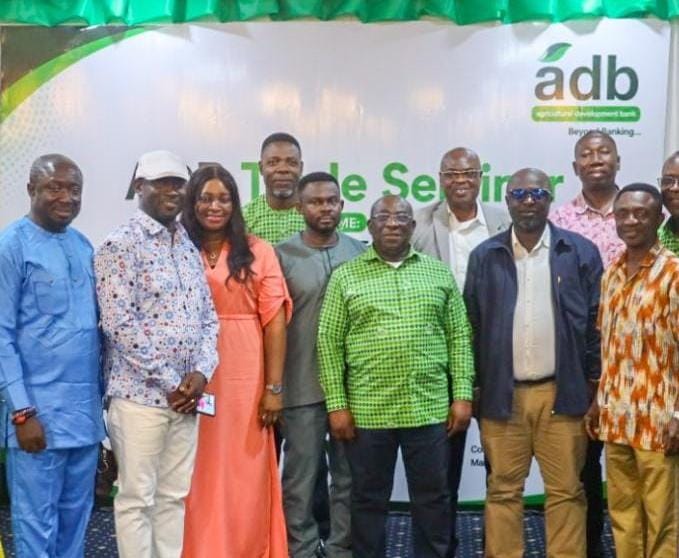
The seminar, held at the Lancaster Hotel on Thursday, July 9, 2026, formed part of the bank’s broader strategy to deepen engagement with the business community and provide practical support on international trade, business financing, risk management and trade-related banking services.
The event brought together key players across the Ashanti Region’s commercial and productive sectors to discuss how businesses can expand across borders, access structured finance, manage trade risks and take advantage of ADB’s trade finance solutions.
Addressing participants, the Managing Director of ADB PLC, Edward Ato Sarpong, said trade remains a central driver of economic transformation and that the bank is positioning itself as a preferred financial partner for businesses seeking growth within and beyond Ghana.
“Trade remains one of the strongest drivers of economic transformation. At ADB, we are committed to equipping Ghanaian businesses with the financial solutions, advisory support, and global banking partnerships they need to compete confidently in international markets,” he said.
Mr Sarpong noted that ADB’s objective goes beyond financing individual transactions, adding that the bank is focused on helping build businesses that can create jobs, earn foreign exchange and contribute meaningfully to Ghana’s economic development.
“Our objective is not simply to finance transactions but to build businesses capable of creating jobs, earning foreign exchange and contributing meaningfully to Ghana’s economic development,” he added.
The comments come at a time when Ghana is seeking to strengthen its export base, improve foreign-exchange earnings and support businesses to become more competitive under an increasingly challenging global trade environment.
For many Ghanaian businesses, especially SMEs and agribusinesses, access to trade finance remains a major constraint. Importers often face difficulties financing machinery, raw materials and inputs, while exporters must manage documentation, foreign exchange, buyer risk, logistics delays and payment uncertainty.
ADB said the Kumasi seminar was designed to help address some of these challenges by exposing businesses to the banking instruments and advisory services available to support international transactions.
Mr Sarpong said the bank continues to invest in innovative trade finance solutions that simplify cross-border transactions while supporting businesses across agriculture, manufacturing, commerce and industry.
The General Manager in charge of Retail Banking, Frank Okyere-Adarkwa, said trade finance is becoming increasingly important for businesses of all sizes, not only large corporate institutions.
“Whether you are a growing SME importing machinery, an agribusiness exporting produce or an established corporate trading internationally, ADB has tailored financial solutions to support your growth journey,” he said.
He noted that engagements such as the Kumasi seminar allow the bank to bring banking closer to businesses by providing practical knowledge that helps entrepreneurs and corporate clients make informed financial decisions.
Mr Okyere-Adarkwa encouraged businesses to take advantage of ADB’s expanding suite of products designed to improve cash flow, facilitate international payments and enhance competitiveness.
In her presentation, the Head of Trade Finance at ADB, Risikatu Sanda, stressed the importance of understanding international trade processes and using the right banking instruments to reduce risks.
“International trade presents enormous opportunities, but it also requires the right structures and safeguards. Our role is to help businesses navigate documentary credits, guarantees, collections, foreign trade payments and regulatory requirements with confidence,” she said.
She added that knowledge is as important as finance in successful international trade, urging participants to work closely with ADB’s trade specialists to structure transactions that minimise risk while maximising business opportunities.
“Knowledge is as important as finance in successful international trade,” Madam Sanda said.
Her remarks highlight one of the most important issues in Ghana’s trade financing environment. Many businesses are unable to take full advantage of international opportunities not only because they lack capital, but also because they do not fully understand trade documentation, payment instruments, compliance requirements and risk mitigation tools.
Letters of credit, guarantees, documentary collections and structured import and export finance can help businesses reduce exposure to non-payment, delivery failure, exchange-rate risk and documentation errors. But these instruments require technical understanding and close collaboration between businesses and their bankers.
Welcoming participants to Kumasi, the Area Manager, Felix Segu Eshun, described the Ashanti Region as one of Ghana’s most vibrant commercial centres, with strong potential for regional and international trade expansion.
“Kumasi continues to serve as a major hub for commerce, manufacturing, and agribusiness. We believe the businesses here are well positioned to access international markets, and ADB remains committed to providing the financial support, advisory services, and partnerships necessary to help them succeed,” he said.
The seminar featured presentations on trade finance products, foreign exchange solutions, letters of credit, guarantees, import and export financing, documentary collections and practical strategies for navigating global trade challenges.
Participants also engaged directly with ADB’s trade specialists, sharing experiences, asking questions and exploring financing options suited to their business needs.
The engagement is part of ADB’s wider effort to support Ghana’s import and export ecosystem, promote entrepreneurship and deepen the bank’s relationship with businesses that contribute to national economic growth.
For ADB, the Kumasi seminar also reflects a strategic attempt to expand its relevance beyond traditional agricultural lending into broader trade, commerce and industrial finance, while still maintaining its historic connection to agribusiness and productive enterprise.
The bank’s message to the business community was clear: Ghanaian firms seeking to compete internationally need more than ambition. They need finance, technical knowledge, risk management tools and banking partners capable of supporting them through the complexities of global trade.
By taking that conversation to Kumasi, ADB is seeking to place itself at the centre of Ghana’s trade growth agenda, especially for businesses outside Accra that have the potential to scale into regional and international markets.

