

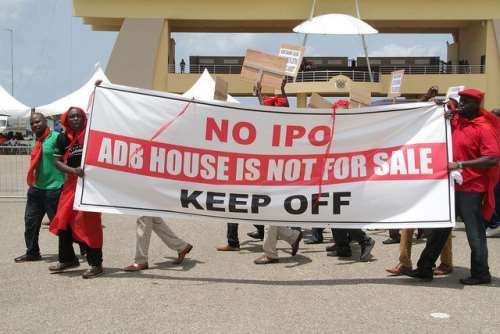

- ADB Union Demands Job Guarantees as Proposed Share Sale Raises Questions Over Bank’s Future
The workers’ union of Agricultural Development Bank PLC has raised concerns about the possible implications of a proposed sale of shares in the state-backed lender, warning that any ownership restructuring must include firm protections for employees and preserve the bank’s development mandate.
The union’s intervention brings an important human dimension to a transaction likely to be presented primarily in terms of capital, ownership and institutional efficiency. For employees, however, the central questions are more immediate: Who will acquire the shares, what strategy will the new investor pursue, and will workers be made to bear the cost of restructuring?
These concerns cannot be dismissed as resistance to change. ADB is already undertaking an organisational and workforce review designed to align its staffing structure with business requirements and regulatory considerations. Management notified the union that the exercise could involve workforce rationalisation, although the number of employees who could be affected has not been officially disclosed.
The prospect of a share sale has therefore emerged at a particularly sensitive moment. Employees are watching two potentially significant processes—ownership change and workforce optimisation develop simultaneously. Even if the exercises are technically separate, workers may reasonably fear that a new shareholder could demand deeper cost reductions, branch consolidation or redundancies to improve returns.
That is why transparency must begin before the transaction is completed, not after decisions affecting employees have already been taken.
ADB’s financial performance provides evidence of a bank recovering from years of losses, capital constraints and deteriorating loan quality. For the nine months ending September 2026, the bank recorded profit after tax of GH¢301.71 million, representing growth of 6.89 per cent over the comparable period.
Profit before tax increased by 6.94 per cent to GH¢478.53 million, while shareholders’ funds rose by approximately 77 per cent to GH¢2.76 billion.
ADB also reported a capital adequacy ratio of 27.41 per cent and a common equity tier-one ratio of 25.41 per cent, placing its reported capital position comfortably above minimum regulatory requirements. Its liquidity ratio stood at 145.83 per cent, supported by cash resources of GH¢10.84 billion and investment securities amounting to GH¢6.38 billion.
Those figures suggest that the bank is no longer in the same immediate financial condition that produced accumulated losses of about GH¢1.3 billion between 2008 and 2024. Management has attributed the institution’s previous difficulties to structural weaknesses and set a longer-term target of generating GH¢1 billion in annual profit.
Yet the recovery remains incomplete.
Revenue declined by 2.95 per cent to GH¢1.13 billion during the nine-month period, while net interest income fell by 5.55 per cent to GH¢867.20 million. Net loans and advances contracted by 10.18 per cent to GH¢2.12 billion, despite customer deposits increasing by nearly 20 per cent to GH¢15.36 billion.
The resulting net loans-to-deposits ratio of approximately 13.80 per cent points to a bank holding substantial liquidity but converting only a limited portion of its deposit base into customer credit.
More critically, ADB’s non-performing loan ratio remained exceptionally high at 66.32 per cent. Although this represented an improvement from 70.13 per cent, it means roughly two-thirds of the bank’s loan portfolio was classified as non-performing.
The decline in impairment charges and recoveries of GH¢119.58 million helped profitability, but a lasting turnaround will depend on improving credit underwriting, recovering distressed loans and growing a healthier portfolio. A share sale alone cannot solve these underlying problems.
A potential investor examining ADB will naturally focus on profitability, operating costs, asset quality and capital efficiency. Employees, meanwhile, could be viewed as one of the most readily adjustable expenses.
That would be the wrong starting point.
Job protection should not mean preserving every existing position regardless of relevance, performance or technological change. However, neither should restructuring automatically equate to retrenchment. The first options must include redeployment, retraining, reskilling, voluntary arrangements and natural attrition.
Where redundancies become unavoidable, the criteria must be objective, transparent and consistent with labour legislation and the bank’s collective agreement. Workers must know how roles are being assessed, how decisions will be made and what compensation, pension and transition support will be available.
ADB also needs a proper skills audit. Digital banking, agricultural value-chain financing, data analytics, risk modelling and loan recovery require specialised capabilities. It would be counterproductive to remove experienced employees indiscriminately and later recruit people with similar institutional knowledge at a higher cost.
The union has already called for attention to job security, career progression, prolonged acting appointments and delayed staff appraisals. Those concerns suggest that uncertainty over the share sale sits within broader questions about human-resource management and employee morale.
The strongest bidder should not necessarily be defined as the party offering the highest purchase price. The quality, experience and long-term intentions of the investor matter equally.
A suitable strategic investor should demonstrate the ability to strengthen corporate governance, upgrade risk-management systems, support digital transformation and provide patient capital. The investor must also understand that ADB is not an ordinary commercial bank detached from Ghana’s economic-development objectives.
Agriculture received only 4.70 per cent of the bank’s total credit in 2024, despite the institution’s historic mandate. This raises a difficult question: Will a new shareholder help ADB rebuild agricultural lending, or push it further towards lower-risk government securities and conventional corporate banking?
Agricultural finance is difficult. Production cycles are long, weather risks are substantial, smallholder records are often inadequate, and collateral arrangements remain weak. But if ADB withdraws from the sector because agricultural lending is demanding, Ghana risks losing a specialised institution precisely when food security, agro-processing and rural employment require greater financial support.
Any share-sale agreement should therefore include measurable commitments covering agricultural financing, small and medium-sized enterprises, regional branch access, technology investment and workforce development.
The proposed transaction must disclose the number of shares being sold, the valuation method, the selection process, the identity of the buyer and the investor’s post-acquisition strategy.
It should also explain whether the transaction will inject fresh capital into ADB or simply transfer existing shares between owners. That distinction is critical. A sale that only changes ownership may generate proceeds for the seller but provide no new money for the bank’s operations.
ADB shareholders have already approved a private-placement recapitalisation, and transaction advisers have been appointed. The bank’s accounts also show a government deposit for shares of GH¢855.60 million, largely reflecting capital support received in 2025.
Consequently, the public deserves to understand how the proposed share sale relates to the recapitalisation programme and whether taxpayers will obtain fair value from any disposal.
The union’s demand for safeguards should ultimately be viewed as an invitation to design a better transaction. Workers must also recognise that job security will be strongest in a profitable, well-governed and commercially sustainable bank.
The real choice is therefore not between reform and employment. It is between a carefully managed transformation that carries workers along and a transaction that treats them as an afterthought.
If executed transparently, the share sale could provide stronger governance, fresh capital and technical expertise. If handled poorly, it could deepen anxiety, weaken morale and dilute ADB’s national development role.

