

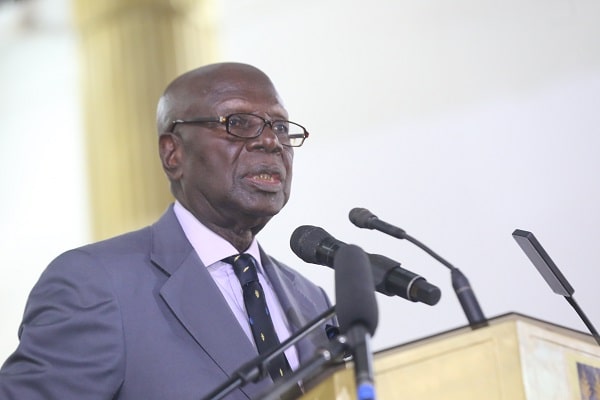

- AFCFTA Needs Skills Mobility to Deliver Shared Prosperity – Dr Ishmael Yamson warns.
Africa’s ambition to build a truly integrated continental economy will remain unfinished unless governments remove barriers to the movement of people, skills and ideas with the same urgency being applied to trade liberalisation, Dr Ishmael Yamson has warned.
Speaking at the Kgalema Motlanthe Winter Seminar 2026 in Johannesburg, Dr Yamson, a member of Ghana’s Presidential Advisory Group on the Economy, said the African Continental Free Trade Area would fall short of its transformational promise if it focused narrowly on goods and tariffs while neglecting the human mobility that drives enterprise, innovation and market creation.
Addressing policymakers, business leaders and academics under the theme “Migration as a catalyst for African integration, innovation and shared prosperity”, he described migration not as a threat to be managed at the margins of policy, but as one of the continent’s most underutilised economic assets.
“Goods do not trade themselves; people trade, entrepreneurs trade, innovators trade, and ideas trade,” Dr Yamson said. “The future of African integration depends as much on people as it does on policy.”
His argument goes to the heart of Africa’s integration challenge. AfCFTA is widely viewed as the continent’s most ambitious economic project, promising to connect fragmented markets, expand intra-African trade, deepen industrial value chains and strengthen Africa’s bargaining power in the global economy. But Dr Yamson’s message was that trade agreements cannot move themselves. They require people who can cross borders, identify opportunities, build firms, mobilise capital, transfer skills, create networks and connect producers to consumers.
Without freer movement of talent, Africa risks building a trade architecture that is strong on paper but weak in practice.
Dr Yamson drew on West Africa’s commercial history to make the point, citing the long-standing trade relationships between Ghanaian traders and Yoruba merchants as evidence that cross-border mobility has historically created markets rather than destroyed them.
“They did not just swap goods; they settled, learned languages, intermarried, and built markets. They proved that when West Africans cross borders, they do not bring scarcity; they bring a market,” he said.
That historical reference is significant because it challenges the modern tendency to treat migration primarily as a border-control issue. Across Africa, migration is often discussed through the language of pressure, insecurity, irregular movement and social strain. Dr Yamson offered a different framing: migration, properly governed, can become a platform for integration, trade, innovation and shared prosperity.
He argued that Africa’s development challenges are too interconnected for countries to continue operating as isolated national markets. Infrastructure gaps, fragmented production systems, limited industrial capacity and thin domestic markets continue to restrict the continent’s ability to scale production and compete globally.
“Our markets are too fragmented, our infrastructure gaps are too large, and our development challenges are too interconnected,” he said. “The future lies in building a more integrated continental economy where goods, services, capital, technology and skills move freely across borders.”
For AfCFTA, this is a critical warning. Tariff reduction may make cross-border trade cheaper, but it will not automatically create competitive African firms. Rules of origin may support regional value chains, but entrepreneurs and skilled workers must still be able to move. Digital platforms may connect markets, but innovators, engineers, financiers, logistics providers and professional services must be able to operate across jurisdictions.
In that sense, labour mobility is not separate from trade. It is part of the infrastructure of trade.
Dr Yamson also placed Africa’s demographic profile at the centre of the discussion. With roughly 70.00% of the continent’s population under the age of 30, Africa has the human base to become one of the world’s most dynamic centres of production, consumption, technology adoption and entrepreneurship. But he cautioned that a youthful population is not automatically an economic advantage.
“Demographics alone do not create prosperity. Prosperity is created when talent meets opportunity,” he said.
That distinction is crucial. Africa’s youth bulge can either become a demographic dividend or a demographic pressure. The outcome will depend on whether countries invest in education, technical and vocational training, entrepreneurship, digital skills and productive employment. It will also depend on whether young Africans can find opportunity within the continent rather than being forced to seek it elsewhere.
Dr Yamson challenged the narrative that migration pressures are driven simply by the desire to leave home. In many cases, he argued, young people move because they cannot access quality education, productive work, reliable infrastructure, efficient markets or entrepreneurial opportunity where they live.
“When young people have access to quality education, productive employment, entrepreneurial opportunities, reliable infrastructure, digital connectivity and efficient markets, migration becomes a choice rather than a necessity,” he said.
This framing carries important policy implications. If African governments want to manage migration better, they must do more than tighten borders. They must expand opportunity. They must create labour markets that reward skills, support businesses that can absorb young workers, invest in infrastructure that connects people to markets, and build digital systems that allow talent to participate in the modern economy.
The seminar, organised by the Kgalema Motlanthe Foundation in partnership with MTN Group, examined how migration can be repositioned as a catalyst for trade, investment, innovation and continental prosperity rather than merely a humanitarian or security concern.
For African policymakers, Dr Yamson’s intervention amounts to a challenge: AfCFTA cannot be reduced to customs reforms, tariff schedules and trade protocols. The agreement’s success will depend on whether Africa can build the softer but equally powerful infrastructure of integration – mutual recognition of skills, easier visa regimes, portable qualifications, cross-border professional practice, digital identity systems, financial interoperability and trust between states.
If an entrepreneur in Accra cannot easily operate in Lagos, Kigali, Nairobi or Johannesburg, Africa’s market remains fragmented. If a software engineer in Dakar cannot work with a start-up in Cape Town, talent remains trapped in national silos. If a logistics firm in Abidjan cannot move people and services across borders efficiently, value chains remain theoretical.
Dr Yamson’s core argument is therefore both simple and profound: Africa cannot trade freely if Africans cannot move freely.
The continent has spent decades discussing integration through institutions, treaties and protocols. But the lived experience of many Africans remains one of visa barriers, border delays, regulatory uncertainty and fragmented labour markets. That mismatch weakens the very integration agenda governments claim to support.
For Ghana and other AfCFTA member states, the message is especially relevant. Hosting continental trade institutions or signing protocols is not enough. The real measure of commitment will be whether governments make it easier for African talent to study, work, invest, innovate and build businesses across borders.
Africa’s greatest resource is not only its minerals, oil, gas, forests or agricultural land. It is its people. But that resource will remain underused if borders continue to limit the movement of skills, ideas and enterprise.
Dr Yamson’s warning should therefore be heard as a call to complete the integration project. Free trade in goods is necessary, but insufficient. Free movement of talent is the missing engine.
Without it, AfCFTA may connect markets on paper. With it, Africa could begin to build the continental economy its people have already imagined through generations of migration, trade and enterprise.

