


- Africa’s New Performance Map: South Africa Leads, Ghana and Côte d’Ivoire Rise in Top 10
South Africa has retained its position as Africa’s best-performing country in the 2026 ranking published by Jeune Afrique and The Africa Report, with Ghana placing 8th in a list that seeks to measure national performance beyond economic size.
The ranking, released in Paris on June 4, 2026, assesses African countries across three broad dimensions: governance, influence and innovation.
Unlike traditional rankings that focus largely on gross domestic product or conventional development indicators, the index is designed to capture how effectively African states govern, attract investment, project influence and prepare for the future through education, start-ups, patents and innovation.
South Africa retained first place with what the publishers described as a comfortable lead, driven mainly by its strength in influence and innovation.
The country’s performance was supported by its academic, scientific and entrepreneurial ecosystem, diplomatic weight, membership of the BRICS and the G20, as well as its cultural and symbolic capital.
However, South Africa’s lower governance score also highlighted the complexity of its development path, showing that economic and diplomatic influence do not always move in line with institutional performance.
Mauritius climbed to second place, supported by institutional stability, an attractive business environment and successful economic diversification.
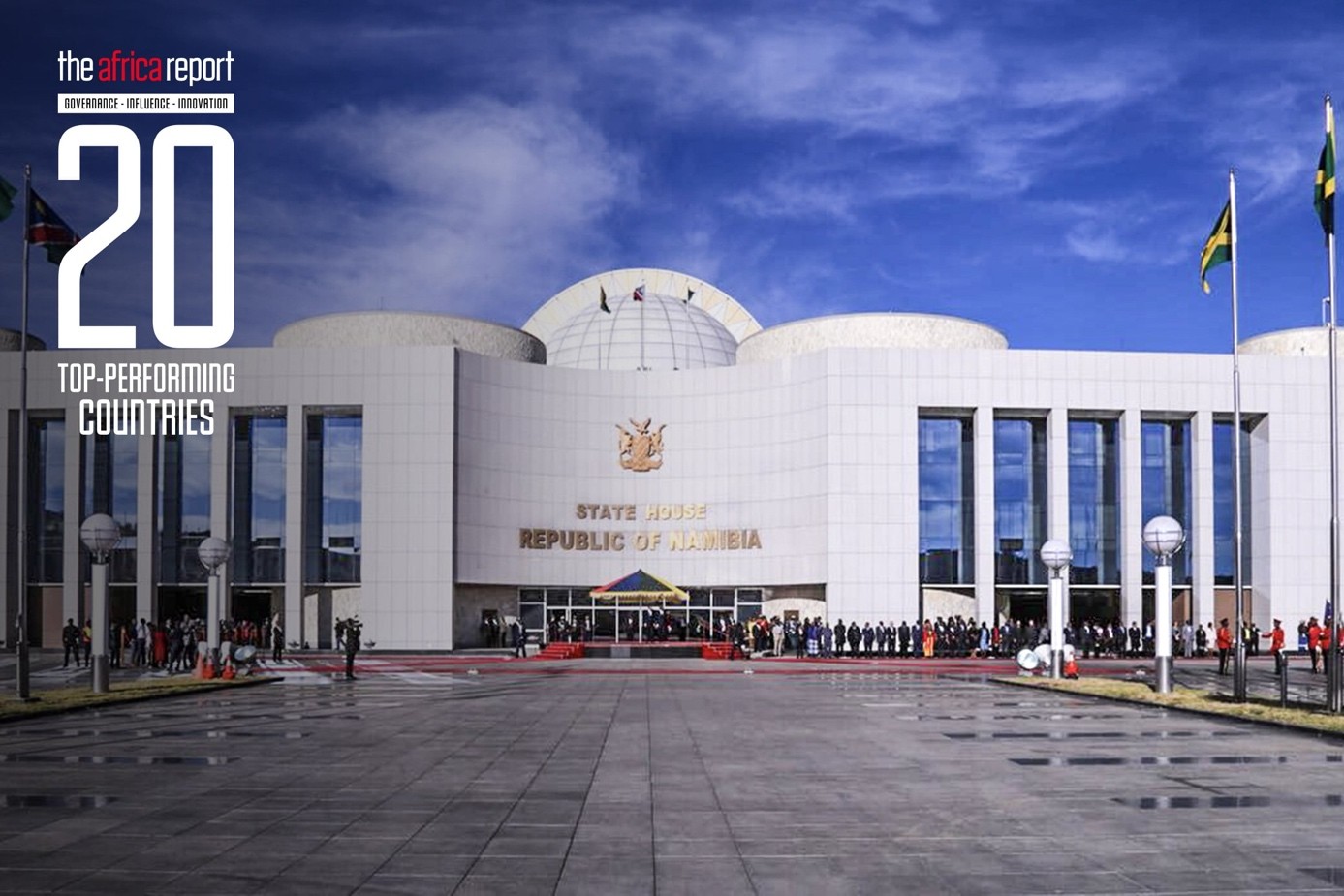
Namibia recorded the strongest rise in the 2026 edition, moving from 15th to 3rd place. Its improved performance was attributed to political stability, infrastructure, financial market depth, natural resources and stronger governance indicators, including tax collection capacity.
Morocco ranked 4th, confirming its position as one of the continent’s most consistent performers following years of investment in infrastructure, industry, renewable energy and sport.
Nigeria placed 5th, gaining four positions despite weak governance scores. Its large domestic market, international influence and innovation capacity helped keep it among Africa’s heavyweights.
Egypt, however, fell to 6th after losing four places. The report said the country was weighed down by falling GDP per capita over the reference period, high debt above 90 percent of GDP in 2024, weak regional integration and one of the continent’s weakest rule-of-law scores.
Rwanda ranked 7th, followed by Ghana in 8th, Côte d’Ivoire in 9th and Kenya in 10th.
Ghana’s position in the top 10 reflects its continued relevance in West Africa’s economic and institutional landscape, particularly as the country competes with Côte d’Ivoire for influence, investment and regional leadership.
The ranking also points to West Africa’s growing dynamism. Nigeria’s rise, Ghana’s top 10 placement and Côte d’Ivoire’s emergence as a major regional hub suggest that the sub-region is becoming increasingly central to Africa’s economic and governance realignments.
Beyond the top 10, the 2026 ranking shows a changing map of African performance.
Algeria advanced to 12th place, partly benefiting from weaker performances by countries previously ranked ahead of it, including Senegal and Tunisia.
Mauritania entered the top 20, supported by renewed diplomatic influence, while Mozambique also joined the ranking.
Ethiopia, by contrast, recorded a sharp fall, penalised by weaknesses in fiscal transparency and governance. Botswana, Kenya and Tanzania also lost several places, reflecting the effect of new criteria introduced in the 2026 methodology.
The publishers said the updated methodology now places greater emphasis on tax burden, regional integration and a more refined measure of soft power.
Julien Wagner, Director of Special Content, Partnerships and Media Diversification at Jeune Afrique Media Group, said the ranking was designed to capture momentum and long-term direction rather than static national size.
“This ranking has a deliberately dynamic and forward-looking dimension, giving greater weight to recent trends,” he said.
“It shows that a country’s performance cannot be reduced to its size, its wealth or its demographic weight. It is measured by the consistency of its long-term choices, the robustness of its institutions, its capacity for innovation and its ability to exert influence.”
He added that the 2026 edition shows a continent in motion, where some established balances are being confirmed while new players are emerging.
“With this second edition, the ranking is becoming a genuine barometer of these realignments,” he noted.
The 2026 methodology is based on 24 indicators spread across three dimensions.
Governance carries the largest weight at 50 percent of the index. It measures economic and institutional performance through indicators such as tax collection capacity, GDP per capita changes, foreign direct investment, debt-to-GDP ratio, rule of law, quality of governance and political stability. Countries that experienced coups d’état over the past three years are penalised.
Influence accounts for 25 percent of the index and assesses diplomatic, cultural, sporting and tourism reach. It includes embassy networks, contribution to UN peacekeeping operations, presence in international institutions, awards and distinctions, music charts, hosting of major competitions, UNESCO heritage and tourism appeal.
Innovation also accounts for 25 percent and considers education, start-up fundraising, innovation capacity, patents filed, academic ecosystem quality and performance in major international rankings.
The broader 2026 feature, published in the June issue of Jeune Afrique, also examines the economic rivalry between Ghana and Côte d’Ivoire, the role of taxation in governance, Abidjan’s influence, data centres and artificial intelligence on the continent, and the new drivers of African soft power.
For Ghana, the ranking offers both recognition and a challenge.
Its place in the top 10 suggests that the country remains one of Africa’s more visible and influential performers. But the index also shows that future performance will depend not only on macroeconomic recovery, but on stronger governance, deeper innovation, regional competitiveness and the ability to convert stability into long-term economic transformation.

