



- Afrophobia: Xenophobic attacks putting the AfCFTA dream under siege
South Africa’s recurring xenophobic attacks against African migrants are not spontaneous outbursts of popular anger. They are organised political violence choreographed by unseen sponsors, executed by a politically weaponised lumpen-proletariat, and tolerated by a state whose accountability deficit is now threatening to unravel the foundational logic of the African Continental Free Trade Area (AfCFTA). Ghana, whose citizens, built on a historical DNA of migration, now operate enterprises across South Africa must move beyond diplomatic whispers and demand firm, consequential action. The cost of silence is paid in blood; the cost of beggarly diplomacy is paid in lost futures.
In April 1994, the world held its breath in hope as Nelson Mandela cast his ballot in South Africa’s first democratic election. The ‘Rainbow Nation’, a phrase coined by Archbishop Desmond Tutu was meant to embody not just multiracial harmony within South Africa’s borders, but a moral debt to the continent whose solidarity had sustained the anti-apartheid struggle. Angola harboured ANC cadres. Tanzania hosted Umkhonto we Sizwe camps. Ghana, under Kwame Nkrumah, gave ideological oxygen to Pan-African liberation. Zambia, Zimbabwe, Lesotho and Mozambique sacrificed precious economic ground to apply pressure on the apartheid regime. The continent bled for South Africa’s freedom. Three decades on, that debt is being repaid with machetes, petrol bombs, and forced displacement. The victims are not the architects of apartheid; they are the very continental cousins whose solidarity made the Rainbow Nation possible. Zimbabweans, Mozambicans, Nigerians, Malawians, and increasingly Ghanaians are the targets of a brand of violence that recurs with the seasonality of a harvest, yet whose roots are anything but natural.
The continent bled for South Africa’s freedom. Three decades later, the Rainbow Nation repays that debt with machetes and petrol bombs.
Xenophobia or more precisely, Afrophobia, since its violence is almost exclusively directed at fellow Black Africans did not arrive with democracy. Its seeds were planted in the structural contradictions of South Africa’s transition: a political liberation that was not matched by economic liberation. The apartheid economy bequeathed a society of extreme inequality, racially concentrated land ownership, a captured industrial base, and a Black majority whose aspirations had been promised but whose material conditions had barely changed.
The earliest post-apartheid indicators emerged in the townships of Gauteng and KwaZulu-Natal through the mid-to-late 1990s, but it was May 2008 that branded the crisis onto global consciousness. A wave of attacks killed 62 people, displaced 100,000 others, and resulted in widespread looting and arson of foreign-owned businesses across Gauteng and KwaZulu-Natal. The 2015 attacks in Durban and Johannesburg with images of Zulu King Goodwill Zwelithini’s reported remarks on foreigners ‘taking’ from South Africans circulating as justification saw renewed mass displacement. In 2019, retaliatory attacks on South African business interests (MTN) in Nigeria and other African countries illustrated how the violence was becoming a continental diplomatic incident, not merely a domestic disorder. Since 2019, episodic surges have continued, often aligned with economic stress events including post-COVID unemployment spikes, load-shedding crises, periods of high fuel and food inflation, or approaching electoral cycles. The latest wave, which has increasingly targeted Ghanaian-owned enterprises and individual Ghanaian migrants, has added a new and troubling dimension to the crisis.
Conventional analysis attributes xenophobic violence to competition over scarce resources such as jobs, housing, social services in a context of mass unemployment (officially above 32%, and effectively above 42%). This narrative, while partially true, is dangerously incomplete. It treats the symptom as the disease, and in doing so, exculpates the architects. A critical under-examined question must be posed bluntly: Who sponsors these attacks? No unemployed young person, surviving on meagre and irregular income, spontaneously mobilises transport, communication, weapons, and organisational coordination to mount sustained, multi-township attacks on migrant communities. The ‘spontaneous anger’ narrative does not survive scrutiny. Behind every major wave of afrophobic violence is a trail of logistical funding, political cover, and deliberate amplification through community networks.
The answer implicates overlapping interests. At one level are local political entrepreneurs, ward councillors, community ‘business forum’ chairpersons, and political party branch officials who mobilise the unemployed as a political constituency by directing their frustration outward onto foreign nationals rather than upward to a failing state. Operation Dudula, the vigilante movement that rose to national prominence during the 2021–2022 wave, exemplifies a dynamic of well-organised, with media-savvy leadership, able to mobilise thousands in coordinated marches, it consistently received tacit tolerance from law enforcement. The question of who finances its operations, its logistics, and its communications infrastructure has never been satisfactorily answered by South African authorities.
No unemployed young man spontaneously mobilises transport, weapons, and multi-township coordination. Behind every wave of xenophobic violence is a trail of funding, political cover, and deliberate amplification.
At another level are economic competitors particularly Black South African business interests in the informal and semi-formal sector (spaza shops, taxi associations, street trade, smallholder agriculture and piggery) who view African migrant entrepreneurs as undercutting their market position. Ghanaians, for example, are engaged in piggery and agribusiness in South Africa often with international business partners. The question worth pursuing is why those international partners chose to work with Ghanaians rather than local Black South African entrepreneurs. The honest answer points to capital access, business acumen, networks, and work ethic not conspiracy. But this honest answer is inconvenient to those who prefer a simpler narrative of displacement and theft.
It is also important to note a conspicuous selectivity in the violence. Why African migrants, and not the Lebanese, Indian, Chinese, or Portuguese business communities, all of whom are often more economically dominant in exactly the sectors where tension are prevalent? Lebanese traders dominate much of South Africa’s informal retail. Chinese entrepreneurs are entrenched in township spaza shops. Indian business interests control significant swathes of KwaZulu-Natal’s economy. Yet the mob does not march on Chinatown or Fordsburg. This selectivity is not accidental, it reflects both the racialised coding of the violence (Black bodies are safe to attack; non-Black immigrant bodies carry invisible diplomatic and economic deterrence) and deliberate channelling of Black-on-Black economic resentment by sponsors who understand that attacking Chinese or Indian businesses would trigger consequences they are unwilling to face.
The lumpen proletariat, that class of the chronically unemployed, street hustlers, petty criminals, and informally surviving youth whom classical political economy identifies as a potentially explosive but directionless social force are the cannon fodder. They are not the generals. These are young men (and sometimes women) who have nothing to lose and who respond to the language of collective identity and economic grievance. But they are deployed, not spontaneous. They are organised, not random. And importantly, they are not attacking the wealthy, they are attacking other poor and working-class migrants who have invested their meagre international savings into small enterprises, trading ventures, and productive livelihoods.
Before Ghana demands accountability from South Africa, it is worth grounding this conversation in a historical humility that strengthens, rather than weakens, our moral position. Ghana’s own urban development tells a story of radical internal migration dynamics that should make us deeply empathetic to the migrant experience and deeply firm in our conviction that no society can build without migrants.
The 1960 census in Ghana is revelatory. In Takoradi, at the height of the cocoa and timber boom economy, only 25% of the population were of local origin. Three-quarters of Takoradi’s residents were migrants, internal and external drawn by economic opportunity. In Kumasi, the Ashanti region’s commercial capital, 37% were of local origin, meaning 63% were migrants. In Sekondi, 40% were indigenous, with 60% of the population comprising people from elsewhere. In Accra, by 1948, 36% of the population had lived in the city for less than five years. In Takoradi that same year, over half the entire population were recent arrivals.
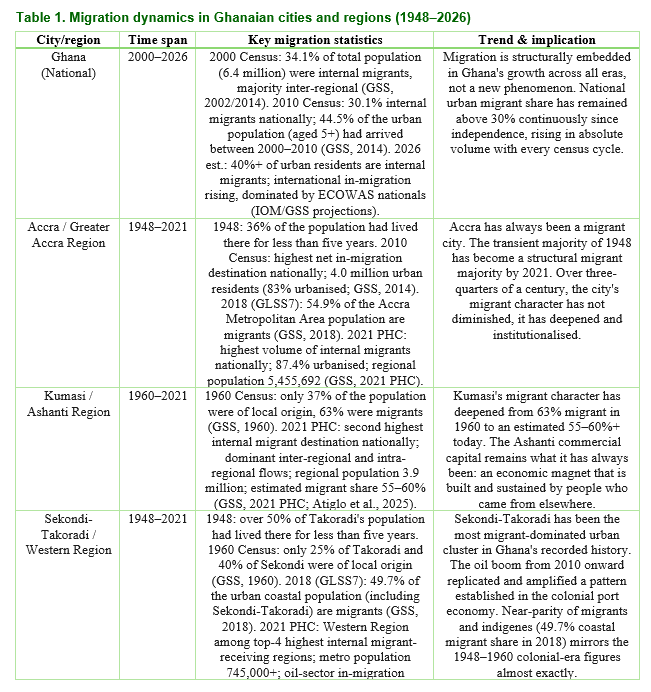
Sources: Ghana Statistical Service (GSS), Population Censuses 1960, 2000, 2010, 2021; Ghana Living Standards Survey Round 7 (GLSS7), 2018; International Organisation for Migration (IOM) Ghana; Atiglo et al. (2025), Springer-Nature; Yaro (2008), University of Ghana. Compiled by Dr. Kojo Ahiakpa I Research Desk Consulting Limited, 2026. NB: 2026 national estimates are projected based on GSS trend analysis. Historical 1948 and 1960 data sourced from original census reports.
A.B. Crentsil’s timeless ‘Atia’ captures this spirit in music, the cultural codification of the migrant experience as normal, admirable, even aspirational in Ghanaian society. Ghana Town in Gambia, established in the 1950s by Ghanaian fishing communities, today hosts an estimated population of 2,000 or more, a testament to how Ghanaians have carried their productive energy across borders for generations. The Fante fishing villages stretching from Côte d’Ivoire to Sierra Leone, Ga and Ewe trading communities in Lomé and Lagos, Akan settler farmers in Côte d’Ivoire’s cocoa belt, all are expressions of the same migratory vitality that built Ghana’s own cities.
This context matters because it demolishes the premise of xenophobia wherever it appears. The migrants in South Africa; Ghanaians, Nigerians, Zimbabweans, Mozambicans are not interlopers. They are the living continuation of an African labour mobility tradition as old as the continent’s civilisations. They are not ‘taking’ from South Africa. They are building it, just as migrants contributed to build Takoradi, Kumasi, and Accra.
And importantly, wherever immigrant labourers and traders exist in large numbers, they represent a vast and inflammable political resource. They form national associations, tribal and ethnic welfare societies, and mutual-benefit networks, all of which are genuine social goods in isolation, but which become ready fuel for socio-economic and political conflagration in the hands of unscrupulous political entrepreneurs. Ghana knows this too after the 2000 elections, there was a documented spike in violence against so-called ‘settler farmers’ in cocoa-growing areas, as political tensions were deliberately channelled into ethnic and migrant-targeting violence. South Africa is not exceptional; it is a more violent and more visible expression of a pathology that afflicts many African states.
For most of the post-1994 period, the primary targets of South African xenophobic violence were Zimbabweans (by far the largest undocumented migrant population), Mozambicans, Malawians, Lesothans and Nigerians. Ghanaians, while present in South Africa in growing numbers and in increasingly visible economic activities from piggery and produce farming to informal trading and professional services were not historically the frontline targets. The recent, sharper focus on Ghanaians demands a geopolitical and economic interrogation that goes beyond surface-level explanations.
Several hypotheses merit serious consideration. First, Ghanaian migrants in South Africa are no longer merely labour migrants, they are increasingly entrepreneur-migrants; people who have invested significant capital in productive enterprises. Piggery operations, market gardening, agro-processing, and service businesses operated by Ghanaians in the Western Cape and Gauteng are visible economic entities with turnover and market presence. They attract attention precisely because they are succeeding. Second, Ghanaian migrants frequently operate with international business partners, some from the broader African diaspora, some from Asia and Europe and this is perceived as economic collaboration that excludes local Black South Africans. But the critical question to interrogate is not why Ghanaians have international partners; it is why the structural barriers facing Black South Africans make such partnerships harder for them to access. The answer lies in South Africa’s unresolved land and capital access inequalities, not in the enterprise of Ghanaian migrants.
Third, and most troublingly, the timing of the escalation against Ghanaians coincides with a period of heightened Ghana-South Africa economic engagement. Ghana’s signing of bilateral investment treaties, the deepening footprint of South African corporations in Ghana’s economy and growing Ghanaian policy confidence in demanding reciprocal treatment in trade negotiations may have made Ghanaians a useful ‘pressure point’ for actors who wish to constrain this trajectory. The violence, in other words, may not be purely domestic in its sponsorship, it may have an international business competition dimension that has not yet been fully mapped.
The violence against Ghanaians in South Africa is not merely domestic disorder. It may carry an international business competition dimension that has not yet been fully mapped.
Any honest assessment of Ghana’s leverage in this situation must begin with a clear-eyed mapping of South Africa’s economic footprint in Ghana. South Africa is, by a considerable margin, one of the most economically embedded foreign nations in Ghana’s economy far more so than most Ghanaians realise. This embedding is not a vulnerability to be apologised for; it is a legitimate basis for reciprocal accountability.
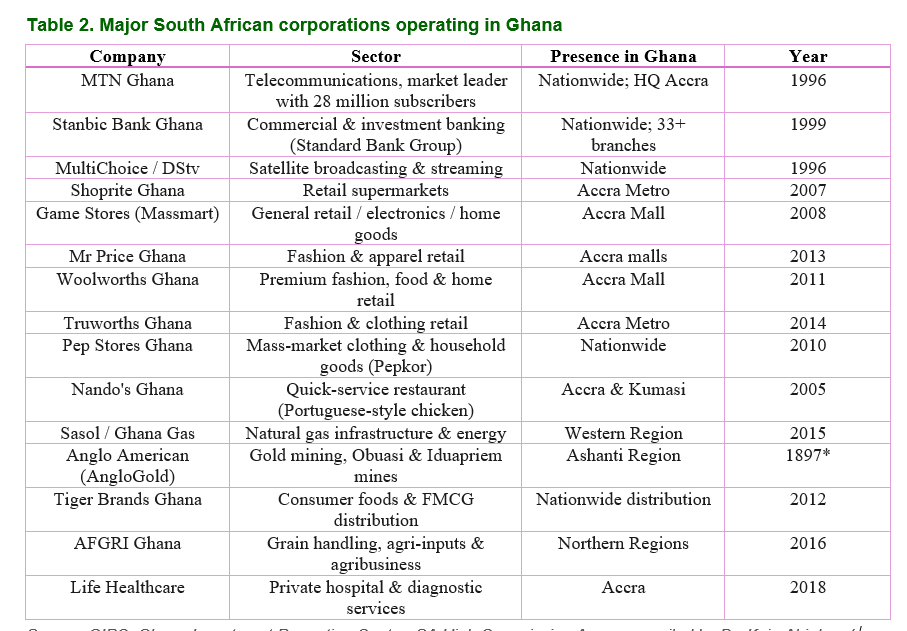
Source: Ghana Investment Promotion Centre; SA High Commission Accra; compiled by Dr. Kojo Ahiakpa / Research Desk Consulting Limited, 2026. AngloGold Ashanti traces its Ghana roots to 1897; modernised as SA-registered entity post-merger.
MTN Ghana alone contributed over GHS 6.8 billion in taxes to the Ghana Revenue Authority between 2018 and 2023. Stanbic Bank Ghana is among the country’s top-five commercial banks by asset base. MultiChoice/DStv commands a dominant share of Ghana’s pay-TV market. Shoprite, Game, Mr Price, Woolworths, Truworths, and Pep collectively employ thousands of Ghanaian workers and anchor major retail malls. AngloGold Ashanti’s Obuasi and Iduapriem operations are among Ghana’s most significant gold-producing assets. These are not trivial economic presences, they represent billions of dollars in invested capital, market access, and brand equity built on the stability and goodwill of Ghanaian society. Beyond corporations, the South African population in Ghana has grown consistently, drawn by Ghana’s political stability, Anglophone business environment, and growing services economy.
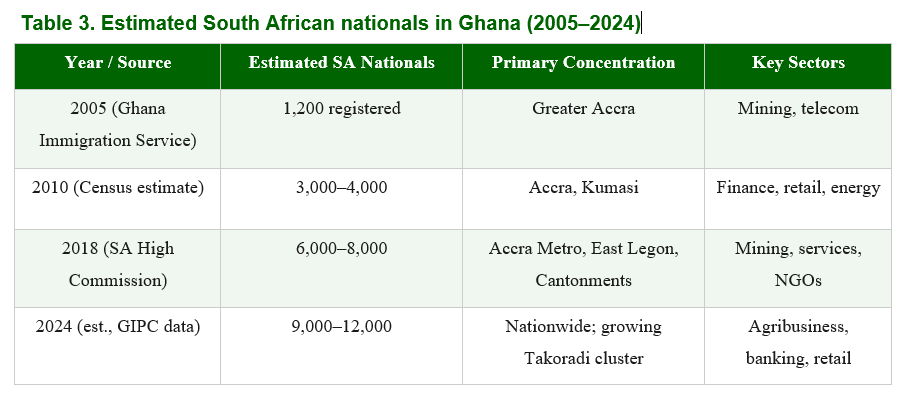
Source: Ghana Immigration Service; SA High Commission Accra; GIPC estimates; compiled by Dr. Kojo Ahiakpa / Research Desk Consulting Limited, 2026
South African nationals in Ghana live safely, operate businesses freely, enjoy Ghana’s hospitality, and contribute to our economy. They are not harassed. They are not displaced. Their properties are not burned. This asymmetry is not merely a moral problem; it is a diplomatic and economic argument. Ghana’s treatment of South African nationals and businesses on its soil constitutes a performance standard against which South Africa’s treatment of Ghanaians on its own soil must be measured. The gap between these two standards is the legitimate ground on which our government must plant its firmest diplomatic flag.
The African Continental Free Trade Area (AfCFTA) operationalised in 2019 and entering its full implementation phase is the most ambitious economic integration project in African history. With a combined GDP approaching US$3.4 trillion and a population of 1.4 billion people, AfCFTA’s vision of a single market for goods, services, investments, intellectual property, and digital trade represents Africa’s best structural response to global economic marginalisation. Remember, the Secretary General of the AfCFTA Secretariat (hosted in Accra, Ghana) is a South African. South Africa is, by economic weight, AfCFTA’s most important member. Its industrial base, financial system, logistics infrastructure, and service sector are the backbone of the continental market’s southern spine. But AfCFTA’s logic is fundamentally predicated on the free movement of goods, capital, and importantly, people. An AfCFTA that enables the movement of goods across borders while subjecting the people who produce and trade those goods to violence, dispossession, and death in their host countries is not a trade agreement. It is a fraud.
The recurring xenophobic attacks in South Africa strike at the commercial confidence that underpins AfCFTA’s viability. Ghanaian traders, entrepreneurs, and professionals considering business activities in South Africa are now factoring in a risk premium, the possibility that their investment, their enterprise, and indeed their physical safety cannot be guaranteed by the host state. This risk premium acts as an invisible tariff, far more economically damaging than any border duty, because it taxes the willingness to invest at all.
African states that consistently fail to protect intra-African migrants and entrepreneurs send a signal to the entire continent that AfCFTA’s free movement aspirations are performative rather than substantive. Every Ghanaian enterprise burned in Johannesburg is a vote against economic integration. Every Malawian trader displaced in Durban is a withdrawal from the continental market. South Africa cannot be both AfCFTA’s economic anchor and its most persistent human security threat to intra-African movement without eventually bearing the consequences in institutional credibility and diplomatic isolation.
Every Ghanaian enterprise burned in Johannesburg is a vote against AfCFTA. South Africa cannot be the continental market’s anchor and its most persistent human security threat simultaneously.
Ghana and South Africa are two of Africa’s most significant states both in terms of democratic credentials, economic weight, and continental influence. The two nations have maintained generally warm bilateral relations since the post-apartheid era, underscored by shared membership in the African Union, ECOWAS-SADC cooperation frameworks, and Commonwealth. South Africa has been among Ghana’s larger trading and investment partners, and Ghana has been a vocal champion of South African-led continental initiatives. This warmth, however, has often shielded Pretoria from the accountability it deserves on the xenophobia question. Ghana’s diplomatic engagement on the attacks against Ghanaian nationals has too frequently been characterised by what can only be described as performative concern, strongly-worded statements followed by quiet normalisation once the media cycle moves on. This pattern of beggarly diplomacy is not merely ineffective; it is actively counterproductive, because it signals to South African political authorities that the attacks carry no lasting cost, and it emboldens the sponsors of violence who rely precisely on the victim-state’s reluctance to impose consequences.
Ghana must understand that a beggarly approach appeals to South African goodwill, expressions of sadness and disappointment, requests for investigations that produce no accountability will further endanger Ghanaians in South Africa. The logic is perverse but real if the South African government believes that attacking Ghanaians produces no diplomatic or economic consequence, there is no structural incentive to suppress the violence. If, on the contrary, South African government is made to understand that Ghanaian lives carry diplomatic, economic, and institutional costs, the calculus changes. Ghana must make it abundantly clear, in terms that cannot be misread; no one can attack a Ghanaian anywhere on planet Earth and expect the matter to pass without consequence. This is not aggression, it is the minimal standard of international conduct that every state owes to its citizens abroad, and that Ghana owes to the generations of Ghanaians whose mobility, enterprise, and courage have carried the nation’s name to every corner of the world.
The following framework represents a graduated, principled, and strategically proportionate response that Ghana’s Ministry of Foreign Affairs, Parliament, and business community should collectively pursue:
- Summon SA’s High Commissioner to Ghana for consultations, signalling seriousness without severing relations
- Demand that the South African government deploy law enforcement in all areas where Ghanaian nationals have been attacked, with specific timeframes for accountability
- Require the South African Department of Home Affairs to fast-track the processing of safety documentation for displaced Ghanaian nationals
- Formally demand the arrest and prosecution of identified attackers, with Ghana’s legal attaché monitoring proceedings
- Commission an independent investigation potentially under AU auspices into the funding networks behind organised xenophobic violence
- Demand that South Africa’s National Prosecuting Authority provide a public accountability report on all xenophobia-related prosecutions from 2008 to date
- Initiate a formal review, through GIPC, of the operating licences and regulatory conditions of South African corporations in Ghana
- Signal to South African corporate interests in Ghana that the continued goodwill of the Ghanaian state is contingent upon reciprocal protection of Ghanaian interests in South Africa
- Leverage Ghana’s role in AfCFTA governance structures to formally register South Africa’s xenophobic violence as a compliance concern under the Agreement’s Protocol on the Free Movement of Persons
- Formally table the issue at the African Union Commission, demanding that the AU Peace and Security Council address recurring xenophobic violence as a threat to continental integration
- Coordinate with ECOWAS member states (particularly Nigeria, which has historically borne the heaviest burden of South African xenophobic violence) to develop a unified sub-regional position
- Raise the matter at the UN Human Rights Council, documenting the systematic nature of the violence and South Africa’s insufficient response
- Ghana’s Parliament should pass a formal resolution condemning the attacks and calling for South African legislative and executive accountability
- The Ghanaian diaspora in South Africa should be formally organised through the Ghana High Commission into structured associations that increase their political visibility and documentation capacity
- Ghana should establish an emergency fund through the Diaspora Affairs Office to support displaced Ghanaian nationals who have suffered economic losses
This op-ed does not call for hostility toward South Africa. It calls for respect. South Africa is a great nation, heir to one of humanity’s most admirable democratic transitions, home to a vibrant civil society that has itself consistently condemned xenophobic violence, and a country whose people in their majority did not invite and do not endorse the violence perpetrated in their name. Cyril Ramaphosa’s government has repeatedly expressed condemnation of xenophobic attacks in principle. The problem is that principled condemnation, unmatched by structural prevention and prosecutorial action, is indistinguishable from tolerance.
Ghana, too, must be honest about its own imperfections in the treatment of migrants and non-nationals within our borders. The 1969 Aliens Compliance Order, periodic harassment of Nigerian traders, tensions around Fulani cattle herders in northern farming communities are chapters in Ghana’s own less-than-perfect relationship with migration. The moral authority Ghana brings to this conversation is not the authority of perfection; it is the authority of a nation that, having known the migrant experience intimately in its own developmental history, has chosen to build a society that broadly welcomes and protects those who come in peace and enterprise.
Africa will not integrate economically through declarations alone. It will integrate through the lived experience of African people feeling safe to move, invest, trade, and build across African borders. If a Ghanaian farmer can be beaten out of his piggery in Gauteng, if a Ghanaian trader can have her merchandise destroyed in KwaZulu-Natal, if a young Ghanaian entrepreneur can be killed for the crime of building a business in a foreign city, then the AfCFTA is a document, not a project. And Africa’s aspirations for the 21st century will remain, as they have too often been, aspirations deferred.
Africa will not integrate through declarations alone. It will integrate through the lived experience of African people feeling safe to move, invest, trade, and build across African borders.
The barbarity must be nipped in the bud. Not because Ghana is stronger than South Africa. Not because Ghanaians are better than South Africans. But because every nation that has ever contributed its citizens’ dignity, labour, and sacrifice to the advancement of a shared African future deserves to know that the continent they helped build will not permit their children to be slaughtered in it.
South Africa owes the continent more than it is currently paying. Ghana must present the invoice.
Dr. Kojo Ahiakpa, 2026 | Research Desk Consulting Limited

