


- Agriculture Needs Capital, Infrastructure and Markets to Drive Ghana’s Next Growth Phase — FAGE
Ghana must substantially increase investment in agriculture if it is to strengthen food security, create jobs and build a more diversified export economy, according to Felix Kamassah, Vice-President of the Federation of Associations of Ghanaian Exporters.
He argues that agriculture should be treated not merely as a source of food but as a strategic engine for industrialisation, employment and foreign-exchange earnings. “Farmers could deal with the shortages and indeed exceed demand if provided the needed support in terms of farm inputs, infrastructure and funding,” he said.
The intervention comes as Ghana continues to grapple with food-price pressures, climate volatility and dependence on imported agricultural products. The underlying challenge, however, is no longer simply one of production because farmers can increase output and still fail to create wealth if storage, irrigation, transport, processing, finance and market access remain weak. The source document describes this as the gap between agricultural potential and productive capacity.
That distinction changes the way agricultural policy should be designed. A tomato farmer without storage remains exposed to post-harvest losses, a vegetable producer without irrigation remains vulnerable to unpredictable rainfall and a farmer without good road access can lose margins to transport costs before produce reaches market. An exporter that cannot consistently meet international standards can also lose access to high-value markets even when domestic production is strong.
The investment case therefore extends across the entire agricultural value chain. Irrigation can lengthen the production season, mechanisation can raise productivity, cold storage can reduce losses, processing can extend shelf life and quality-control infrastructure can help exporters meet international requirements. The source argues that agricultural investment should consequently be treated as a value-chain proposition rather than simply as a subsidy programme.
The foreign-exchange implications are significant for an economy seeking to diversify beyond gold, oil and cocoa. Agricultural and agro-processed exports offer a route to generating value across a broad domestic supply chain rather than concentrating earnings around natural-resource extraction.
If Ghana can build consistent production, processing and logistics capacity, agriculture could become a stronger source of export earnings while simultaneously supporting domestic food supply.
Financing remains one of the biggest constraints. Agriculture carries risks that commercial banks often find difficult to price because production depends on weather, commodity prices, disease outbreaks and market conditions, while the payback period for modern infrastructure can exceed the lending horizons preferred by many banks.
The result is a cycle in which farmers struggle to modernise without capital, banks remain cautious because agriculture is perceived as risky and low investment then reinforces low productivity.
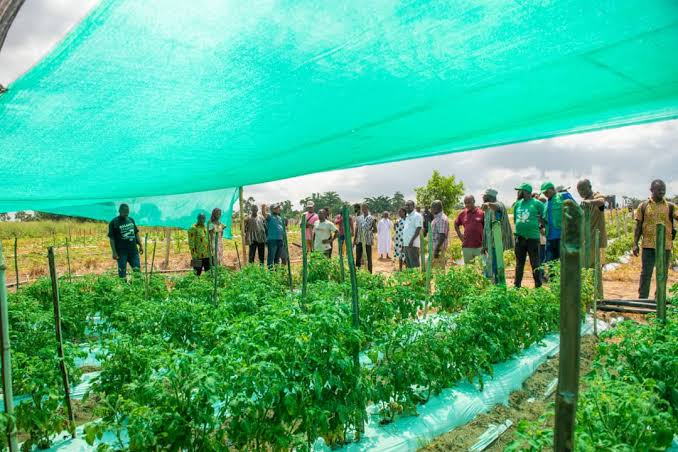
Kamassah has highlighted greenhouse farming as an example of why conventional short-term finance may not fit the sector. “Greenhouses are expensive, and banks are hesitant to finance agriculture. It takes three years before you can even break even,” he said. That suggests agricultural finance may require credit guarantees, insurance, patient capital and development-finance structures capable of absorbing longer investment horizons.
Climate change is strengthening the case for investment in irrigation and smarter farming systems. Ghanaian agriculture remains heavily dependent on rainfall, making output increasingly vulnerable to weather variability, while predictable water supply can support year-round production and reduce seasonal shortages. The document argues that irrigation should therefore be treated as economic infrastructure in much the same way as roads and electricity.
That approach would also require better use of existing assets. Kamassah has questioned why some irrigation sites remain underutilised when they could support higher agricultural output, suggesting that new infrastructure should not be pursued while existing capacity remains idle. The broader implication is that agricultural policy must focus not only on new spending but on utilisation, maintenance and measurable productivity from infrastructure already financed.
For exporters, consistency is as important as volume. International buyers demand reliable quantities, traceability, quality standards and timely delivery, meaning Ghana cannot build an export industry around occasional surpluses.
Commercial-scale farming, aggregation, cold-chain logistics, packaging, certification and processing are therefore essential if agricultural exports are to become a dependable source of foreign exchange.
The opportunity becomes larger if Ghana moves beyond raw agricultural exports. Processing tomatoes, fruits, vegetables and other commodities domestically can create manufacturing activity, additional jobs and tax revenues while retaining more value before products leave the country. The strategic objective, the document argues, should be to move from farm production to agro-industrial production.
Execution remains the central challenge. Kamassah has warned against agricultural strategies that remain largely on paper, saying, “The policymakers have to think about practicality. It’s not just about writing policies in a book—how are we implementing them?” That question places greater emphasis on measurable targets, transparent financing and accountability for outcomes rather than programme announcements alone.
Government’s role will include providing infrastructure, reducing investment risks and maintaining a predictable policy environment, while the private sector must bring capital, technology, management expertise and market access. Development partners can support the transition through technical assistance and long-term financing, but the sector ultimately needs to become commercially sustainable. The source argues that stronger agriculture could lower food-price pressures, create rural employment, reduce imports, strengthen exports and support industrialisation.
The FAGE call is therefore broader than another request for subsidies to farmers. It is an argument about whether Ghana can convert agricultural potential into predictable, scalable and internationally competitive production capable of supporting a more resilient economic structure. As the document concludes, “The question is no longer whether Ghana can afford to invest more in agriculture. It is whether Ghana can afford not to.”

