

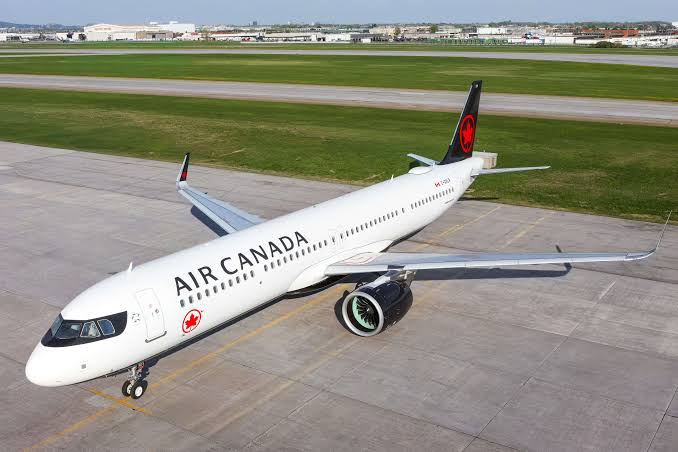

- Air Canada Moves on Lagos as Nigeria’s Aviation Market with Canada Surges
Air Canada is preparing to launch scheduled flights to Lagos in 2027, positioning itself to enter a fast-growing Nigeria-Canada travel market that has more than doubled in size over the past decade and is now Canada’s third-largest bilateral aviation market in Africa
The move follows an expansion of the air transport agreement between the two countries, opening the way for direct scheduled passenger services that were previously unavailable under the bilateral framework. The earlier arrangement, negotiated in 2014 and signed in March 2025, was limited largely to codeshare operations.
Under the expanded agreement, airlines from both countries can be designated to operate scheduled services and are permitted up to 14 passenger flights a week. The framework also allows as many as 10 weekly all-cargo flights for carriers from each country, alongside fifth-freedom rights for cargo operations.
Air Canada has already started the process of obtaining the government approvals needed to serve Nigeria commercially. The airline has not yet disclosed the Canadian city from which the Lagos route would originate, the proposed frequency or the aircraft type that would be deployed.
“We welcome this expanded Air Transport Agreement and look forward to obtaining the necessary government approvals to begin service to Lagos, Nigeria in the coming year,” Mary-Jane Lorette, Air Canada’s vice-president for revenue management, partnerships and international affairs, said.
The commercial case for the route is increasingly difficult to ignore. Transport Canada said Nigeria was its 38th-largest international air transport market in 2025 but its third-largest bilateral market in Africa, behind Morocco and Algeria.
Passenger demand between Nigeria and Canada has more than doubled over the past ten years despite the absence of a direct scheduled connection. Travellers currently tend to route through hubs in Europe, the United States or elsewhere, adding both time and cost to journeys between the two countries.
That means a direct Lagos service would not necessarily be creating demand from scratch. Instead, Air Canada would be attempting to capture an already substantial traffic flow that currently leaks through foreign hubs.
The size of the Nigerian community in Canada provides a further base of demand. More than 25,000 Nigerians held Canadian study permits as of March 31, 2026, while cities such as Brampton have developed sizeable Nigerian-Canadian communities.
Business, education, family travel and tourism therefore provide multiple sources of passenger traffic. That diversity is important because long-haul routes are more resilient when demand is spread across several traveller categories rather than being dependent on a single segment.
Canada also appears to be treating aviation access as part of a broader commercial strategy towards Africa. Ottawa has been looking to diversify its international trade relationships, while Nigeria’s population of more than 237 million gives it particular importance as both a consumer market and regional business hub.
Transport Minister Steven MacKinnon said the expanded agreement is expected to support tourism and trade while making it easier for companies and travellers in both countries to connect. That is where the significance of a direct route extends beyond passenger convenience.
Direct aviation links can lower travel friction for investors, executives and exporters. They can also improve cargo connectivity, particularly for high-value or time-sensitive goods where longer transit times through third-country hubs can weaken competitiveness.
The expanded cargo provisions are therefore as noteworthy as the passenger rights. Up to 10 weekly all-cargo services and fifth-freedom rights create room for airlines to build broader freight networks connecting Nigeria, Canada and third-country markets.
For Nigeria, this could improve access to North American markets if airlines eventually deploy the full capacity allowed under the agreement. For Canada, it offers another gateway into Africa’s largest population centre and one of the continent’s most commercially significant economies.
Air Canada’s proposed Lagos route would also deepen its relatively selective African network. The airline first entered Africa through its Montreal-Casablanca service in 2016, and the planned Nigeria connection would broaden its exposure to the continent.
The move also fits into a wider Canadian push to expand aviation agreements across Africa. Canada concluded its first air transport agreement with Ghana and expanded its arrangement with Senegal in 2025, reflecting growing interest in improving commercial and passenger connectivity with the continent.
Nigeria nevertheless stands out because the travel market has already grown substantially without direct scheduled flights. That gives Air Canada the prospect of entering a route where underlying demand has been demonstrated rather than merely projected.
The economics will still matter. The expanded agreement does not guarantee that airlines will immediately use all 14 weekly passenger frequencies, and Air Canada’s plan remains subject to regulatory approval and commercial assessment.
The carrier has also not indicated whether the Lagos service would operate throughout the year or seasonally. Those decisions will depend on expected load factors, yields, aircraft availability and the balance between business, leisure and diaspora traffic.
But beginning the approval process is significant because it provides the first major commercial test of the expanded bilateral agreement. If the service launches in 2027, passengers would gain a direct scheduled option between Africa’s most populous country and Canada after years of relying largely on connecting itineraries.
It could also create competitive pressure on airlines currently carrying Nigeria-Canada traffic through hubs elsewhere. A nonstop service can be particularly attractive to passengers who value reduced travel time, fewer connections and lower disruption risk.
For Nigeria, the opportunity goes beyond one Air Canada route. The bilateral framework allows multiple airlines from both countries to participate, creating scope for greater capacity and competition if passenger demand continues to expand.
The larger question is whether airlines on both sides will eventually use that space. Aviation agreements create legal capacity, but commercial viability determines whether aircraft actually fly.
For now, Air Canada appears prepared to make the first major move. A Lagos service in 2027 would not only connect two large diaspora and business communities more directly; it would also mark another step in the gradual deepening of Canada’s aviation and commercial engagement with Africa.

