
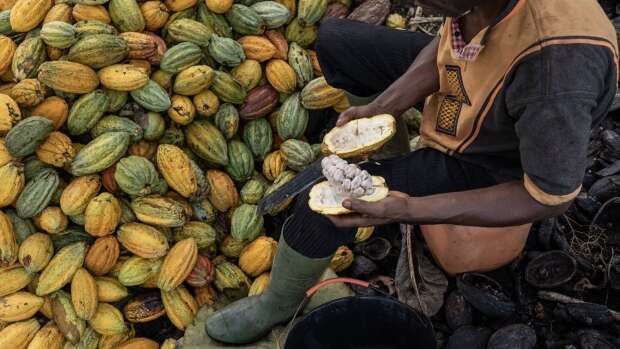

How Did Ghana Get Here: From Predictable Borrowing to a Financing Experiment That Broke the Chain
For years, Ghana’s cocoa system ran on a bargain that was not perfect but was predictable. Farmers delivered beans. Licensed Buying Companies paid farmers quickly. Ghana Cocoa Board (COCOBOD) used a well-worn financing route, anchored by syndicated borrowing, to raise cash early, buy cocoa through the chain, and sell forward into global markets.
It was never cheap. It was never risk-free. But it worked because the pipe was clear: credit came in, cocoa moved, and money flowed down to the farm gate. The farmer’s most important question today, “When will I be paid?”, usually had an answer.
That is why the current crisis is not only about price. It is about a financing chain that snapped, and about trust that is now leaking out of the system faster than any new policy can pour it back in.
The symptoms are visible in human terms. Farmers say they have not been paid for beans delivered since November 2025. Some have threatened demonstrations. Others warn of social stress in the area of children’s school fees, healthcare, basic food, and a loss of confidence across cocoa communities. Look, if you have not heard or read, international coverage has described farmers cutting meals and struggling to maintain their farms as payments are delayed for months.
But symptoms are not the diagnosis. The diagnosis is that Ghana moved from a predictable borrowing model into a financing experiment that depended on behaviour that could not be enforced: international buyers paying large deposits upfront, early in the season, and carrying pre-financing risk that Ghana Cocoa Board (COCOBOD) used to manage.
That experiment has been described plainly in reporting carried by NorvanReports: a revamped system introduced for the 2024/25 season shifted the burden of pre-financing purchases from Ghana Cocoa Board (COCOBOD) to international traders, but traders resisted paying deposits of at least 60% of forward contract value, leaving a stockpile and delays rippling down to farmers.
In a market, you can demand many things. You cannot demand that other people lend you money on terms they no longer like.
And the timing could not have been worse. Cocoa prices on the world market have fallen sharply, with Reuters reporting prices halving over a year to around $4,000 a tonne. This means Ghana’s fixed farmgate price became hard to defend and hard to finance. Once buyers concluded Ghana’s cocoa was “uncompetitive and very expensive”, the logic of upfront pre-financing collapsed.
So, the chain broke at the weakest point: the farmer.
This is why I keep coming back to a single framing that matters more than the politics of “price cut” versus “price increase”: “Liquidity rescue vs. farmer confidence”. The state can reset prices. But if arrears persist, farmer trust collapses, and next-season investment collapses with it. That is not a headline problem. That is a production problem.
Farmers invest in the next season with today’s cash. If payments are delayed, they prune late, spray late, apply fertiliser late, hire fewer hands, and sometimes abandon maintenance entirely. NorvanReports has already pointed to this risk in their news article: payment delays threaten farmers’ ability to service loans and do January maintenance like pruning and fertiliser application.
But the government now says it is acting because the risk is no longer theoretical. In the Finance Minister’s national address, the crisis is presented as both immediate and structural: a liquidity crunch, a failed financing model, and a legacy of financial distress at Ghana Cocoa Board (COCOBOD) stretching back years.
The numbers and admissions are sobering, as his address says Ghana Cocoa Board (COCOBOD) finances deteriorated significantly by 2022, leading to a first-ever default and restructuring of cocoa bills in 2023, and the 2023 syndicated loan faced major delays due to lost confidence in the economy. He added that the board defaulted on a $70m bridge finance from the Ministry of Finance (Ghana) in July 2024 and finally pointed the nation and the media to a production in 2023/24 which was 432,145 tonnes against a projected 800,000 tonnes, priced low, producing losses of “over $1 billion”.
These are not small errors. They are the kind of balance-sheet damage that makes any financing model fragile, especially one that expects other people to prepay willingly.
Then there is the most politically sensitive projects. The address says road construction contracts, particularly between 2018 and 2021, accounted for a significant portion of Ghana Cocoa Board (COCOBOD)’s financial difficulties. That line should force a national, deeper question: was cocoa being run as a cocoa business, or as a parallel public finance system?
If the answer is “both,” then the crisis was always going to arrive, because markets eventually punish blurred mandates. A cocoa regulator that behaves like an infrastructure ministry eventually meets the same constraint every government meets: you cannot promise everything and still pay everyone on time.
And now, the unpaid open. Dr Ato Forson reports that the Ghana Cocoa Board (COCOBOD) is saddled with about 50,000 metric tonnes of unsold cocoa at the ports, while Licensed Buying Companies are owed about GH¢2.04bn, with some farmers unpaid since November 2025. The media similarly reports Ghana holding tens of thousands of tonnes unsold and links the backlog to the mismatch between Ghana’s fixed price and global prices. In that setting, the producer price announcement on February 12, 2026 is best understood not as a moral judgement about what farmers “deserve”, but as a liquidity decision meant to stop the pipe from bursting completely.
As we know now the new producer price is GH¢41,392 per tonne (GH¢2,587 per bag), a reduction from the previous GH¢51,660, effective February 12, 2026. The Finance Minister’s address repeats the same new price and ties it to injecting liquidity and reflecting market realities. A separate government release from October 2025 confirms the earlier 2025/26 producer price level (GH¢51,660 per tonne; GH¢3,228.75 per bag) and frames it as 70% of the average Gross FOB at the time.
But here is the point I think Ghana must not dodge: a “price” that does not arrive as cash is not a price. It is a promise. And right now, that promise is discounted in cocoa communities.
This is why the government’s emergency measures matter most where they meet the arrears question.
We know, according to the Minister of Finance, that the Cabinet directed the Ghana Cocoa Board (COCOBOD) to commence immediate payment of outstanding arrears, following an emergency meeting on February 11, 2026.
Good. But the hard question is: what is the payment plan in dates and amounts, and who verifies it?
Farmers do not rebuild confidence with announcements. They rebuild confidence with receipts.
This is also where the broader reforms begin to look less like politics and more like necessity.
First, the proposed Cocoa Board Bill, meant to institutionalise automatic price adjustment and guarantee farmers at least 70% of Gross FOB, goes directly to the core weakness of a fixed price regime in a volatile global market. I have seen the media, including my own outlet NorvanReports, report the same intent: linking farmgate rates to international market prices and guaranteeing 70% of FOB.
Why does that matter? Because the current crisis is, in part, a mismatch problem: Ghana’s internal price remained high while global prices dropped, and financing stopped because no one wanted to buy cocoa that implied a loss. Automatic adjustment is not a miracle. But it is a way that the market will continue until the chain breaks again.
Second, the shift to domestic cocoa bonds, starting from 2026/27, is an attempt to end dependence on a single annual external borrowing ritual and rebuild a revolving liquidity pool. It is also, in plain terms, a bet that domestic capital will carry cocoa risk more reliably than foreign buyers who can walk away.
That could help. It could also transfer risk into the domestic financial system if the structure is not tight, transparent, and insulated from politics. The lesson of the last few years is not “finance is bad.” It is “opaque finance breaks quickly.”
Third, the crack is not optional. The address says the new bill will prohibit non-core expenditure such as road construction, with penalties. That matters because if cocoa money is again used to do what the budget should do, the same liquidity crisis will return in a different disguise.
The government’s plan to clean up the balance sheet points in that direction: seeking parliamentary approval to convert GH¢5.8bn of legacy debt owed by Ghana Cocoa Board (COCOBOD) to the Ministry of Finance (Ghana) and Bank of Ghana into government liabilities, transferring GH¢4.35bn in road liabilities away from Ghana Cocoa Board (COCOBOD), and pointing to a $500m World Bank financing. That is an admission that the old model mixed mandates in a way that damaged the cocoa core.
Fourth, the local processing push is being treated as a pillar, not a side project. Government says it will allocate the remaining 2025/26 beans for domestic processing and mandate at least 50% local processing from 2026/27, while reviving the Produce Buying Company (PBC) and Cocoa Processing Company (CPC).
Here, I will be blunt: value addition is the right ambition, but mandates can create new losses if the economics are financing costs, efficiency, quality control, and export market access will decide whether “process 50%” becomes industrial growth or industrial subsidy. That is why the government’s engagement with processors matters: The Minister of Finance reported that he and the Madam Elizabeth Ofosu-Adjare met processors on February 12, 2026, and the Trade Minister linked cocoa reforms to broader macro stability, including cedi strength.
The promise is big. The, how did Ghana get here? We got here because predictable borrowing, however imperfect, was replaced by a financing arrangement that assumed buyers would pre-finance on command, even as the global market turned. We got here because internal pricing and external pricing drifted apart until the gap became unfinanceable. We got here because historic financial distress and defaults weakened credibility. We got here because the cocoa institution carried non-core obligations that pulled cash away from the farm. And we got here because when the pipe finally blocked, the farmer, always last in line, became the lender of last resort.
That is the broken chain. And that is why the new reforms are needed, not because Ghana enjoys changing prices mid-season, but because a cocoa system that cannot pay farmers on time is not a cocoa system at all. It is a crisis machine.
If the reforms do one thing, they must do this: restore trust by restoring cash discipline. Pay arrears with a clear timetable. Anchor prices to reality so the market keeps buying. Stop non-core spending so cocoa money stays cocoa money. Build a financing pool that does not depend on goodwill deposits. And make the rules enforceable, not poetic.
Ghana’s cocoa is still valuable. But cocoa does not grow on speeches. It grows on farmer confidence. And farmer confidence grows on one simple habit: deliver cocoa, get paid, on time and every time.

