

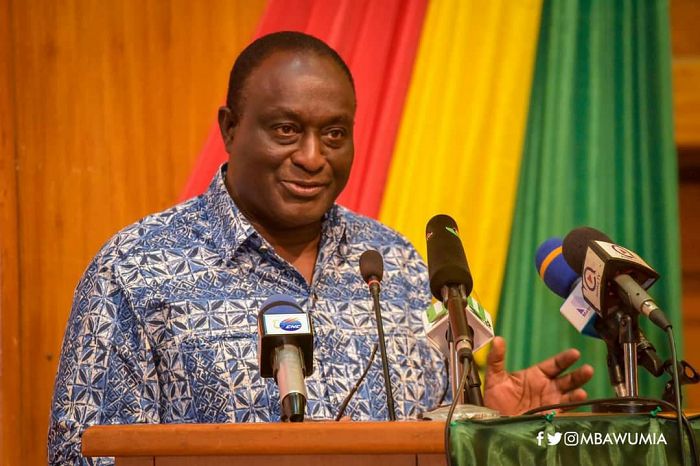

- Alan’s KENOMICS Plan Seeks One-Year Mining Freeze and Corporate Ownership for Miners
Alan Kyerematen has proposed a one-year suspension of all small-scale mining in Ghana, arguing that the distinction between licensed operations and illegal mining has become too blurred for the country to restore its rivers and forest reserves through enforcement alone.
The former Trade and Industry Minister said the proposed moratorium should be used to conduct a forensic audit of every small-scale mining licence, reclaim degraded land and reorganise informal miners into regulated corporate entities.
“Let’s impose a one-year temporary ban on small-scale mining activity,” Mr Kyerematen said during a public lecture outlining his economic transformation framework, branded KENOMICS.
“Within that one-year period, we have to reclaim all the land and then also restore our water.”
The proposal represents one of the most extensive policy interventions advocated by a senior political figure in response to illegal mining, known locally as galamsey.
It would suspend not only operations already classified as illegal but also licensed small-scale miners until the government had established which concessions were being used responsibly and which licences had become a cover for activities outside approved areas.
Mr Kyerematen argued that Ghana’s current licensing system could not be trusted to distinguish consistently between lawful and unlawful operations.
He alleged that some licence holders had been allocated areas with limited gold deposits and subsequently moved their machinery and workers into locations where they had no legal right to operate.
“People who are holding small-scale licences, the areas that have been given to them, they know there’s no gold there,” he said.
“So they use their licence to operate in areas where they do not have the right to mine.”
The claim goes to the heart of Ghana’s enforcement problem. A miner may hold a valid licence, but that authorisation applies to a defined concession and does not permit extraction in river bodies, forest reserves or other unapproved locations.
If operators can present legitimate documents while working outside the boundaries covered by those documents, enforcement becomes more complicated than simply separating licensed companies from unlicensed miners.
Mr Kyerematen said the one-year suspension should be accompanied by a forensic review of licences, concessions, equipment and operating records.
A forensic audit would have to establish more than whether a licence exists.
It would need to determine whether the holder is the beneficial owner of the operation, whether mining is occurring within the approved concession, whether environmental obligations have been met and whether production and gold sales correspond with official records.
The review would also need to track excavators and other heavy equipment used at mining sites.
Ghana has previously introduced registration and tracking measures for earthmoving machinery, but illegal mining has persisted, indicating that the existence of a database is insufficient without consistent inspection and enforcement.
“You have a licence,” Mr Kyerematen said. “Go and show us where you mine.”
“If you go and review the forensic audit and you have mined responsibly, your licence is restored.”
Under his proposal, operators that passed the review would be allowed to resume work after the moratorium. Those found to have breached concession boundaries or environmental requirements would lose their authorisation.
Such an exercise would require transparent criteria and an appeals process to avoid arbitrary decisions or political interference.
It would also need an independently verifiable digital register showing the location, ownership and status of every small-scale mining licence.
Without public disclosure, a forensic audit could become another administrative exercise whose findings are difficult for citizens, journalists and affected communities to scrutinise.
The proposed moratorium would create a defined period for restoring polluted rivers, reclaiming abandoned pits and protecting forest reserves.
Mr Kyerematen said the environmental cost of illegal mining had become too great to justify policies focused mainly on the foreign-exchange benefits of gold.
“If you are saying that you want to support our cedi, and so we use money to buy gold to mobilise reserves and use it to support [the currency], by the time you finish supporting your currency, there will be no life for me to enjoy,” he said.
The argument highlights a growing policy contradiction.
Gold exports strengthen Ghana’s trade balance and generate foreign currency. Domestic gold-purchase programmes may also support reserve accumulation and reduce reliance on external borrowing.
But those financial benefits can obscure the cost of polluted water, destroyed farms, unsafe pits and the future expense of restoring degraded land.
An increase in gold revenue is not an unqualified economic gain if part of that value is obtained by transferring environmental costs to communities and future taxpayers.
The challenge is to ensure that gold contributing to Ghana’s official exports and reserves can be traced to operations meeting environmental and labour standards.
A one-year suspension could create space for such reforms, but only if restoration is properly financed and implemented.
Reclaiming land and treating polluted rivers are complex and expensive. The government would need to determine whether the cost should be carried by licence holders, the state or a dedicated fund supported by the mining industry.
Mr Kyerematen’s proposal differs from a simple prohibition because it includes a plan to reorganise people currently working at informal mining sites.
He argued that young miners should be brought together into properly constituted companies and provided with machinery, technology, training and regulated concessions.
“You bring them together, you create a company for them,” he said.
“You give them all the machinery they need, the technology they need and then also the training, and then give them the licence.”
Mr Kyerematen said this approach could transform miners from casual labourers working for politically connected or financially powerful sponsors into owners of formal mining enterprises.
“Within one year, these boys can become owners of mining companies in Ghana,” he said.
The model seeks to address one of the central weaknesses in previous anti-galamsey campaigns: enforcement may remove workers from illegal sites without providing a commercially credible alternative.
Where mining communities lack other income sources, displaced workers may return to illegal operations once enforcement pressure declines.
Corporate formalisation could give miners a legal economic stake and improve accountability. A registered company can be taxed, audited and sanctioned more easily than a shifting network of informal operators.
But forming companies on paper would not be enough.
Mining is capital-intensive, and equipment supplied without strong governance could be diverted back into unauthorised areas. Companies would require qualified managers, environmental plans, financial controls and monitored access to approved processing facilities.
The proposed entities would also need transparent ownership structures to prevent influential sponsors from controlling them indirectly while local miners serve merely as nominal shareholders.
A nationwide moratorium would carry significant economic and social costs.
Small-scale mining supports many workers directly and sustains traders, transporters, equipment operators and communities indirectly. Suspending the entire sector for a year could sharply reduce household incomes in mining districts.
It could also reduce official gold purchases and encourage smuggling if enforcement is uneven.
The credibility of the policy would therefore depend on whether it applies equally to politically connected operators and ordinary miners.
Previous campaigns have often been weakened by accusations of selective enforcement, seized equipment disappearing and politically exposed individuals receiving protection.
A new suspension would need independent oversight, public reporting and clear rules governing the seizure and return of machinery.
Alternative livelihoods would also need to be economically realistic. Short training programmes or temporary public works cannot easily replace the income miners expect from gold.
Mr Kyerematen’s corporate model attempts to avoid that weakness by preserving mining as a livelihood while changing how it is organised.
Its success would depend on whether the government could complete the audit, establish new companies, restore licences and prepare compliant sites within the proposed one-year period.
The small-scale mining plan forms part of KENOMICS, Mr Kyerematen’s proposed economic framework for moving Ghana from stability to growth and ultimately prosperity.
The model calls for an enterprise economy “with African characteristics”, reflecting Ghana’s high level of informality, dependence on commodity exports and need for state-supported private-sector development.
Mr Kyerematen also proposed greater domestic processing of gold, cocoa, oil and other resources, expansion of non-traditional exports, lower interest rates, venture-capital financing for small businesses and strategic investment in manufacturing, agriculture and tourism.
He argued that Ghana’s economy had remained dependent on the same raw commodities for more than a century, despite repeated periods of growth and economic reform.
The mining proposal illustrates the broader philosophy behind his model: natural resources should be converted into domestic ownership and productive enterprise without sacrificing the environment.
Whether a complete one-year ban is administratively and politically achievable remains uncertain.
But the proposal forces a central question into Ghana’s mining debate: if licensed and illegal operations have become intertwined, can incremental enforcement still repair the sector, or does the country require a temporary shutdown and complete reconstruction of the licensing system?
For Mr Kyerematen, the answer is a reset.
“What was supposed to be a blessing has now become a curse,” he said.

