


- Argentina Hit with Player Bans, Stadium Sanctions and US$321,000 Fine After World Cup Final Fracas
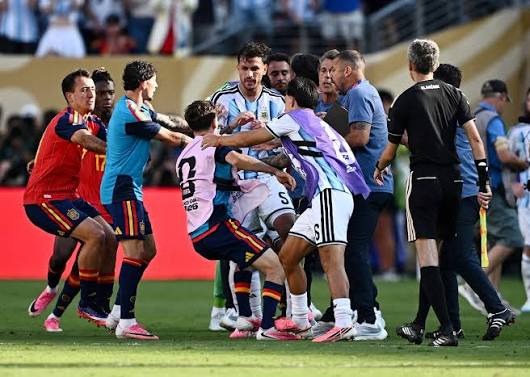
Argentina have been handed a series of disciplinary sanctions following the disorder that broke out after their 1-0 extra-time defeat to Spain in the 2026 FIFA World Cup final, with Leandro Paredes suspended for 10 matches and Nahuel Molina banned for seven.
The sanctions, issued by FIFA, extend beyond the two players. Argentina have also been ordered to play two home matches at 50.00% stadium capacity, while the Argentine Football Association has received a US$321,000 fine in a separate disciplinary matter linked to a political banner displayed after the team’s World Cup semi-final victory over England.
The punishments represent a significant post-tournament blow for Argentina after a campaign that ended in defeat to Spain in the final at the New York/New Jersey Stadium in East Rutherford on July 19.
Paredes was handed the heavier sanction after becoming involved in multiple clashes with Spanish players, including Gavi, in the confrontation that followed the final whistle.
Molina was also involved in the altercations and received a seven-match suspension.
Spain players Eric Garcia and Dani Olmo were among those caught up in the post-match disorder.
The scenes overshadowed what had already been a tense final, with Spain eventually winning 1-0 after extra time.
For Argentina, the consequences will now stretch well beyond the tournament itself.
A 10-match suspension is substantial at international level because national teams play comparatively fewer fixtures than clubs. Depending on Argentina’s schedule, Paredes could miss a significant part of the team’s next competitive cycle.
Molina’s seven-match ban is similarly disruptive.
The stadium sanction adds another layer to the punishment, with Argentina required to stage two home fixtures with only half of available capacity.
That measure directly affects supporters as well as the federation, reducing the number of fans able to attend and potentially lowering matchday revenue from ticketing and other stadium-related activity.
The disciplinary action also underlines FIFA’s willingness to impose collective sanctions where player conduct escalates beyond individual incidents.
Argentina’s problems were compounded by a separate case involving the team’s World Cup semi-final against England.
Following Argentina’s 2-1 victory over England, some players displayed a banner carrying the message “Las Malvinas Son Argentinas” — “The Falklands are Argentine.”
The slogan refers to Argentina’s longstanding sovereignty claim over the Falkland Islands, known in Argentina as the Malvinas, and the 1982 war fought between Argentina and the United Kingdom over the British-controlled territory.
FIFA imposed a US$321,000 fine on the Argentine Football Association over the incident.
The episode highlights the governing body’s longstanding restrictions on political messages in football settings, particularly where national teams and official competition spaces are involved.
For Argentina, the combination of the fine, crowd restrictions and player suspensions creates a disciplinary hangover from a tournament that had already ended in disappointment.
The final itself should have been remembered primarily for Spain’s victory and Argentina’s attempt to defend their status at the top of world football.
Instead, the post-match clashes have become one of the defining images of the aftermath. The Paredes case is especially notable because of the length of the suspension.
A 10-match international ban effectively removes a senior player from a large block of national-team activity, potentially affecting selection continuity and squad planning.
Argentina’s coaching staff will now have to prepare for upcoming fixtures without both Paredes and Molina for extended periods.
The sanctions also place renewed emphasis on discipline during major tournaments, particularly in matches where tensions can spill over after the final whistle.
World Cup finals carry extraordinary emotional and competitive pressure, but FIFA’s punishment makes clear that misconduct after a match can carry consequences almost as significant as events during play.
The two-match capacity restriction could also have symbolic importance. Argentina’s home support has traditionally been a major part of the national team’s identity, and staging matches with half-empty stands will make the disciplinary impact visible long after the World Cup has ended.
The political banner case is separate from the final fracas but adds to the federation’s disciplinary burden.
The Falklands/Malvinas dispute remains a deeply sensitive political issue in Argentina, where the islands are claimed as sovereign territory.
But displaying the message in the context of a FIFA competition exposed the federation to sanctions under rules governing political expression.
Taken together, the penalties show how quickly the consequences of a major tournament can extend beyond results on the pitch.
Argentina left the 2026 World Cup as losing finalists. They now also face the prospect of beginning their next phase with two senior players unavailable, reduced-capacity home matches and a substantial federation fine.
For Paredes and Molina, the bans will be felt immediately. For the Argentine Football Association, the wider issue is reputational and institutional.
A World Cup campaign that came within one match of another title has instead ended with disciplinary action across several fronts a costly reminder that conduct after the whistle can have consequences long after the tournament itself is over.

