

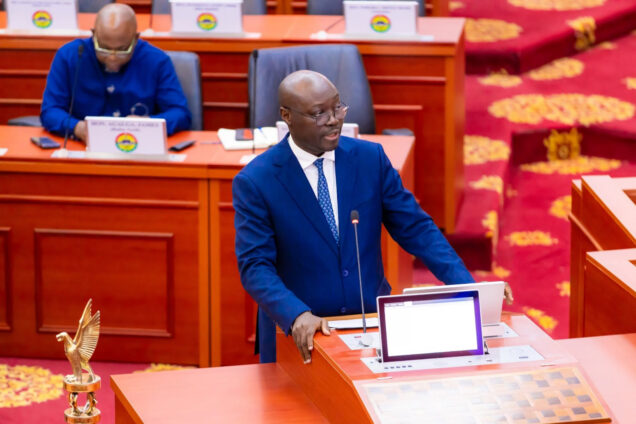

- Ato Forson Presents GH¢389.2bn Spending Plan for 2027
Ghana’s 2027 Budget sets out a GH¢389.2 billion spending plan and a clear argument for how public money should be used: more of it should build assets, expand production and create jobs.
The credibility of that shift will depend on whether the budget can turn allocations into completed projects and measurable gains while keeping debt and recurrent costs under control.
The government has budgeted GH¢100.4 billion for capital expenditure on a cash basis, equal to 5.60% of GDP. When capital spending financed through transfers to other government units is included, the total rises to GH¢120.5 billion, or 6.70% of GDP.
Finance Minister Dr Cassiel Ato Forson said the plan marked “a decisive shift towards productive expenditure, putting more of Ghana’s money into the assets that will expand production, create jobs and raise incomes.”
The scale is substantial. Capital expenditure is set to exceed the GH¢61 billion allocated for interest payments and the GH¢92.7 billion budgeted for wages and salaries.
Yet total employee compensation is estimated at GH¢104.1 billion, while interest payments are projected at GH¢61 billion.
These figures show the competing demands within the budget: building infrastructure, paying public workers and meeting the cost of borrowing.
The investment case is strongest where public spending unlocks activity beyond government. Roads can reduce transport costs; reliable power can help factories operate; irrigation and storage can limit post-harvest losses.
But an allocation is not an asset, and a project is not productive simply because it is classified as capital expenditure. The ultimate test is whether the spending removes a constraint, serves a clear economic need and creates benefits that endure after construction ends.
That makes project selection and delivery as important as the headline increase in capital spending. Delays, cost overruns and weak procurement can leave the country with higher expenditure but fewer usable assets.
The government’s own formulation expanding production, creating jobs and raising incomes offers a useful standard against which projects can be judged.
It also invites public scrutiny of which projects are completed, who benefits and whether they deliver the promised value.
The spending plan assigns GH¢30 billion to the New Economy programme and GH¢29.8 billion to the Big Push programme.
Education receives GH¢48 billion, while GH¢40.3 billion is allocated to the Ministry of Health. Those commitments reflect the government’s attempt to balance physical investment with services that directly affect people and the skills and health of the workforce.
But the budget’s room for manoeuvre remains constrained. Transfers to statutory and earmarked funds are projected at GH¢76.5 billion. A further GH¢13.9 billion is set aside to clear arrears, including GH¢4.3 billion in legacy obligations to independent power producers.
Such payments may address obligations that have built up over time, but they also reveal how previous commitments compete with new priorities for the same public resources.
The government forecasts revenue and grants of GH¢323.4 billion, equivalent to 17.90% of GDP, against expenditure of GH¢389.2 billion.
That produces a cash-basis deficit of GH¢65.8 billion, or 3.60% of GDP. On a commitment basis, the deficit is projected at GH¢51.9 billion, with a primary surplus of GH¢9 billion, equivalent to 0.50% of GDP.
The difference between the cash and commitment measures matters. They capture different views of the government’s fiscal position, and readers should not treat the primary surplus as evidence that the entire budget is balanced.
The cash deficit reflects the gap between money received and spent; the commitment balance accounts for obligations on a different basis and excludes interest costs in the primary balance. Both figures are relevant to understanding the government’s plans and financing needs.
Debt management is another prominent feature of the budget. The government intends to redeem GH¢29 billion of Domestic Debt Exchange Programme bonds that were due in February 2027, with the payment brought forward using funds in the Cedi Sinking Fund Account.
The Finance Minister said more than GH¢36 billion in debt would be cleared ahead of schedule by December 2026.
Early repayment can reduce uncertainty for bondholders and demonstrate that funds reserved for debt obligations are available.
It also raises a question of prioritisation: how should government balance early debt repayment against the need to finance infrastructure, social services and arrears?
The answer depends partly on the terms of the debt, the cost of carrying it and whether the funds used for repayment could otherwise generate a greater public return.
The budget’s central promise is that investment can help move Ghana from stabilisation towards stronger production and employment. That promise will not be settled by the GH¢100.4 billion cash capital allocation or the GH¢120.5 billion broader measure. I
t will be settled by delivery: completed projects, reliable services, lower costs for businesses, jobs that last and public investments that support private activity.
The scale of the plan makes transparency essential. Regular reporting on project costs, timelines, procurement and outcomes would allow Parliament and the public to distinguish between money allocated and value delivered.
It would also reveal whether capital expenditure is concentrated in ready-to-execute projects or dispersed across commitments that may take years to materialise.
Ghana’s 2027 spending plan gives productive investment a more prominent place in the fiscal story. But it also carries a sizable cash deficit, heavy compensation costs, large transfers and debt obligations.
The government is asking citizens to believe that a higher investment allocation will yield a different kind of growth.
The test will be whether the assets built with public money expand the economy’s capacity to produce and whether the benefits reach the households and businesses expected to carry the next stage of growth.

