

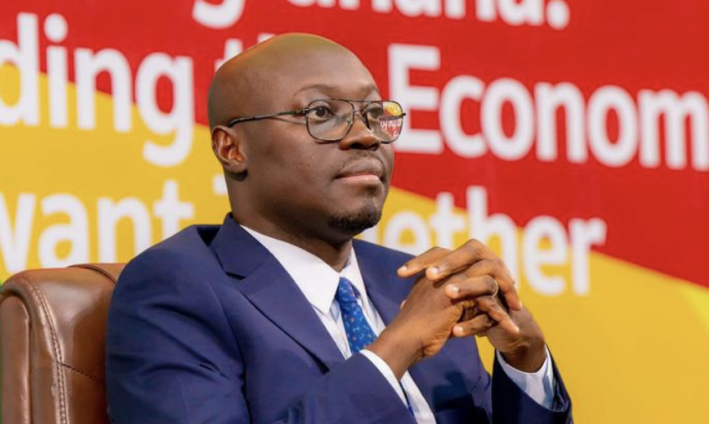

- Ato Forson Says Managing Ghana’s Public Purse Is a ‘Sacred Duty’
Ghana’s Finance Minister, Dr Cassiel Ato Forson, has described the management of taxes, government borrowing and public expenditure as a “sacred duty”, placing personal integrity and accountability at the centre of his stewardship of the country’s finances as the government seeks to consolidate recent fiscal gains.
Dr Forson said the principle that guides him most in office is maintaining a clear conscience about how public resources entrusted to him have been managed.
“What guides me most is a clean conscience. When I go to sleep, I know I haven’t done anything wrong,” he said, while also stating that he had not taken public funds for himself.
His remarks, made in an interview shared by TV3 Ghana, are personal assertions about his conduct rather than an independent assessment of Ghana’s public financial management. They nevertheless come at a consequential moment for the country’s fiscal policy, as government attempts to sustain tighter expenditure control after years of elevated deficits, debt accumulation and restructuring.
The broader numbers show a marked improvement in the headline fiscal position.
Bank of Ghana data show the overall fiscal deficit narrowed to GH¢9.9 billion, equivalent to 0.6% of GDP, in the first half of 2026, compared with GH¢21.4 billion, or 1.5% of GDP, during the same period a year earlier.
The primary balance recorded a surplus of GH¢11.5 billion, or 0.7% of GDP, providing evidence that government revenue excluding interest costs was exceeding primary expenditure during the period.
The improvement, however, reflects a combination of stronger revenue and restrained expenditure rather than revenue performance alone.
Total revenue and grants reached GH¢99.39 billion in the first six months, 16.1% higher than a year earlier but still 10% below the programmed GH¢110.41 billion. Government expenditure stood at GH¢109.38 billion, 24.9% below budget, partly because interest payments and capital expenditure were lower than programmed.
A lower deficit produced partly by delayed or below-budget expenditure does not necessarily carry the same economic implications as one produced entirely through sustainable improvements in revenue mobilisation and structural reductions in recurrent spending. The durability of the fiscal adjustment will consequently depend on what happens as delayed investment is executed and other spending pressures emerge.
Ghana’s public debt stood at GH¢719.5 billion, equivalent to 45% of GDP, at end-June, according to the central bank, with nominal debt increasing partly as government built buffers for future debt-service obligations.
The 2026 Budget has made fiscal discipline a central pillar of economic policy, establishing a target for a primary surplus of at least 1.5% of GDP on a commitment basis. Government has also amended the Public Financial Management framework to anchor a medium-term debt ceiling of 45% of GDP by 2034 and a minimum annual primary surplus of 1.5%.
Those rules are intended to shift fiscal discipline away from reliance on the preferences of individual finance ministers towards institutional constraints capable of surviving political and administrative transitions.
That is where Dr Forson’s emphasis on personal stewardship intersects with the larger public-finance challenge.
The Ministry of Finance sits at the centre of decisions over taxation, borrowing and spending, with consequences extending across interest rates, inflation, exchange-rate stability, infrastructure investment and private-sector access to credit. Persistent government borrowing can compete with businesses for domestic liquidity, while uncontrolled deficits can eventually increase debt-service burdens and undermine macroeconomic stability.
Taxpayers, investors and development partners also depend on procurement systems, commitment controls, audits, parliamentary oversight, transparent reporting and enforceable fiscal rules to ensure public resources are properly managed regardless of who occupies the Finance Ministry.
Government has sought to strengthen some of those safeguards, including through a commitment-authorisation regime across ministries, departments and agencies and the creation of oversight structures such as the Independent Fiscal Council and Office of Value for Money.
Financial difficulties at state-owned enterprises, accumulated arrears and government guarantees can eventually migrate onto the sovereign balance sheet even when they are not immediately visible in the headline deficit. Effective fiscal management therefore requires government to identify contingent liabilities early and determine how commercially weak public entities should be restructured or financed.
The challenge may become more demanding as Ghana moves from economic stabilisation towards greater spending on growth, infrastructure, employment and productive investment.
Fiscal discipline is often easier to assert during adjustment than to preserve when revenues improve and political pressure rises for additional expenditure. The government’s credibility will therefore depend on whether stronger growth can coexist with expenditure controls and declining debt vulnerabilities.
For Dr Forson, the personal benchmark is his stated confidence in how he has handled resources entrusted to the Finance Ministry.
A credible fiscal reset will ultimately be judged through sustained primary surpluses, stronger revenue mobilisation, controlled arrears, transparent expenditure, manageable borrowing and debt that remains on a sustainable trajectory.
As the Finance Minister describes stewardship of the public purse as a sacred duty, the longer-term test will be whether that principle becomes embedded not simply in the conduct claimed by an individual officeholder, but in institutions strong enough to protect public money whoever occupies the office.

