

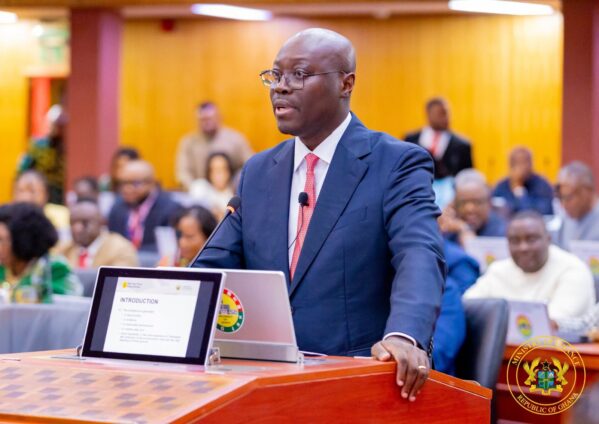

- Ato Forson to Present Jobs-Focused 2027 Budget on November 12
Finance Minister Dr Cassiel Ato Forson will present Ghana’s 2027 Budget Statement and Economic Policy to Parliament on November 12, with job creation, productivity and economic transformation expected to dominate the government’s policy agenda.
Deputy Finance Minister Thomas Nyarko Ampem announced the presentation date during the launch of the Ghana Statistical Service’s Ghana in Numbers 2025 report in Accra.
He said the budget would outline the next phase of the government’s economic programme and provide details of its New Economy agenda, which seeks to move Ghana beyond macroeconomic stabilisation towards productive investment, job creation and improved living standards.
“Stability is the foundation. Productivity is the engine. Jobs and prosperity must be the destination,” Mr Ampem said.
The Deputy Finance Minister indicated that the government’s immediate task was to ensure that improving economic indicators translated into higher incomes, employment opportunities and measurable improvements in household welfare.
Ghana’s economy expanded by 6.00% in 2025 and grew by 6.20% during the first half of 2026. Inflation also declined from 23.80% in December 2024 to 5.20% in September 2026.
Despite those improvements, unemployment, informality and limited opportunities for young people remain major weaknesses. The 2027 Budget will therefore face the more difficult task of converting macroeconomic stability into employment-intensive growth.
“We must move from exporting raw materials to exporting value and from producing job seekers to nurturing innovators, entrepreneurs and job creators,” Mr Ampem stated.
Sources familiar with preparations for the budget say it could be presented under the theme “New Economy, New Ghana: Jobs and Prosperity,” although the proposed theme has not yet been officially confirmed.
The government is expected to prioritise local value addition, commercial agriculture, agro-industry, energy-sector reforms, critical minerals, textiles and garments, tourism, culture and the creative economy.
These sectors have been identified as areas capable of expanding production, increasing exports and creating jobs at scale if the government can direct capital towards viable projects and remove constraints facing private businesses.
The Finance Ministry has previously described the New Economy programme as a transition from economic stabilisation to job creation, sustainable growth and wealth generation.
“Stabilisation was never the destination. It was the price of entry. Ghana has paid that price,” Dr Forson said during consultations on the programme.
“What comes next is the work that changes lives at scale—the work of transformation.”
President John Dramani Mahama has indicated that the programme will involve approximately US$10 billion in investment across selected sectors. The 2027 Budget is expected to explain how that amount will be mobilised, the period over which it will be deployed and the respective contributions expected from government, development partners and private investors.
The credibility of the employment agenda will depend heavily on these details. Large headline commitments do not automatically create sustainable jobs. The budget must identify the projects to be financed, expected employment outcomes, implementation institutions and mechanisms for measuring performance.
The government is also expected to announce significant allocations for the completion of ongoing infrastructure projects. However, overall expenditure is not anticipated to depart substantially from projections contained in the 2026 Budget.
Dr Forson may propose a reduction in the primary surplus target to create additional room for growth-supporting expenditure. Such a move would signal a carefully managed shift from strict fiscal adjustment towards investment, but it could also introduce risks if the additional space is used for recurrent consumption rather than productive projects.
The budget will therefore need to balance two potentially competing objectives: creating sufficient fiscal space to support jobs and maintaining the discipline required to protect Ghana’s recent gains.
Sources say the government is likely to target economic growth of approximately 5.00% in 2027 and inflation of 8.00%, within a tolerance band of two percentage points.
The medium-term strategy is also expected to preserve debt sustainability, avoid excessive fiscal deficits and strengthen protection for poor and vulnerable households.
Achieving these objectives simultaneously will be challenging. Infrastructure, industrial financing and social protection require significant public resources, while Ghana remains constrained by debt-service obligations, limited access to international capital markets and a narrow domestic revenue base.
The quality of spending will consequently matter as much as its size. Government expenditure must crowd in private investment, reduce business costs and strengthen industries capable of sustaining employment without permanent state support.
Commercial agriculture and agro-processing could create jobs outside major cities while reducing food imports. Critical-mineral processing could retain more value from Ghana’s natural resources. Textiles and garments could employ large numbers of young people, while tourism and the creative industries could generate foreign exchange with relatively broad employment effects.
Energy-sector reforms will be equally important because unreliable or expensive electricity can undermine every industrial ambition contained in the budget.
Mr Ampem also called on the Ghana Statistical Service to provide every Member of Parliament with access to its statistical dashboard to support evidence-based debate on the budget.
He said reliable data would improve transparency and strengthen planning and policy evaluation.
The November 12 presentation will consequently be judged on more than growth and inflation projections. Ghanaians will be looking for evidence that the government has developed a practical route from stability to employment.
After years in which economic management focused on debt, inflation and fiscal consolidation, the central question for the 2027 Budget is whether government can preserve those gains while making growth visible in factories, farms, businesses, wages and jobs.

