

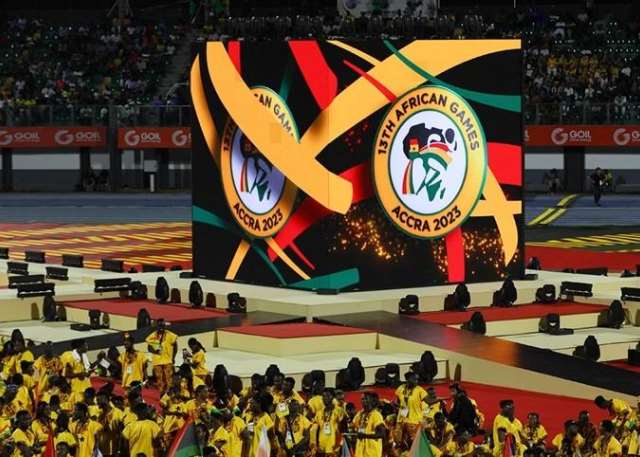

Audit Uncovers GH¢580m Irregularities in Ghana’s 13th African Games Expenditure
A special audit into Ghana’s hosting of the 13th African Games has uncovered financial irregularities amounting to GH¢580.04 million, raising fresh questions over procurement controls, contract pricing, payment approvals and public financial accountability in one of the country’s most expensive recent sporting events.
The audit, conducted by the Audit Service of Ghana following a directive by President John Dramani Mahama, reviewed spending linked to procurement, infrastructure, broadcasting, accommodation, catering, transport, sports equipment, anti-doping services and logistics for the continental event held in Accra.
The findings point to a familiar public finance problem: large national projects are often justified as strategic investments, but weak controls, poor documentation and inflated pricing can turn them into accountability risks long after the event has ended.
According to details of the audit reported by The Vaultz News, the irregularities included unsupported payments, inflated contracts, overpricing, duplicated cost items, weak cash controls and procurement breaches across several components of the Games organisation.
One major area flagged was catering, where services valued at GH¢33.9 million included several non-food cost components without adequate supporting documentation. These reportedly included transport and logistics expenses, utilities, infrastructure and equipment costs, staffing and project management charges embedded within the catering contract without detailed cost schedules or independent verification.
The auditors also raised concerns about possible overlaps between the catering arrangement and other contracts awarded to separate providers, creating the risk of duplicated expenditure.
Anti-doping services were another area of concern. The Ministry reportedly contracted Omni Speciality Product Limited for anti-doping tests at a value exceeding €739,000, but benchmark comparisons with internationally accredited laboratories showed pricing differences estimated at more than GH¢8 million.
Accommodation and transport contracts also came under scrutiny. Auditors reportedly found that hotel rates used in some claims exceeded market rates, with official rates ranging between $50 and $70 per room. The resulting differential was estimated at GH¢10.08 million.
Transportation contracts linked to the same company recorded overpricing of about GH¢13.1 million, while a further GH¢2.2 million was classified as overpayment after invoice recalculations showed inflated quantities and incorrect usage computations.
The audit also questioned more than GH¢15 million in payments reportedly processed through Local Organising Committee accounts for activities outside the approved mandate of the Games. These included advance salary payments and disbursements connected to officials and staff of Ghana’s national football team, according to the report.
Separately, Joy Sports reported that the forensic audit identified more than $40 million in avoidable costs, questionable claims and irregular variations across projects linked to the Games, including the Borteyman Sports Complex, University of Ghana Stadium, Games Village hostels, cricket facilities and access roads.
The Borteyman Sports Complex produced one of the biggest red flags, with auditors estimating a net omission and “opportunity cost for scope shrinkage” of $34.43 million from the original contract value of $145.09 million. Several major components initially captured in the contract were either omitted or significantly rescoped.
Those included warm-up football fields, road works, drainage works, an electrical substation, concrete sidewalks, a children’s playground and equipment installations such as CCTV, irrigation and security systems. Despite the scope reductions, consultant supervision fees reportedly increased after the rescoping exercise.
At the University of Ghana Stadium, auditors flagged claims amounting to $2.81 million as opportunity costs arising from variations and delays, including interest on delayed payments, prolongation costs and cost adjustments.
The findings are likely to intensify public debate over the cost of Ghana’s hosting of the Games and whether the country received value for money from the expenditure.
The 13th African Games were presented as a major opportunity to showcase Ghana’s sporting capacity, improve infrastructure and strengthen the country’s standing as a continental events destination. But the audit findings suggest that the financial management of the Games may now become as important as the sporting legacy itself.
For government, the issue is no longer only whether facilities were built or athletes hosted. It is whether contracts were properly priced, whether payments were supported by evidence, whether procurement rules were followed, and whether public funds were protected.
The audit also raises broader questions about Ghana’s management of large public events. Mega-events often create pressure for fast procurement, emergency contracting and accelerated payments. Without strong controls, that pressure can weaken accountability and open room for inflated costs.
Audit findings, by themselves, do not recover money or punish wrongdoing. The credibility of the process will depend on whether responsible institutions pursue recovery of unjustified payments, refer suspected breaches for investigation and strengthen procurement systems to prevent repetition.
For taxpayers, the central question is simple: how did a national sporting event produce financial red flags of this scale?
Until that question is fully answered, the 13th African Games will be remembered not only for its sporting moments but also for the unresolved public finance concerns now surrounding its cost.

