


- Baku, Malaysia and Singapore Could Decide Whether F1’s 2026 Title Race Stays Alive
Formula One’s 2026 championship enters what could become its defining phase this week as Azerbaijan begins a demanding three-race sequence through Malaysia and Singapore, with 83 points available and Kimi Antonelli holding an 81-point advantage at the top of the standings.
The Mercedes driver arrives in Baku after back-to-back victories at Monza and Madrid, while his main rivals are rapidly running out of opportunities to close the gap.
The next three weekends may therefore determine whether the championship remains a genuine contest into the final rounds or becomes largely a battle over the positions behind the leader.
Antonelli’s advantage is imposing not only because of its size but because of the form behind it. The 20-year-old has won eight races this season and leads team-mate George Russell by 81 points, while Mercedes have taken 10 victories from the opening 14 rounds.
Lewis Hamilton sits 101 points off the lead and Lando Norris 106 behind, leaving both with little room for further setbacks if they are to remain mathematically and competitively relevant.
The calendar now creates exactly the kind of compression that can either stabilise or destabilise a championship. Azerbaijan is followed immediately by the relocated Bahrain Grand Prix at Sepang in Malaysia and then Singapore, where the Sprint format adds eight additional points to the usual grand prix allocation.
Across the three weekends, there are 75 points available from the races and eight from the Singapore Sprint, enough to reshape the standings if Antonelli encounters trouble and one rival strings together a sustained run of results.
Baku is perhaps the least forgiving place to begin such a sequence. The 6.003km street circuit combines a very long flat-out section with tight 90-degree corners and the narrow castle section, creating a track where low drag, braking confidence and driver precision matter in equal measure.
Only three races at the venue have been won from pole, while last year’s weekend featured six red flags in qualifying and an early race-ending crash for then-title leader Oscar Piastri.
Mercedes should theoretically be well suited to the circuit. Sky Sports analyst Nico Rosberg pointed to the combination of long straights and low-speed corners as conditions likely to favour the Mercedes power unit, especially after the team’s strong showing at Monza.
“Engine power is always going to favour Mercedes in that way,” he said, while suggesting Max Verstappen could emerge as the main surprise if Red Bull can carry its recent improvement into Baku.
Verstappen remains one of the more intriguing variables in the title picture even if his own championship position is less favourable. The Red Bull driver finished second to Antonelli in Madrid and has six podiums this season, but is still seeking his first victory of the year.
Baku offers him a circuit where he has already won twice, and a third victory would make him the venue’s first three-time winner.
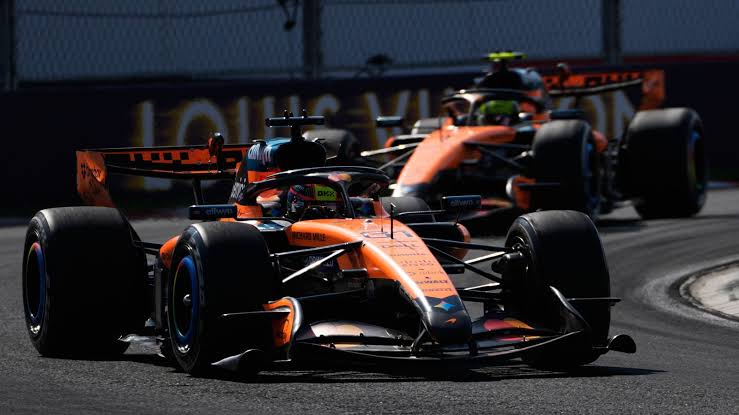
McLaren also arrive with renewed momentum and another upgrade package. Norris has been one of the grid’s strongest performers over the most recent run, winning in Hungary and the Netherlands before taking third in Madrid, and McLaren are bringing fresh aerodynamic changes to the MCL40 for Azerbaijan.
Their progress creates an additional complication for Mercedes because the championship leader may not have to deal with one direct rival but several teams capable of taking points from one another.
Malaysia could then shift the balance again. Formula One returns to Sepang for the first time since 2017, meaning several leading drivers including Antonelli, Russell and Norris have never raced there in Formula One machinery.
The circuit’s sweeping corners and extreme heat and humidity will introduce a different physical and technical challenge from Baku, while simulator preparation can only partly reproduce the conditions drivers will face on track.
The bigger strategic issue at Sepang is Mercedes’ long-awaited upgrade. Team principal Toto Wolff said the W17 will receive a significant package in Malaysia after the team had gone without a major aerodynamic update since Canada in May.
“I think we are bringing a solid upgrade in Malaysia,” Wolff said, while acknowledging that correlation between simulation and track remains uncertain.
That timing could be decisive. Ferrari, McLaren and Red Bull have progressively narrowed Mercedes’ advantage through development, but a successful Sepang upgrade could allow the championship leader’s team to regain some of the performance margin it held earlier in the season.
Mercedes also retain the option of deploying a power-unit upgrade later in the year, which could give the team further flexibility as the title fight moves into its final third.
Singapore then adds the final layer of unpredictability. The Marina Bay circuit remains one of the most physically demanding races on the calendar, and this year it will host a Sprint weekend for the first time.
With only one practice session before competitive running begins, any setup error or early mistake will be punished more severely, while the close walls leave little margin for recovery.
For Antonelli, the challenge is therefore psychological as much as technical. He continues to insist that he is “not thinking about the championship”, a stance Wolff says is genuine and useful in keeping pressure under control.
But if he emerges from Singapore with an advantage similar to or larger than his current 81-point margin, the arithmetic will increasingly overwhelm the narrative of an open title race.
That is why the next three weekends matter disproportionately. After Singapore, only six rounds would remain, with a maximum of 150 points available, meaning every poor result suffered by Norris, Russell, Hamilton or Verstappen would become harder to recover from.
Conversely, one Antonelli retirement or difficult weekend combined with a rival victory could reduce the gap quickly enough to transform the final phase of the season.
The title fight is therefore entering a period where volatility matters more than consistency alone. Baku can produce accidents and safety cars, Sepang introduces unfamiliarity and extreme conditions, while Singapore combines a punishing street circuit with Sprint-weekend compression.
Together, the three events offer exactly the combination of risk, technical variation and points density that can either revive a championship or effectively settle it.
For Mercedes, the objective will be to survive Baku, validate the Malaysia upgrade and minimise exposure in Singapore. For Norris, Verstappen, Russell and Hamilton, the requirement is far less forgiving: they need wins, podiums and, above all, Antonelli to start dropping meaningful points.
If that does not happen over the next three weekends, the 2026 championship may still remain mathematically open but the competitive argument could already be close to decided.

