

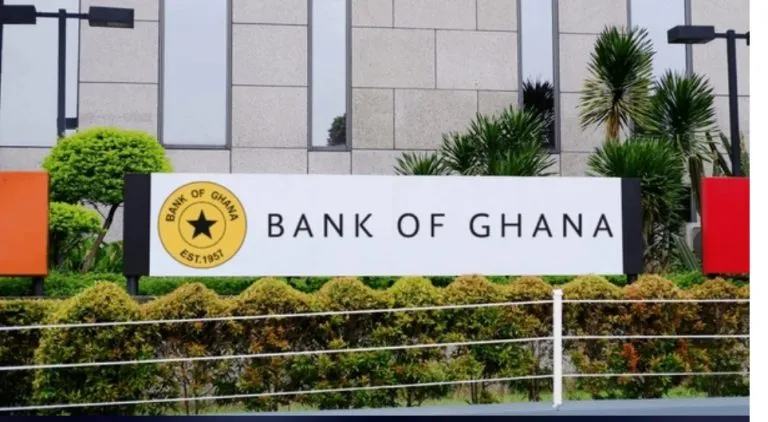

- Bank of Ghana Sells GH¢9.97bn in 14-Day Bills at 10.50% Interest Rate
The Bank of Ghana has sold GH¢9.97bn in short-term securities through its latest 14-day bill auction, withdrawing a substantial volume of liquidity from the banking system only days after maintaining its monetary policy rate at 14 per cent.
Results of Tender 880, conducted on September 23, show that the central bank allotted the bills at discount rates ranging from 10.4000 per cent to 10.4578 per cent.
The weighted average discount rate was 10.4555 per cent, equivalent to an annualised interest rate of 10.4977 per cent.
“Total amount sold: GH¢9,969.39 million,” the Bank of Ghana said in its official auction notice.
The transaction is a monetary-policy operation rather than ordinary government borrowing. Bank of Ghana bills are issued by the central bank to manage liquidity and influence short-term interest rates, while Treasury bills are issued on behalf of the government to finance its operations.
The scale of the sale nevertheless provides an important indication of conditions in the banking system.
Nearly GH¢10bn has been placed with the central bank for just two weeks, suggesting that financial institutions continue to hold substantial short-term liquidity that can be absorbed without offering rates close to the 14 per cent policy rate.
The bills carried the International Securities Identification Number GHCBAGH01470 and will mature after 14 days.
The 10.4977 per cent weighted average interest rate is about 3.50 percentage points below the Bank of Ghana’s policy rate.
That gap is significant because the policy rate is intended to serve as the central reference point for monetary conditions. In practice, however, money-market rates may trade below the policy rate when liquidity is abundant and banks have limited alternatives for deploying excess funds safely over short periods.
Financial institutions may accept the lower return because the bills carry minimal credit risk, have a short maturity and provide a predictable destination for temporary liquidity.
The pricing therefore appears to reflect a banking system in which the demand for safe, short-duration assets remains strong.
For the Bank of Ghana, the auction provides a mechanism for preventing surplus funds from exerting downward pressure on short-term market rates or feeding excessive credit creation and foreign-exchange demand.
The central bank’s challenge is to ensure that the liquidity needed to support economic activity does not become so abundant that it undermines inflation control or currency stability.
The GH¢9.97bn sale shows that this balancing exercise is continuing even as headline inflation has remained relatively low and the Monetary Policy Committee has stopped reducing the policy rate.
The Monetary Policy Committee’s decision to maintain the policy rate at 14 per cent indicated that the central bank was unwilling to loosen monetary conditions further in the face of emerging risks.
The bill auction gives operational effect to that cautious stance.
A policy-rate decision sets the direction of monetary policy, but liquidity operations determine how that decision is transmitted through the financial system. If banks are left with excessive funds, short-term rates could fall well below the central bank’s desired range regardless of the announced policy rate.
By selling its own securities, the Bank of Ghana temporarily removes money from banks and replaces it with an interest-bearing asset. When the bills mature, the funds return to the financial system unless the central bank rolls over the securities or conducts another liquidity operation.
The 14-day maturity gives the Bank considerable flexibility. It can reassess liquidity conditions every two weeks and adjust the size and pricing of subsequent auctions.
This is particularly useful in a period when government payments, foreign-exchange interventions, reserve accumulation and the maturity of existing securities can cause large movements in banking-sector liquidity.
Liquidity management is not free.
The Bank of Ghana must pay interest on the securities it issues. Persistent reliance on central-bank bills can therefore create a financial cost, particularly when large amounts are rolled over repeatedly.
The economic justification is that the cost of withdrawing surplus liquidity may be lower than the wider consequences of allowing it to fuel inflation, exchange-rate pressure or destabilising movements in short-term interest rates.
The more difficult question is whether the liquidity being absorbed is temporary or structural.
Temporary liquidity can arise from short-term fluctuations in government accounts, foreign-exchange transactions or the maturity of other financial instruments. In such circumstances, 14-day bills are an appropriate tool.
Structural excess liquidity presents a different problem. If the central bank must repeatedly issue large volumes of securities merely to prevent money-market rates from falling, the resulting interest expense can accumulate and weaken its balance sheet.
This means the amount sold in one auction should not be viewed in isolation. The more useful measure is the pattern across several tenders: how much is issued, how much matures, whether the stock of outstanding bills is rising and how the weighted average rate changes.
Tender 880 provides only the amount sold and the accepted rates. It does not disclose the total value of bids submitted, the number of participating institutions or the amount initially targeted.
A bid-cover ratio therefore cannot be calculated from the published notice. It would be misleading to describe the auction as oversubscribed or undersubscribed without those figures.
The willingness of financial institutions to place almost GH¢10bn in a 14-day instrument yielding about 10.50 per cent may also reveal something about the allocation of credit.
Banks choose among several uses for their funds, including loans to businesses and households, government securities, foreign-exchange assets, interbank lending and deposits with the central bank.
A large placement in BoG bills does not necessarily mean banks are refusing to lend. Some of the funds may be required for liquidity management and may not be suitable for long-term credit.
But consistently strong demand for short-term central-bank securities could suggest that banks prefer low-risk instruments to expanding private-sector lending, especially where borrower risk remains high or credit demand is weak.
That would create a monetary-policy paradox.
The central bank may want lower interest rates to support investment and economic growth, yet banks may continue to park large sums in short-term securities rather than extend credit to productive businesses.
The difference between the policy rate and the bill yield also matters for bank profitability. Institutions able to obtain funds at costs below the BoG bill rate can earn a relatively secure return, while those with expensive deposits may find the instrument less attractive.
The auction’s broader economic effect will therefore depend on the source of the liquidity and whether the funds would otherwise have been used for lending, foreign-exchange purchases or other investments.
Liquidity conditions are closely connected to Ghana’s foreign-exchange market.
When banks and other market participants hold excess cedi balances, some of those funds can be used to purchase dollars, increasing pressure on the domestic currency. Absorbing liquidity can reduce that immediate capacity, although it cannot replace stronger foreign-exchange inflows or address structural demand for imports.
The operation is therefore consistent with a central bank attempting to protect recent gains in inflation and exchange-rate stability without raising the policy rate.
It also demonstrates why a stable headline inflation rate does not automatically translate into immediate monetary easing.
The Bank must consider not only current inflation but the amount of liquidity in the financial system, movements in international reserves, fiscal spending, commodity prices and expectations about the cedi.
Tender 880 suggests that liquidity management remains an active part of that calculation.
The central question is whether the GH¢9.97bn operation represents a short-term adjustment or the continuation of a large and increasingly expensive sterilisation programme.
If the funds are released at maturity and absorbed again through another auction, attention will shift to the cumulative stock of Bank of Ghana bills and the interest cost of maintaining them.
For now, the message from the auction is clear: although the policy rate has been held at 14 per cent, the central bank is not allowing that decision to become an uncontrolled loosening of financial conditions.
The Bank of Ghana may have paused at the policy level, but in the money market it is still actively managing the volume and price of cedi liquidity.

