
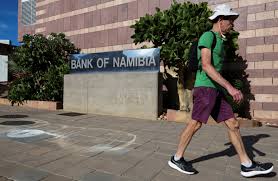

- Bank of Namibia Holds Rates as Iran War Darkens the Outlook
Namibia’s central bank has kept its benchmark interest rate unchanged at 6.50%, saying the direct inflation impact of the Iran war has not yet materialised in local price data even as the conflict worsens the outlook for growth and inflation through higher global energy costs.
The decision marks the third consecutive meeting at which the Bank of Namibia has held its repo rate steady, reflecting a cautious “wait-and-see” stance as policymakers monitor whether the conflict-driven shock to oil and shipping costs filters into domestic inflation and broader financial conditions.
Annual inflation slowed to 2.1% in March, down from 2.4% in February, the lowest reading since 2020, although the central bank expects inflation to rise again in coming months. The latest data allows the Bank some near-term room to keep rates unchanged, but officials made clear that risks are moving in one direction.
“Risks to the domestic inflation outlook remain tilted to the upside, notably through potential increases in administered prices, exchange rate volatility, and the spillover effects of the prolonged war in the Middle East,” Governor Ebson Uanguta told a press conference after the decision.
Namibia’s government has already moved to cushion households and firms from fuel-driven price pressure, cutting fuel levies by 50% for at least three months through the end of June, in response to the global energy price surge triggered by the U.S.-Israeli war against Iran, Reuters reported.
Even with the levy relief, the Bank raised its inflation forecast for 2026. It now expects inflation to average 3.7% this year, up from the 3.5% projection issued at its previous meeting in February. The revision underscores the central challenge facing many emerging and frontier central banks: inflation can remain subdued in headline terms, but external shocks, particularly energy and currency channels can quickly change the trajectory.
The growth picture is also deteriorating. Earlier this month, the Bank of Namibia lowered its growth forecasts for this year and next, citing weaker-than-expected performance in primary industries, especially metals and diamond mining, a key driver of export earnings and fiscal revenues.
For investors, the decision reinforces Namibia’s tight policy constraints. The country’s monetary policy typically mirrors South Africa’s because the Namibian dollar is pegged one-to-one with the rand and the two economies are closely linked. South Africa’s central bank last held its key rate at 6.75%, narrowing the scope for Namibia to break away even if domestic inflation appears benign.
That peg discipline is both protection and constraint. It anchors Namibia’s inflation expectations and limits extreme exchange-rate swings, but it also means the Bank must keep one eye on Johannesburg and global capital flows, particularly during periods of geopolitical stress when risk appetite can shift quickly.
The Iran war is now adding a new layer of complexity. If energy prices remain elevated, the inflation impulse is likely to arrive with a lag, transmitted through transport costs, electricity tariffs, and imported goods. The central bank’s signal is that it is not reacting prematurely, but it is positioning the market to expect a tougher stance if inflation pressures become more visible.

