


- Banks deepen ESG adoption as sustainable finance compliance reaches 73.00%
Ghana’s banking sector has made significant progress in integrating sustainability into its operations, with industry-wide compliance with the Sustainable Banking Principles rising to 73.00% as of September 2025, the Bank of Ghana has disclosed.
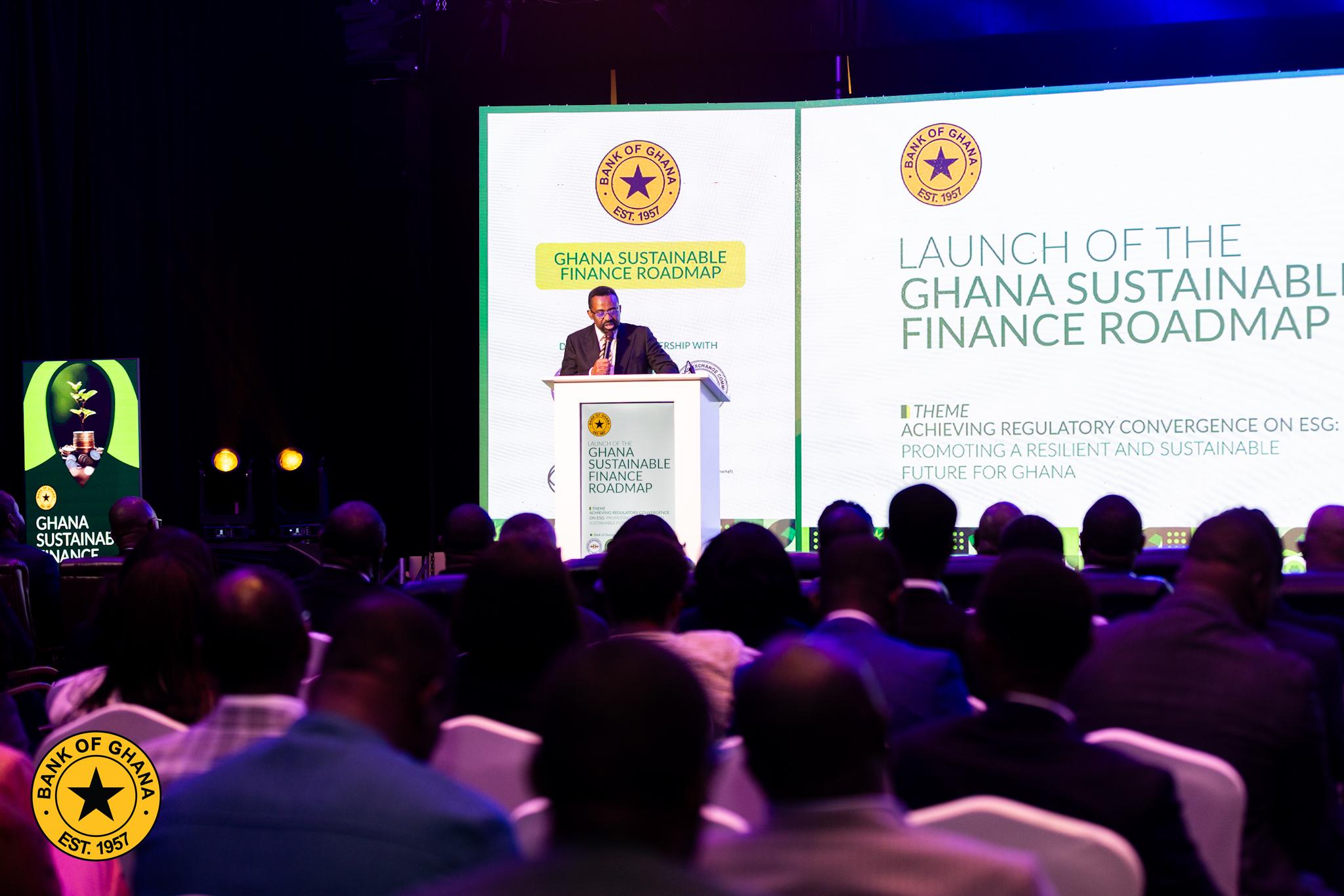
Governor of the Bank of Ghana, Dr Johnson Pandit Asiama, announced the development at the launch of the Ghana Sustainable Finance Roadmap in Accra, describing the improvement as evidence of the banking industry’s growing commitment to environmental, social and governance standards.
According to him, all 23 chief executives of Ghana’s commercial banks voluntarily endorsed the Sustainable Banking Principles, committing their institutions to incorporate sustainability considerations into governance structures, risk management systems and overall business operations.
“The unified commitment marked a turning point, signalling the readiness of Ghana’s banking sector to embrace sustainability not as an obligation, but as a strategic imperative,” Dr Asiama stated.
The Sustainable Banking Principles, developed in 2019, were designed to help banks manage environmental and social risks, promote green and sustainable investment, and align financial intermediation with Ghana’s broader development objectives.
Dr Asiama said the progress recorded so far reflects nearly a decade of deliberate work by the Bank of Ghana and other stakeholders to embed sustainability in the country’s financial sector.
In 2015, the central bank convened a multi-stakeholder committee, later formalised as the Sustainable Banking Principles Steering Committee, bringing together the Bank of Ghana, the Ghana Association of Banks and the Environmental Protection Agency.
The process later produced the Sustainable Banking Principles and Sector Guidance Notes in 2019, which were voluntarily endorsed by all commercial bank chief executives.
In 2021, with support from the International Finance Corporation and the Swiss Secretariat for Economic Affairs, the Bank of Ghana developed a standardised framework to measure compliance with the principles. That framework, according to the Governor, has helped drive continuous improvement across the industry, with compliance reaching an average of 73.00% by September 2025.
Bank of Ghana described the 73.00% compliance level as evidence of the banking industry’s increasing commitment to ESG standards and sustainable finance integration.
Dr Asiama said the central bank has also taken further steps to strengthen climate resilience within Ghana’s financial system. In 2024, the Bank launched a four-year Strategic Plan on Sustainability and Climate-Related Risks, covering the period from 2024 to 2028, to consolidate and expand its sustainability agenda.
The Bank of Ghana also issued the Climate-Related Financial Risk Directive to strengthen the capacity of regulated financial institutions to identify, assess and manage climate-related financial risks, while embedding those considerations into supervisory and regulatory frameworks.
Speaking at the launch of the Sustainable Finance Roadmap, Dr Asiama said sustainability risks are no longer remote concerns, but realities that increasingly shape economies, businesses and financial systems.
He noted that climate-related risks, including recent flooding across Ghana, could affect the financial system through asset values, claims costs and the security of lending.
“The instruments and structures of the past were not built for them and meeting them asks us to recalibrate how we supervise, how we price risk, and how we plan,” he said.
The Governor stressed that sustainable finance is not only about managing risks, but also about positioning Ghana to access new pools of global capital, finance critical infrastructure, support the energy transition, deepen financial markets and strengthen long-term growth.
“Sustainable finance is increasingly central to financial stability, to long-term investment, and to economic resilience,” he said.
The Sustainable Finance Roadmap is anchored on three pillars: Environmental, Social and Governance integration; climate-related risk management; and financing sustainability. These pillars are intended to provide a coordinated framework for Ghana’s financial regulators across banking, insurance, securities and pensions.
Dr Asiama said the Roadmap would help move Ghana from isolated sustainability initiatives to a more coordinated financial-sector approach, with practical actions assigned to the relevant regulators.
He added that sustainable finance could open new opportunities for Ghana by attracting domestic and international capital into sectors and projects that support long-term resilience.
“Done well, this is not a cost we carry. It is a market we open,” he said, pointing to deeper access to climate and development finance, a more resilient banking system and Ghana’s potential leadership in sustainable finance across the region.
The progress in banking-sector compliance signals that Ghana’s financial institutions are gradually shifting sustainability from a regulatory checklist to a core part of business strategy.
For the Bank of Ghana, the next test will be implementation: ensuring that the 73.00% compliance level translates into stronger credit decisions, improved climate-risk management, better governance and increased financing for sustainable economic activity.
As global investors increasingly demand credible ESG frameworks and climate-risk disclosures, Ghana’s banking sector may now have an opportunity to position itself not only as a participant in sustainable finance, but as a credible regional leader in the field.

