


- Beyond the Numbers: How the Biggest World Cup in History Redefined Football Forever
The curtain has fallen on the 2026 FIFA World Cup, but the tournament will be remembered for much more than Spain’s historic triumph over Argentina in the final. It was a competition that rewrote football’s record books, stretched the sport across an entire continent and introduced a new era for the global game.
From a record-breaking 48-team format and unprecedented prize money to extraordinary individual achievements and tactical evolution, the World Cup in the United States, Canada and Mexico offered a glimpse into football’s future while producing unforgettable moments on the pitch.
For the first time in history, 48 nations competed for football’s biggest prize. The expansion increased the tournament to 104 matches, making it the longest and largest World Cup ever staged.
The competition produced 308 goals, the highest total in World Cup history, while averaging 2.96 goals per match—one of the best scoring rates recorded since 1966.
The expanded format also brought fresh stories to the global audience. Nations making rare World Cup appearances tested some of football’s established powers, while traditional giants were forced to navigate unfamiliar challenges over a month-long marathon across North America.
Spain’s Golden Generation Completes Its Masterpiece
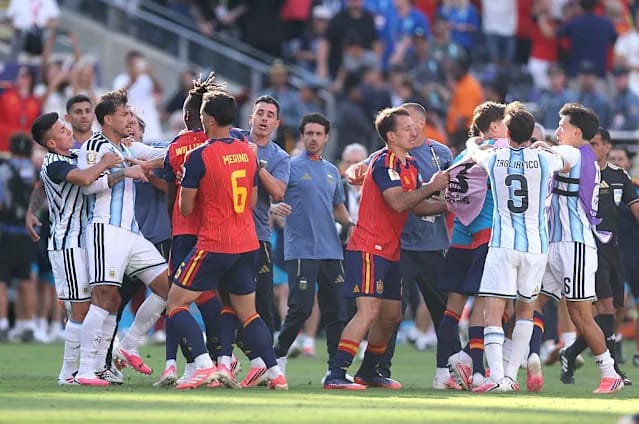
Spain emerged as worthy champions after defeating defending champions Argentina 1-0 after extra time in the final at MetLife Stadium.
Substitute Ferran Torres became Spain’s unlikely hero, smashing home the winning goal in the 106th minute after Nico Williams brilliantly headed Pedro Porro’s cross into his path.
The victory secured Spain’s second FIFA World Cup title, adding to their historic triumph in South Africa in 2010 and completing one of the finest international cycles in modern football after winning UEFA Euro 2024.
Coach Luis de la Fuente built a side that dominated possession without becoming predictable. Spain conceded only one goal throughout the entire tournament, the fewest ever by a World Cup champion, highlighting their remarkable defensive organisation alongside their attacking flair.
Unlike many previous champions, Spain were not overly dependent on set-pieces or moments of individual brilliance. Instead, they relied on collective intelligence, squad depth and tactical discipline, with substitutes frequently changing matches—including Torres’ decisive contribution in the final.
Mbappe Claims Football Immortality
Although France fell short of reaching the final, Kylian Mbappe ensured his tournament would never be forgotten.
The Real Madrid forward scored twice in France’s dramatic 6-4 victory over England in the third-place playoff to finish with 10 goals, winning his second consecutive FIFA World Cup Golden Boot after also claiming the award in Qatar in 2022.
Those two strikes also elevated Mbappe to 22 career World Cup goals, surpassing Lionel Messi to become the competition’s all-time leading scorer.
His World Cup journey has been extraordinary. He announced himself with four goals as a teenager during France’s victorious 2018 campaign before exploding with eight goals in Qatar four years later, including a stunning hat-trick in one of the greatest World Cup finals ever played against Argentina.
In North America, Mbappe reached another level, scoring 10 times despite France missing out on the championship match.
Ironically, while Mbappe rewrote history, Lionel Messi was unable to respond. The Argentine captain failed to score in Sunday’s final and ended what is widely expected to be his final World Cup appearance without adding to his tally of 21 goals.
Messi’s Final Dance Ends in Tears
The tournament also marked the emotional conclusion of Lionel Messi’s remarkable World Cup career.
The 39-year-old entered the competition hoping to emulate Pele by winning multiple World Cup titles, but Spain denied him a dream farewell.
Argentina failed to register a single shot on target in the final, leaving Messi isolated throughout much of the contest as Spain dominated possession.
Following the final whistle, images of the Argentine captain sitting alone on the pitch before breaking down during the medal ceremony became some of the defining moments of the tournament.
Despite the heartbreak, Messi leaves the World Cup as one of its greatest legends.
He remains one of the competition’s most decorated players, winning the tournament in Qatar in 2022, reaching another final in 2026, and setting numerous records for appearances and overall influence across six World Cup campaigns.
Records, Surprises and Giant Killers
The expanded tournament naturally created larger gaps in FIFA rankings between opponents than ever before.
The average ranking difference reached a record 27 places, contributing to several convincing victories for football’s traditional heavyweights.
Higher-ranked nations won approximately two-thirds of their matches, underlining the challenge many newcomers faced.
Yet the tournament still delivered memorable upsets.
Ghana’s resilient goalless draw against England ranked among the biggest surprises based on FIFA rankings, while Cape Verde earned widespread admiration after frustrating eventual champions Spain in another scoreless encounter.
New Zealand also stunned observers by holding Iran to an entertaining 2-2 draw.
These performances reinforced the idea that even in an expanded competition, smaller football nations continue to narrow the gap on established powers.
Older Teams, Smarter Football One of the tournament’s most surprising trends was the age profile of competing teams.
The average starting XI was the oldest in World Cup history at more than 28 years, suggesting coaches increasingly valued experience, leadership and tactical intelligence over youthful exuberance.
Veteran-laden squads from Iran, Colombia and Cape Verde all relied heavily on experienced players to navigate the demands of elite international football.
Spain’s triumph, however, demonstrated the value of balance. Their youthful stars, including Lamine Yamal, Nico Williams and Pau Cubarsi, blended seamlessly with experienced campaigners such as Rodri, creating perhaps the most complete squad at the tournament.
No World Cup has demanded more from players physically. With matches spread across three countries, teams travelled unprecedented distances.
England covered more than 25,000 kilometres, the most of any nation, while Spain also logged over 24,000 kilometres en route to lifting the trophy.
By comparison, co-hosts Mexico travelled less than 1,000 kilometres throughout their campaign.
Players also had to cope with intense heat in cities such as Miami, high altitude in Mexico City and constant long-haul flights between venues.
These factors influenced team selection, tactical planning and recovery strategies, making squad depth more important than ever before.
Set Pieces, Super Subs and Tactical Evolution
Nearly one in every four goals came from set-piece situations, highlighting the growing importance of dead-ball specialists.
England and Argentina scored seven goals each from corners and free kicks, while Bosnia and Herzegovina relied heavily on rehearsed routines for most of their goals.
Substitutes also became decisive weapons.
Around one-fifth of all tournament goals came from players introduced from the bench.
Belgium’s Romelu Lukaku repeatedly rescued his side after coming on, while Ferran Torres’ extra-time winner in the final perfectly illustrated how modern football is increasingly decided by squad depth rather than just starting line-ups.
Penalty statistics also revealed changing trends.
Players using elaborate stuttering run-ups converted significantly fewer spot-kicks than those employing more traditional approaches, raising fresh debates over penalty-taking techniques.
Record Financial Rewards
Away from the pitch, FIFA introduced the richest prize structure in World Cup history.
Every participating nation received $12.5 million simply for qualifying.
Champions Spain walked away with approximately $50 million, while runners-up Argentina earned $33 million.
Third-placed France collected $29 million, with England receiving $27 million for finishing fourth.
The expanded financial model is expected to provide a significant boost for national associations, allowing greater investment in youth development, coaching education, infrastructure and grassroots football programmes.
A Tournament That Changed Football Forever. The 2026 FIFA World Cup proved that bigger does not necessarily mean poorer quality.
While concerns existed before kick-off about competitive imbalance and increased travel demands, the tournament ultimately delivered unforgettable football, record attendances, historic individual achievements and compelling storylines from start to finish.
Spain’s triumph embodied control, tactical intelligence and squad depth in a tournament defined by constant adaptation.
Mbappe cemented his place among football’s immortals.
Messi bid an emotional farewell to the world’s biggest stage.
And FIFA’s bold expansion opened the World Cup to more nations than ever before, creating opportunities for emerging football countries while ensuring the global game continues to grow.
When historians look back on the summer of 2026, they are unlikely to remember only the champions. They will remember a World Cup that expanded the boundaries of football itself—a tournament that changed the sport’s landscape and set a new benchmark for every edition that follows.

