

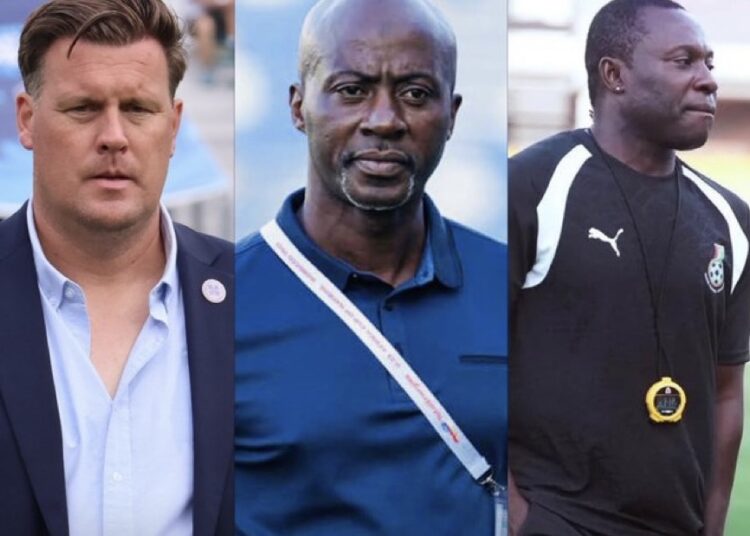

- Björkegren, Tanko and Attram Handed Urgent Black Stars Rescue Mission
Ghana’s decision to place Kim Lars Björkegren, Ibrahim Tanko and Godwin Attram in temporary charge of the Black Stars is less an experiment than an emergency response to a qualification campaign.
The interim technical team must prepare Ghana for November’s matches against Somalia while the Ghana Football Association continues its search for a permanent head coach. Former Black Stars goalkeeper Fatawu Dauda will remain responsible for the goalkeeping department, providing continuity within the coaching structure.
The appointments combine four qualities Ghana urgently needs: fresh tactical thinking, knowledge of the national-team environment, familiarity with domestic talent and continuity in goal. Whether those qualities become a coherent football plan will determine if the Black Stars can revive their 2027 Africa Cup of Nations qualifying campaign.
Ghana have lost their opening two qualifiers, against Côte d’Ivoire and The Gambia, leaving the team under severe pressure. The Somalia double-header is therefore not an ordinary transition window. It is effectively a six-point examination in which dropped points could turn an already difficult campaign into a crisis.
Björkegren’s selection has generated the most discussion because his principal responsibility remains the Black Queens. The Swedish coach was appointed in January 2025 and guided Ghana’s women to a bronze medal at the Women’s Africa Cup of Nations, returning them to the competition’s semi-finals after a 19-year absence.
That achievement gives his appointment more substance than the novelty of moving a women’s national-team coach into the senior men’s setup. His Black Queens have sought to press aggressively, retain possession and attack through quick transitions. Those principles could address Black Stars problems: passive starts, weak midfield control and an inability to sustain pressure after spells.
But tactical philosophy is only useful when adjusted to personnel. Björkegren will have limited preparation time and cannot treat the Somalia fixtures as a laboratory for wholesale reconstruction. His first task should be to simplify roles, establish a balanced midfield and give Ghana’s attackers repeatable patterns rather than rely on isolated individual inspiration.
The workload question cannot be ignored. The Black Queens are preparing for Women’s World Cup qualifying play-offs beginning later in November, shortly after the Black Stars’ Somalia assignment. Managing two national teams risks divided attention, especially when both require opponent analysis, player communication and physical planning.
The GFA must ensure that the interim role does not weaken the women’s programme. Björkegren’s Black Queens position should not be treated as secondary simply because the men’s team is under pressure. Clear delegation and technical support will be needed to protect both assignments.
Tanko offers the institutional memory that Björkegren may lack. He previously served as a Black Stars assistant under Kwesi Appiah and helped the team qualify for the 2019 Africa Cup of Nations. He also led the Black Meteors to fourth place at the 2019 Under-23 Africa Cup of Nations, narrowly missing the Tokyo Olympics after a penalty defeat to South Africa.
His experience as Medeama’s head coach also keeps him connected to the realities of Ghanaian club football. That matters because national-team selection should not become permanently detached from domestic performance. Tanko can help translate Björkegren’s concepts into instructions suited to Ghanaian players while offering insight into personalities, dressing-room dynamics and the pressures surrounding the Black Stars.
Attram contributes a different but complementary profile. The former Ghana international represented the country at youth, Olympic and senior levels before moving into coaching and player development. His work with Accra Great Olympics and the Attram De Visser football academy gives him practical knowledge of emerging players and the technical development gaps that often follow footballers into senior competition.
He has also worked with Tanko within Ghana’s youth setup. That existing relationship could be valuable because interim appointments often fail when authority is unclear or assistants compete to influence the head coach. The trio will need sharply defined responsibilities: Björkegren setting the overall framework, Tanko helping organise team structure and opposition preparation, and Attram supporting attacking work and player assessment.
Dauda’s retention offers stability in a position where confidence and communication are crucial. His experience at the 2014 World Cup and several Africa Cup of Nations tournaments gives him an understanding of the scrutiny Ghanaian goalkeepers face. Yet his task must extend beyond shot-stopping drills to distribution, command of the penalty area and coordination with a defence expected to play under pressure.
The larger issue is whether a collection of credible individuals can quickly become an effective unit. Complementary CVs do not automatically produce complementary coaching. Selection decisions, training priorities and in-game authority must be agreed before camp opens. Players should know who communicates tactical changes and whose instructions prevail when matches become difficult.
Ghana’s problems also extend beyond the technical area. Repeated coaching changes can create uncertainty, weaken accountability and encourage the belief that every setback requires another reset. An interim team may stabilise the immediate situation, but it cannot substitute for a durable football strategy covering recruitment, performance analysis, succession planning and a recognisable national playing identity.
Somalia will present a particular test of patience. Ghana may dominate possession and enter both games as favourites, but superiority on paper can produce frustration if an early goal does not arrive. The Black Stars must move the ball quickly, defend against counterattacks and avoid forcing low-percentage passes as anxiety rises.
The coaches must also select players on present form rather than reputation. An emergency window rewards clarity, energy and tactical reliability. Names alone will not repair Ghana’s midfield structure or improve decision-making near goal.
If the team secures six points with convincing performances, the interim arrangement will buy time for the permanent search and restore some public confidence. If Ghana struggle, questions will intensify about the appointment process, preparation and the direction of the national team.
Björkegren, Tanko, Attram and Dauda therefore inherit more than two fixtures. They inherit a credibility test for Ghanaian football administration. Their mandate is temporary, but its consequences may not be. Against Somalia, results remain the unavoidable measure; the deeper test is whether Ghana can combine talent, structure and purpose.

