- Black Meteors Opens Camp as Ghana Steps Up 2028 Olympics Preparations
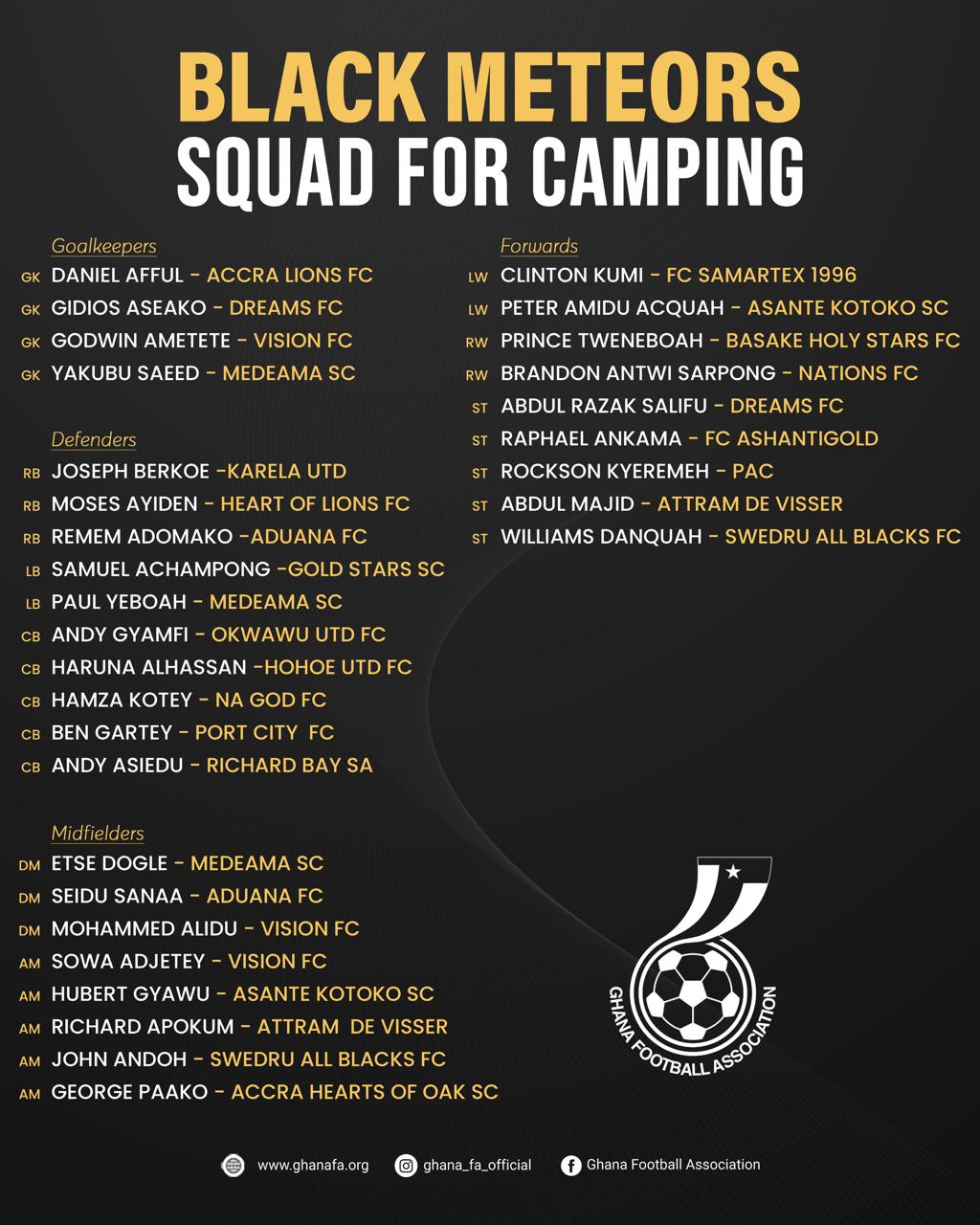
Ghana’s national U-23 team, the Black Meteors, will open camp in Accra on Wednesday, August 5, 2026, as the Ghana Football Association steps up preparations towards the next U-23 Africa Cup of Nations qualifying cycle and the country’s bid to return to the Olympic Games in Los Angeles in 2028.
The latest camp marks another stage in the rebuilding of the Black Meteors programme after the GFA earlier identified scouting, structured camping and international friendlies as central to preparing a competitive squad for the next qualification campaign. The Association confirmed on its Black Meteors platform that the team would begin camping in Accra on Wednesday.
The move is important for a Ghana side seeking to end a prolonged absence from the men’s Olympic football tournament.
Preparations for the current cycle began well before the August camp. In November 2025, the Black Meteors management and technical teams held a joint planning meeting focused on the U-23 AFCON qualifiers, which provide the pathway to the 2028 Olympic Games.
That meeting reviewed scouting programmes, training camps and possible international friendly matches, with officials stressing the need to start preparations early rather than wait until the qualifying competition approaches.
The GFA has also emphasised the importance of combining home-based and foreign-based players as it attempts to build a squad capable of navigating what is typically a demanding continental qualification process.
Officials agreed during the preparatory meeting that Ghana would require “a formidable blend of both foreign-based and home-based talents” to compete effectively through the U-23 AFCON qualification process and ultimately reach Los Angeles.
That approach gives the Accra camp added significance.
Rather than functioning merely as a short training exercise, the gathering provides the technical team with an opportunity to assess players, establish tactical principles and begin narrowing the talent pool well before competitive qualification intensifies.
Early camps can also help address one of the persistent challenges facing African U-23 teams: assembling players who may be spread across domestic competitions and overseas clubs, often within narrow international windows.
Ghana’s Olympic football history gives the current campaign additional weight.
The Black Meteors became the first African football team to win an Olympic medal when Ghana secured bronze at the Barcelona Games in 1992, a milestone that helped establish the country as one of the continent’s leading youth-football nations. The GFA has repeatedly cited that history as it seeks to rebuild the team’s standing at U-23 level.
Yet recent Olympic qualification campaigns have proved more difficult, making early planning increasingly important.
The Association’s longer-term strategy has placed particular emphasis on talent identification and development rather than relying on a hurried squad assembly immediately before qualifiers.
That philosophy was reflected when the GFA appointed Kassim Ocansey Mingle as Black Meteors head coach, highlighting his experience with Great Olympics, Bechem United and Nations FC as well as his background in academy, colts and second-tier football.
The Association said at the time that his experience in developing younger players was central to the appointment and that the objective was to build a stronger Black Meteors side capable of restoring Ghana’s reputation at this level.
The wider preparation programme has also involved the team’s management structure.
At its November planning meeting, officials acknowledged that qualification would require significant resources and called for stronger support from government and corporate Ghana.
GFA Business Development Manager Janice Odonkor said efforts were being made to attract commercial partners, reflecting the financial demands associated with sustained camps, scouting programmes, player travel and international friendlies.
That funding question remains important.
Successful U-23 preparation is significantly more complicated than assembling locally based players for occasional training sessions. Overseas scouting, international friendlies and access to foreign-based players all involve considerable expenditure.
The quality and continuity of the preparation programme may therefore depend partly on whether the Association can secure sufficient financial support to sustain the team through the qualification cycle.
There is also a developmental value beyond Olympic qualification.
The Black Meteors sit at an important point in Ghana’s national-team pathway, bridging youth football and the senior Black Stars.
A well-structured U-23 programme can therefore serve both immediate competitive goals and the longer-term development of players capable of progressing into the senior national side.
That makes sustained scouting particularly important.
Players who emerge from the domestic league, lower divisions and Ghanaian academies can be evaluated alongside those based abroad, potentially creating a broader pipeline of talent for future national-team assignments.
For the technical team, the August camp will provide another opportunity to establish continuity as the qualification programme takes shape.
The GFA’s earlier planning documents envisaged a preparation cycle built around scouting, repeated training camps and friendly matches rather than a single short-term assembly.
That approach represents recognition that Olympic qualification cannot easily be achieved through last-minute preparation.
The U-23 AFCON route is highly competitive because it places many of Africa’s strongest football nations into a limited qualification structure, with only a small number eventually earning Olympic places.
Ghana’s challenge will therefore be to turn early preparation into a settled and competitive team.
The opening of camp in Accra is only one step in that process, but it signals that preparations are moving from administrative planning to sustained on-field work.
For Ghana, the objective is clear: build the Black Meteors early enough, expose the team to competitive opposition and create the continuity needed to navigate U-23 AFCON qualification.
More than three decades after making African football history in Barcelona, the latest camp represents the beginning of another attempt to place Ghana back on the Olympic stage.